Thursday, July 29, 2010

Roos to Hiroshima: Too little too late for some

Just saw on NHK news that Ambassador Roos will visit Hiroshima on August 6 to commemorate "all the victims of WW2." The Japan Times reports it here, without reporting Roos' "all victims" statement.

One older lady, questioned during the obligatory "man-on-the-street-interview" said "It's a little late isn't it, for the American Ambassador to come?"

In anticipation of the soon to be in full swing annual remembrance (and selective, but often generous forgetfulness of preceding/concurrent/following events) of the atomic bombings of those two cities, I thought a little review of the circumstances might be helpful:

(It seems I cannot embed the 2-hour video at American Experience, but Victory in the Pacific is here and the transcript here. It gives a little taste of the atmosphere of those times.)

Sitting in my nice chair in an air conditioned room 55 years after the fact with information that Truman and the rest of the government did not have at the time, it is easy for me to judge the bombings as unnecessary, inexcusable in the targeting of a civilian populations, and worse. However for those in power in 1945 who wanted to end the war and for those who were expecting to be part of the invasion force to defeat Japan (and die, be maimed, or perhaps to endure the hell of being a POW if not executed outright) such judgments may have been a bit harder to reach.

But I would say to the lady with the complaint: I regret that the visit to Hiroshima by the US Ambassador has not turned out to be as early as it could have been and that you are not pleased. And I would ask her that if she thinks there is anything that Japan might be a little late in doing that it should do now so that we can all begin to put WW2 in the past.

Oh, I enjoyed Clint Eastwood's movie Letters from Iwo Jima. Am awaiting a similar movie from Japan's movie industry. Pride does not count. (A stolen thought, but I enjoyed it so much that I feel no guilt about the theft.)

Note the comment left on the NYT review (linked above) of Pride:
This is not an entertaining film or anything but I would like to give 5 stars because the filmmakers took a risk of getting criticized badly by foreign journalists and Japanese left wings. Please don't get mad at the film just because it portrays the truth that was told in the court. Films like this should be seen more instead of what Japan did wrong in the war. It didn't hit the box office abroad because they don't want to give a chance for Japan to explain about the war. Japan has to be the bad one because they lost the war.

I wouldn't call myself an educated man. Daydreamed through the 8th-11th grades. Finished university after the USAF on one of the versions of the G.I. Bill. Even had to spend the first year or so at a community college. Still, I thought I knew a few things until September of 2008 when I learned that I didn't know squat about the way the world works. I realized that I was an idiot and that I would never be like those who can confidently predict the future and know the way to solve the world's problems. I mean, I ain't no Nobel Prize winner like Paul Krugman. (They don't give those things out for nothing, you know.) Plus, I am an American which as everyone knows is the most poorly-educated group on earth. Why, just a week or so ago, there was more hand-wringing in the US over the fact that fewer US students were graduating from universities despite the absurdly inflated costs of doing so. What the hell, put the poorer of them in the military and send 'em to well-off foreign lands to "preserve freedom."

Fortunately, I now live in a country which is ideal for an idiot because of the ability to learn from the highly educated populace. I learn something new and valuable nearly every day. It could be a trivial thing like I learned Monday: People in Osaka walk faster than people in any other city on earth while folks in NY walk second fastest, and those in Tokyo walk third fastest. And here I had been thinking that most people in Tokyo walked at about the pace of a dead snail that is reading email on a cell phone. Stoopid me.

Or it could be something breathtaking and potentially world changing.

Tuesday started as a normal day. I had been given my usual Tuesday task of gathering information about some sort of puzzling New-Think, this time concerning Red Ocean/Blue Ocean. This had apparently been the subject of a popular 2005 business book which I had not read nor even heard of. These small details would not stop me from finding out as much as I could about the subject in 3-4 hours and then pretend I had a clue of what I was talking about.

Fortunately, I found an interview with the authors in which they clearly explained the concept:

We use the terms red oceans and blue oceans to describe the market universe. Red oceans are all of the industries in existence now... ...Blue oceans, in contrast denote all industries not in existence today...

I cut a little, but the above should be sufficient to prompt most to run out and either buy the book, Blue Ocean Strategy, or jump from a tall building. My understanding is that a good "blue ocean strategy" company will try to find customers and markets by thinking outside the box, throwing out the Old-Think, and establishing a new paradigm---all very unusual for a cutting-edge business book.

Oh, to the point of this post...

Later, I got to chat with a fellow whose major had been economics. He is now a fairly high level executive---shall we say in the top level of his organization which is one of the largest in his industry. We talked economics, as he is wont to do when he is not detailing some unique character traits of the Japanese (which seem incredibly commonplace to an uneducated flunky) and how the current environment is affecting his industry and company. For an international company heavily dependent on imported raw materials, the increasing demand for those raw materials is pushing up prices and eliminating profits.

Then he let me in on what may be a secret. There is sort of a cartel controlling prices on these raw materials. It involves a number of foreign countries, including one in South America in which a minority of folks are of European descent. (1-2%, according to him.)

This was interesting. We had discussed this before, but not in such detail. The way he was talking, I began to suspect the Illuminati, but after beating around the bush a bit, he told me: The Jews!

Oh yes, I should have known! It seems many here take for granted the "theory" that to some degree or another Jews control the US, or tend to believe in a general Jewish conspiracy to control the world, but this was the first that I had heard that they controlled a major raw materials market.

Later, as dim-witted and poorly educated as I---and all other Americans (meaning only the US in this case)---am, I began to get an idea. I don't know why I am the only one to think of this, but I may have solved not only my problems, but Japan's and perhaps the rest of the world's. With so much of the world's power and money in the hands of Jewish people, why not convert to Judaism? It may be immoral if one is not sincere, but it would seem to be a pretty simple way to resolve financial worries. I could certainly use the power and influence that this small percentage of the world's population is rumored to have, too. It may even make me more welcomed by some here.

And the risk of an aimless, goalless, thoughtless, clueless leadership class leading the country to the Fujiwara-ian glory of the past of poverty and hardship for all except the powerful elites? Could not Japan convert to Judaism and take advantage of that power and wealth? Isn't there some evidence that Japanese are actually Jewish anyway?

I feel honored that I may have stumbled into the secret of solving all the world's problems in a discussion with a man who, without a doubt, represents one of the most well-educated classes in the country. Not only that, I got to experience that mysterious Eastern wisdom which has been handed down through the generations, and which, despite the fact that we are in roughly the same age group, makes me feel like I was born yesterday while he has the accumulated knowledge of a zillion years.

Whereas these sorts of Jewish conspiracy theories would not be considered acceptable in many other countries, and might be taken as a sign of ignorance or even antisemitism, we can't use that sort of Old-Think about subscribers to the theories in Japan. Things are different here. It's all harmless and innocent. Sort of a quaint and cute provincialism. By the way, my acquaintance is very polite and seems a nice guy. So how could anything be wrong?

*From the 1989 TV mini-series, Lonesome Dove. I think ol' Gus would have saved a lot on powder, balls, and caps for his Walker Colt had he left the plains of Texas and Montana for my current neck of the woods.

Sunday, July 25, 2010

TIME declares time running out for Japan

The country is probably at yet another crossroads.

Sometimes Japan seems to be on the wrong continent. Everywhere else in Asia, from Shanghai to Mumbai to Jakarta, there is an aura of perpetual motion, a sense that tomorrow will be better than today. The region is on a frenetic 365-day-a-year hurtle into a brighter future. Japan once shared Asia's dynamism and mission. But not anymore. Today, Japan is an island of inertia...TIME

Time, the magazine which seems to me to always blow things way out of proportion, has published a new story on Japan. A read through it reveals little that anyone paying attention doesn't already know (with only a few quibble worthy points on first read), and tends to make one want to abandon ship. Being an optimist here is not something one can achieve while sober.

Saturday, July 24, 2010

I wanna go Stateside

It has been a tough week. I am not talking about the wonderful experience of riding sardine cans full of people. That might even be fun sometimes if some sweet young thing would snuggle up agin' me, but I always get middle-aged or older salarymen who seem to lose any fear of foreigners when it comes to getting within smooching distance.

I am not talking about trying to walk down a sidewalk without being hit by a self-centered, negligent fool on a bicycle. Nor am I talking about watching someone dawdle in 7-11 closely examining the final item of a 37.5 item purchase + bill paying until they see me start to move to the register with my single item and then rush to get there first. And I don't even consider being a victim of vehicular assault while attempting to use a crosswalk unusual.

No, I am not talking about the folks here. I am talking about the comment I read that some lady from overseas left on a photo on flicker. Seems a fellow had unknowingly committed a faux pas while doing bird photography and was approached by a birder and gently admonished. The comment read something like "I have been to Japan and was treated very politely. It is good to see that the good manners extend to animals too."

I would like to put my head in an oven, but all I have is a microwave. How is it possible that people can lose all common sense when it comes to things Japanese. Really, I do not believe the woman could possibly be as silly as her comment. How do the dolphins of Taiji feel, I wonder?

Been here too long.

Thursday, July 15, 2010

Ten long sentences

Richard Katz of The Oriental Economist, and Naomi Fink of UFJ Bank were asked to write five sentences in answer to two questions concerning Japan's national debt and its assets and and they responded with one of the most informative dialogs I have read on these topics. You can read this over at Shisaku, should anyone not have already done so.

One particularly interesting fact in the post---only because PM Kan had planned to cut Japan's corporate tax from the 40% current rate---is that only one-third of Japan's corporations pay any corporate taxes and the actual tax rate is closer to 26%.

The OECD has recommended lowering the tax while increasing the base (corps actually paying taxes) and in this OECD Observer article stated that increasing indirect taxes (eg consumption taxes) taxes has had a "less negative" effect on economies in OECD countries than increasing income taxes.

Anyhow, not directly connected to the Shisaku post, but maybe ol' Kan was close to being onto something before he got his head handed to him on Sunday. Perhaps if he had done a little better job of explaining his tax plans, and had any sense of timing, and had not assumed that his party was immune to what happened after the last two consumption tax increases, and had guessed that just because people may believe a tax increase is needed sometime in the future that it doesn't necessarily mean that they want one soon (i.e. while they are still living), and....well, let's just say that we might have been spared the spectacle of the LDP appearing to rise from the grave. They haven't really, of course, since when the sun comes back out, they'll realize that nobody believes they have an answer for anything and they'll sooner or later be heading back underground.

By the way, as usual with things economic, one can easily find an opposing point of view. Here is one concerning the wisdom of corporate tax cuts:

The conventional wisdom is that it is primarily small economies that feel compelled to cut corporate taxes in order to attract foreign investments–Ireland and a handful of the newest EU members are often put forward as examples of this–but it is actually some of the largest economies in the world that have lost most tax revenue from corporations over the last decades. Most notably, between 1970 and 2003, corporate taxation as a share of total taxation dropped by 51% in Japan and by 39% in the US and in Germany.

Yet at the same time corporate profits are booming and wages are stagnating. After-tax profits in the US are, as a proportion of GDP, at their highest in 75 years, and in the euro area and Japan they are also close to 25-year highs.

Wages, on the other hand, are making up an ever smaller part of national income, down from 68% in 1982 to 59% in 2005 in the 15 EU members. And at 56.9% in the US in 2005, they are, except for a brief period in 1997, at their lowest level since 1966. Kristian Weise, of The International Trade Union Confederation at OECD Observer

This wage stagnation thing seems somewhat familiar. Thank goodness for deflation.

Wednesday, July 14, 2010

Blasphemy!

I don't think these guys (Congressman Barney Frank et al) are allowed to write this sort of thing:

Immediately after World War II, with much of the world devastated and the Soviet Union becoming increasingly aggressive, America took on the responsibility of protecting virtually every country that asked for it. Sixty-five years later, we continue to play that role long after there is any justification for it. Huffington Post

Given that every incremental federal dollar spent today is being financed with borrowed funds, maintaining that collection of overseas bases results in a perverse daisy chain of borrowing from foreigners,* spending those borrowed funds overseas then sending never-ending interest payments back overseas as we roll over that debt again and again. (Letter to the National Committee on Fiscal Responsibility and Reform by Rep. Barney Frank, Rep. Ron Paul, Rep. Ron Wyden, Rep. Walter B. Jones Linked PDF from the above Huffington Post)

I have read that Okinawa was mentioned somewhere by Reps Frank and Paul, but can find no direct reference to it. (Edited to add: Here is one.)However, wouldn't it be nice if Americans and Japanese---the people, not just the governments and the "experts"---would get a chance to look at this and debate it and force those "in the know" to explain exactly why forces at the present level and configuration are still necessary in 2010, and to explain what would indicate that they would no longer be necessary at some point in the future?

No, I am not on drugs; I am merely fantasizing.

NPR's On Point is to broadcast an discussion on the military spending issue with Ron Paul and Barney Frank today (audio not up yet.)

Note that they are not talking about cutting expenses on the backs of those in Iraq and Afghanistan, but questioning the continued need for 480 US military installations in 38 countries.

*Ironically, one of the recent justifications given for the need to have US troops in Japan is the----how shall I put it?---the rising China threat. China is one of our biggest creditors, so we are borrowing from China and paying interest on that debt to China, in order to defend against China. Wonder if China would demand higher interest should the the US get into a conflict with them? Or would the US just stop borrowing from China and fund the conflict some other way? Oh, wait....did I say fund a conflict, meaning something like pay for it without borrowing from foreigners? Sorry, maybe I am on drugs.

Sunday, July 11, 2010

So what's the point again?

Oh, there is an (upper house) election today. That's what all those signs are about, and for those unfortunate enough to live near a station, what all the screaming through loudspeakers by candidates was about.

The early results from NHK (very early, most based on exit polls IF I am not mistaken) is interesting only because of the performance of the new Your Party which is a strong number four (corrected 9:24pm) so far---5 seats to the New Komeito's 7.

According to exit polls, those who opposed a consumption tax increase voted roughly equally between the DPJ and LDP. That's not a surprise I suppose, since the 10% figure was floated by both. Support for the tax increase was closely split too, with those opposing the increase only a few percentage points ahead of those opposing.

Michael Cucek, of Shisaku (required reading for anyone interested in Japanese politics) has written an essay for The Diplomat which is more interesting than the actual election titled Japan's Meaningless Election:

[Addressing pre-election polls showing about a third of voters undecided] "the failure of 3 out of 10 Japanese voters to have made up their minds is down to one simple fact—the election has no meaning, or at least its meaning has changed so many times over the past few months and weeks that a reasonable person could well be asking what they’re actually voting for."

I am glad that I don't have to make that voting decision as I would find it easier to explain what I was voting against than for.

Saturday, July 10, 2010

In a nutshell

The most succinct, accurate analysis of Japan politics I've seen in a while. Quoted from a Martin Fackler article in the NYT, of all things.

“Something ended when the L.D.P. lost,” said Koji Kubota, 74, a retired post office worker who listened on a recent afternoon to a candidate’s stump speech, “but no one is sure what comes next.”

Gerald Curtis notes in the same article that this is "a period of creative destruction and the destructive phase is not yet over."

Friday, July 09, 2010

We never asked

for Armchair Asia's opinion, but it's always valued, informative, and interesting:

Saying nothing, ignoring complaints, and “looking forward,” is a very Japanese tactic to avoid responsibility and confrontation.

Why does that ring so true both personally and professionally?

Armchair Asia's July 9 post, Unforgiven,* concerns apologies and the continued lack thereof for the use of American POWs during WW2 by a number of major Japanese corporations.

Some may recall one of the companies, Mitsubishi, even denied in court that there was any forced labor in at least one of their mines (this specifically concerning Chinese slave labor):

...the Mitsubishi defense team has crossed a Rubicon of historical revisionism by denying that any forced labor occurred at its Fukuoka coal mines. More audaciously still, the company based these denials on its own 1946 site reports and the fact that Occupation authorities never brought CFL war crimes charges against it. Japan Focus (How's your Nikon working? Nikon wouldn't be part of the Mitsubishi group would it? Oh well, the war's long over anyway, isn't it? When's the new D700X coming out?)

This is all a shock as I just read an article by a learned Japanese PhD in which he claimed that Japan needs to tout its higher moral ground in WW2 to win friends and influence people today. His cute little article also shows just why WW2 is NOT over for some in this country, including some who could be mistaken for reasonable and maybe even cosmopolitan.

More on that later.

*There are links in the Unforgiven post worth reading as well.

2142: Edited for semi-clarity.

kuso!

I tried to edit my Japan links list and deleted all of them. It will take a while to get them back. Should I miss any, please remind me. Note that "undo edits" like a lot of functions on blogger do not works. It's ok though as it's free and worth every yen.

Oh, I hate, I truly hate, blogger. Gonna have to bite the bullet and move on. Oh, I effing despise blogger. On top of everything else, its spelling is even worse than mine.

Wednesday, July 07, 2010

Controversial in Arizona, hunky-dory in Japan

Racial profiling had never struck me as a personal issue. I am a Japanese woman living in Japan after all, where less than 2 percent of the population is foreign....

...I was stunned by the officer’s blatant profiling of me... [she believes it was based on her being a bit taller than the average Japanese woman which led some of Tokyo's finest to suspect that she might be a non-Japanese.]

...“The same thing as in Arizona has been in place in Japan for a long time without much criticism,” says my cousin and lawyer Genichi Yamaguchi. NYT/IHT 7 July 2010 Op ed.

Ms. Makihara goes on to state that most Japanese don't know about the racial profiling that goes on as a rule in Japan and wonders just how much anyone would object.

She continues with some indications that Japanese may be becoming less willing to try to understand anything beyond Japan's borders. Some not-so-generous people would wonder how that would be possible since most of the past attempts to understand seem to be as much about reaffirming the uniqueness of the Japanese (or selling cars and radios) than a real attempt to understand others as humans of the same species.

Ms. Makihara plans to protest the next time that she is stopped that such behavior is racial profiling. I wonder how the couple of fellows from Down Under who occasionally write columns for the Japan Times in support of discrimination and bigotry would respond to Ms. Makihara. Would they explain that this is being done for her safety?

By the way, one of those fellows was writing a book about what the world could learn from Japan (the usefulness of discrimination based on race, ethnicity national origins?), but as eagerly as I have awaited it, I have not found it yet. Wonder what happened?

If that is not enough, the troublesome foreigner---oops! Can't say that as he's a Japanese citizen---Debito Arudou has penned another article at the Japan Times (perhaps to be rebutted by one of the above mentioned apologists for bigotry soon) concerning the long-time and apparently never-ending illegal refusal of service to non-Japanese by many hotels in Japan. Tyler Brule, when are you gonna visit one of those and let the well-heeled know about that kind of wonderful Japanese service?

(My understanding of the law in Arizona is that it is not nearly as broad as what exists in Japan now.)

Sunday, July 04, 2010

Nobelist Obama's radical new Japan policy

OK, It's not really brand new:

The United States has asked Japan to help shoulder hundreds of millions of dollars in additional fees to transfer Marines from a controversial base on Okinawa island to Guam, Kyodo news agency reported. USA Today

It's all cool. The poorly informed will still be able to blame the continued problems with Okinawa bases on the folks in the US military there. (Of course, we know that SOFA personnel have much lower crime rates than citizens of Okinawa.*)

*Concerning the linked article about SOFA crime rates, the author notes that on base stats are not covered. Having been a military policeman, I'd guess that unless the world has turned upside down, that on-base crimes and incidents are much, much lower than the civilian population. I see no reason it would be different here, unless one disproves the Hassett article---and others with similar findings over the years.

Saturday, July 03, 2010

Let's pray for the poor rightists

who were arrested in Yokohama today when they tried to break into a theater showing the dangerous, one-sided, "anti-Japanese" film, The Cove. The rightists hate one-sided movies, news programs, and so on. I pray that none were injured in the attempt to hide something that they haven't the courage to allow people to see.

Michael Moore is damned lucky he ain't making his type of movie about Japan, although he does not know that.

(Cannot find a link yet, the information is from TV news.)

9:16PM: AFP story here, but no information on arrests. Seems that folks want to see it for themselves before making up their minds, something the nutters apparently dread.

July 4, 830pm. I have found no reports on the arrests to link to in either Japanese or English. Makes me wonder if I misunderstood NHK. I listened to the English subchannel, not the Japanese so I hope I can at least still understand English.

Foreign trainee voluntarily works self to death

just as his kindly company president was about to reduce his overtime and spread the labor to others. The unnamed president of Fuji Denka Kogyo may even have planned to pay the late Jiang Xiaodong (31) for his overtime work. Unfortunately, Jiang refused the offer to work less and died of cardiac arrest. It couldn't be helped. Nobody could expect the company president to require an employee to do anything.

Some mean people have accused the government of lax oversight of the slavery intern system. This, of course, could not be accurate.

Story in English at Japan Times.

Irritating

isn't it:

The Japan which Aya Okabe presents in her work is perhaps too familiar to those who live there and not nearly Japanese enough for those who don’t. Japan Exposures

Where are the geisha?

Friday, July 02, 2010

The SONY timer

The Sony timer: that thing which is included at no extra cost with every Sony product sold in Japan and causes the product to fail just as the warranty expires. I never knew this feature existed until a Japanese guy explained it to me years ago. I had thought that Sony simply manufactured junk.

1000 Things about Japan: Won't miss #191.

Oh and cover your ears, there' some cussing and cursing in this Onion news report. (Yes, a repost, but I've nothing else ready to post at the moment. Disgustingly immature.)

Sony Releases New Stupid Piece Of Shit That Doesn't Fucking Work

Sunday, June 27, 2010

Pre-election political analysis

While some make their political predictions and analysis based on years of experience and research, I find that it is much better to use tangible things to get a feel of the mood and then make my unerringly accurate predictions in the 24-48 hours following the election.

Over the last few days, I have been conducting surveys of political posters in the Denechofu/Okusawa/Jiyugaoka areas which should give an accurate overview of the situation in the entire country. You know, sorta like those land-line telephone surveys of 621 people in a nation of 127+ million.

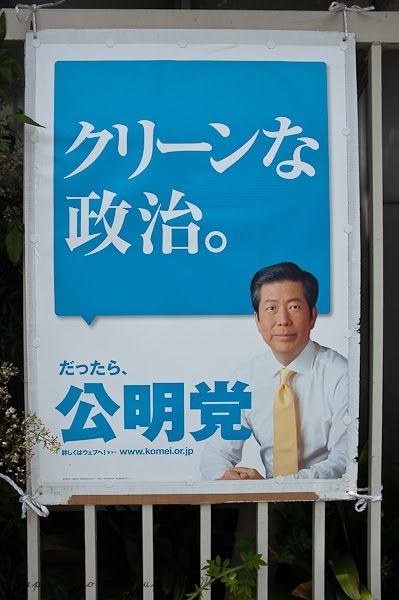
The New Komeito is relying on its reputation of cleanliness to attract voters:


The Commies are po'd about the US, Futenma, and nukes or something as they always have been. Should they ever come to power, one suspects that they might modify their position a bit, but there is no guarantee. The party that seems to have survived in large part due to the fact that it was the most opposite of the LDP hasn't had a new idea since Marx was a child.


The LDP wants to give Japan the finger yet again, but having entirely lost any competence they once had cannot even figure out the correct finger to use. Instead, some fellow named Tanigaki went berserk at the DPJ and Kan for suggesting that it might have been close to right about the consumption tax. The LDP is offended by the suggestion that any of its ideas might be correct. After all, what would happen if by some miracle the party did not continue to sink into the cesspool of irrelevance, but got back into power and had to do what it would not have proposed had it still been in power?


And the DPJ. I must admit a bias toward this party as I cannot see any of the others as anything but a bunch of goofballs. Perhaps that's why I am not even allowed to vote on local elections. Anyway, the DPJ poster below featuring Kan is short, sweet, and to the point.


Perhaps too short and sweet and that's why this fellow is pondering it. Maybe he is wondering about the DPJ's tax plans---you know, to lower corporate taxes so that Japanese companies won't flee Japan to areas of lower taxes while Japan receives increased revenue from the lowered corporate tax rate (it worked well in the US didn't it?). Perhaps he is wondering about DPJ Secretary General Yukio Edano's rather interesting, maybe controversial, and possibly insane claim that previous increases in the consumption tax had minimal repercussions on demand (Hmmm. What happened in 1997/98? No connection? Minimal?), and Edano's claim that it would not "accelerate" deflation. Deflation would like, what, stay at the present level. Oh, that's good!

He could be wondering how people would just calmly accept a 5% increase in the tax and not reduce spending. He could be asking himself that should that be proven to be inaccurate, is it at all possible that producers would react by reducing prices to offset the tax increase. What's the phrase he may be thinking of? Is it Voodoo Economics? (Edited to add: Not to be confused with the US version, but a homegrown voodoo economics.)

Or maybe he is ruminating on the meaning of Edano's translated statement that the DPJ "was debating whether to implement tax refunds for low-income families, and said such plans will be further discussed after the Upper House election. "* It may have entered his mind that if the DPJ decides not to address the recessiveness** of the consumption tax after the Upper House election, that it is in effect saying of the poor, "let them eat cake---but only after they pay the 10% tax."

*Emphasis mine. Edano quoted from "exclusive" JT interview (linked ).

**Google spell-check refuses to recognize recessiveness as a word. If it is not a real word, please pretend that it is not really written above.

Related: Economics prof. Hisakazu Kato of Meiji University doubts 10% consumption tax will ultimately be enough, but: "I think it would be much riskier than raising the consumption tax to do nothing about reducing the debt and possibly causing an excessive reaction in the market that would lead to a plunge in government bond prices," Japan Times.

Eddie O.

How interesting to find that there is a new biography out about Edwin Reischauer, the Japan and Asia scholar, who later became U.S. ambassador to Japan. Some cynical s.o.b.s have been known to claim that he forget which country he represented.

The new bio, written by George R. Packard---a fellow whose name rang a bell, but I had to google to be sure---is president of the US-Japan Foundation and a former Reischauer assistant. The US-Japan Foundation may also ring a bell. Especially to those foolish, mistaken revisionists who were so sacrilegious as to challenge the Reischauer view of Japan.

In Jeff King's Japan Times review, he points out that Reischauer remains a controversial figure among scholars. I ain't no scholar, but what surprises me about is that Reischauer is still relevant enough to be controversial.

According to King, Reischauer (and apparently Packard) dismisses most of the "revisionist's" because they were closer to correct than him and Reischauer as far as trade, economic issues and Hirohito are concerned because they were "opportunistic journalists out to take advantage of trade issues." (Anyone remember any of the explanations Reischauer originally gave us about 1980s era Japanese trade policies? He later admitted that maybe, just maybe, there could have been something to US complaints other than cultural misunderstandings.)

When I was in university in the late 80s, Reischauer was still very influential in the field. I especially recall his book The Japanese since it is the one which later solidified my opinion of him as a sugar-coater. I understand his reasons---he was trying to repair the WW2 damage to the US-Japan relationship, and introduce Japan to the US (mainly) as something other than a weird country and people that cannot be understood. Reading through that book, one cannot often say that he is entirely wrong or misleading on most points, but something isn't right. Everything was given what appeared to me to be a heavy coat of sugar to play down any less than attractive aspects of Japan. Even though I had had some professors who very aggressively questioned Reischauer's view of Japan, I didn't really grasp it until I first lived and worked here in the early nineties. To accept what Reischauer wrote, and then to come to Japan and see what it really was without a change of mind would require one to assume that yes, Japan is inscrutable, it is something that foreigners can never grasp; it must be some sort of Zen koan, for it seems almost nothing like Eddie wrote in his book.

Despite that, I have a fascination with the man. I have probably read most of his books and I will spend 33 plus bucks on a book about him which I am guessing will be a sugar-coating of Reischauer. If I can escape the Google disease and actually read the whole book in less than a month, I am kinda curious to see what difference having spent the last 10-plus consecutive years in Japan might make in my opinion.

Related: Reviewing Revisionism: Judging a Legacy of an era of U.S.-Japan Acrimony. The Asia Foundation. Had it not been for the revisionists that Reischauer (and Packard) dismissed, would things have been better? From 2000. www.tafjapan.org/english/forums/pdf/article.pdf

Edited: Removed reference to Reischauer and US aiding LDP until I verify my memory and find links. He was influential in ultimately ending the US subsidy for the LDP.

Wednesday, June 23, 2010

Let a hundred flowers bloom

I always enjoy it when someone from the right-wing (I do not mean merely conservative as it is often used in the US*) expresses their views and thoughts in a public forum. I especially love it when they do so in English for it is important for people to know these thoughts and opinions. It is especially valuable for those people in the US as we need to know who our friends are.

Recently, I was fortunate have had an opportunity to read the comments of an anonymous commenter here, who if not a member of the far (?) right is certainly a convincing actor able to explain exactly why Japan cannot build a relationship with China, and who even had something nice to say about the people of the US. Now I get it.

*Not that we don't have a right wing there.

Edited to add: Oh, good grief. Should I explain the post heading? I use it in the sense of allowing folks to come out and freely express their opinion so that we know may who our friends are. And aren't.

Monday, June 21, 2010

The rightwingers may have failed in their attempt to censor what people can see. Imagine how much nuttier this will drive that small, but noisy minority:

The cancellations [of the movie, The Cove in theaters around Japan] prompted a group of Japanese journalists, academics and film directors to sign a letter urging the theaters not to back down, saying the issue "underlines the weakness of freedom of speech in Japan."AP

Thank goodness that not all journalists think like Takeharu Watai. And thank goodness that folks who signed that letter (and those who support them) showed what a fool I was to write: Perhaps foreigners are less easily deterred by the threats of thugs.

Sunday, June 20, 2010

In reference to the post below, Kan has stated that he wants to make the regressive consumption tax more progressive by lowering it for certain items.

June 21: Japan Times article in English here.

Friday, June 18, 2010

Creatively moving away from an export dependent economy

Having become entirely befuddled about things economic (does that make me an economist? Just joking!), I am a bit confused about PM Kan's plan to revitalize Japan. He plans to increase the consumption tax, double it actually, to the LDP recommended level of 10%. However, to show that he is no tax-and-spend lefty, he plans to cut the corporate tax first. Additionally, the DPJ has said that it was necessary to increase domestic consumption to get away from the old ship-everything-including-unemployment-elsewhere ways of the past.

Of course there is a lot of support for a consumption tax increase in Japan. Just ask around (might avoid asking housewives, but then again, this ain't 1989). I hear it all the time, sort of a knee-jerk reaction to everything. Raise the consumption tax. You might want to avoid follow-up questions as to what that will do to consumption and possible effects, good or bad, on the economy or anything along those lines for you'll quickly learn that Econ 101 was not something taken very seriously in school. (Perhaps they missed a key class due to the screening of a controversial film).

There is no doubt that a real tax increase has to come, but I wonder why only the regressive consumption tax is given serious consideration. Who actually believes that consumption will not take at least a serious short-term hit from a doubling of the rate? Could we not have an income tax increase? How about some well thought out combination of the two?

This could be Kan's version of the fabled Third Way. Or a new form of Trickle-down. Not sure which. If the corporations which got the tax cut (we've all heard ad nauseum how Japanese corporations are taxed at a higher rate than the US and others---no doubt a bad thing) then use part of the tax savings to hire new employees in Japan and not shift production overseas, then those new workers will have a salary and probably won't mind paying more to consume the same and even more to consume more! In that way, domestic consumption will increase, more people will have jobs, dependency on exports will decrease, and we'll live happily ever after.

In reality, the aim of this policy has more to do with cutting Japan's debt than increasing domestic consumption. I am glad to see that someone is actually addressing the issue instead of making noises of how debt doesn't really matter since it is owned domestically. I await the details of cost-cutting measures, but right now, it smells of the support of large corporations over citizens (subjects?) that has gone on for decades.*

4:52 pm: Edited for slight corrections and an addition.

*The Tokyo Foundation, a Tokyo based think tank, has a piece on the need to lower the corporate tax rate here. Thanks to Sigma1 for the link.

Thursday, June 17, 2010

Censorship fails a little

Perhaps foreigners are less easily deterred by the threats of thugs.

The Cove will be shown online in Japan, according to Reuters. The first 2,000 viewers will be able to see it free. How will the loony-birds fight that?

I might have given it a pass until the nutjobs got going, but now I wanna see it too.

Wednesday, June 16, 2010

Japanese university worries about classes!

In a stunning new development in Japanese higher education, a Japanese university---where most go for a four-year vacation before joining the drudgery of the salaryman life---has suddenly become concerned about its classes!

Tokyo's Meiji U. has pulled the plug on an on-campus screening of "The Cove" that was to have been followed by a Q and A with pic advisor and dolphin activist Ric O'Barry.

University officials said they feared Thursday's screening would interfere with classes. Variety

Perhaps students who might go to the screening and the following discussion would compare that to the content of the lecture they face should they for some reason actually attend a class. Or it might cause them to get too stimulated to sleep in said class.

Ahh, what the hell. They're all the same anyway.

You'd expect more from a congressman, but that would mean that you are a fool.

During BP hearings in the US Congress, Louisiana Congressman Joseph Cao made the observation:

...in the Asian culture we do things differently. During the Samurai days, we just give you a knife and ask you to commit harakiri." CBS

Rep. Cao is Vietnamese-American.

Cao further explains how "Asian culture" works here.

(The post heading is meant to be sarcastic, not a statement of personal beliefs. I shouldn't have to add that, but experience tells me that I must.)

Tuesday, June 15, 2010

Speaking of headlines

In Yokohama, a 15-year old girl was stabbed by a classmate today and taken to the hospital with a serious wound. The classmate has been arrested for attempted murder. Asahi Shimbun (In Japanese and sure to disappear soon as all Japanese language articles do from Asahi.)

The world's worst headline

Honda-driven Japan motors past Cameroon in World Cup opener

Japan Times via Kyodo News Service

Sunday, June 13, 2010

Who let the dogs out?

The Denenchofu/Okusawa areas of Tokyo are generally kept pretty clean. Garbage is taken away regularly and efficiently and people usually clean up their doggy doodoo. Occasionally though, one can step in a pile of smelly dog crap that someone missed, as I almost did today.

The Kokuminshinto, aka the People's New Party, an insignificant bunch led by the fellow who went got mad and resigned his cabinet post after 3 days on Friday, has put up new campaign posters emphasizing why the country needs watchdogs like the PNP and alpha male Shizuka Kamei. It's to protect the country by opposing permanent resident "foreigner" suffrage in local elections---naturally this would include PR of Korean descent---and to protect families from the damage that would occur should married couples be allowed to keep their separate surnames. (Non-Japanese and mixed couples may keep their family names when hitched, but they don't count anyway.) Alberto Fujimori, although originally a foreign dictator* who was later put in the hoosegow for killin' and stealin,' once ran as a member of the PNP while under house arrest in Chile. Alberto, a buddy of Blinky Ishihara, had been hanging out in Japan for a number of years prior to being arrested in Chile.

They are recruiting volunteers should anyone be interested. Phone number is on the blue poster. Can't see it? 03-3239-454X. I shan't post the last number, but anyone who could add 1+4 could figure it out. The e-mail address is on the poster too, should you prefer a more modern method.

Edited: For corrections/clarifications and a few additions, not the least of which is the sexy alpha male's mugshot. By the way, need I mention Kamei and his party want to roll back postal reforms?
Sic 'im Shizuka-chan!

*Dictator is too strong. He was merely an authoritarian president who was later convicted of various human rights abuses and other crimes. Wikipedia notes that, ironically, "there is no law banning participation in an election by someone under house arrest in a foreign country" in Japan. (Kamei conveyed Fujimori's "original campaign statements.") I guess that's much safer than allowing non-Japanese permanent residents to vote in local elections.

Saturday, June 12, 2010

Wa

Was going to write something about this, but Thomas Dillon at the Japan Times beat me to it. He's a bit too kind in his assessment.

You don't really walk with your feet here. You walk with your ears. For sharp hearing will alert the careful pedestrian as to what lies around the bend...

...Pedestrians do not squeal. Most of them anyway. So ears are of no help. To avoid being bumped or cut off you have to rely on your eyes.

But much of the pedestrian horde appears to be blind. Or only focused on their own destinations. Many march on impervious to the fact that between them and their goals walk other people.

We refer to this behavior as "group harmony" or "good manners" or something like that. And, Good Lord, we haven't even considered the negligent homicide-inclined mama-chari-ist cum (recently) road cyclist.

Friday, June 11, 2010

Futenma becomes interesting

Or at least the issues connected with it do.

For a serious discussion on the U.S.-Japan "alliance" it would be worthwhile---if the whole world has not already done so---to read this June 9 post at Shisaku and download the PDF and read it. Essays include:
  • Troubled Alliance by Kenneth B. Pyle
  • Return to Basics: Recalibrating the US-Japan Security Alliance by Michael Finnegan
  • Redefining the US-Japan Security Alliance by Michael Green
  • Alliance Endangered by Kent Calder
  • The 50th Anniversary: Time for a "Renewal of Vows" by Andrew Oros
  • A Short-term challenge to the US-Japan Security Alliance Putting its Long-term Heath at Risk by Yuki Tatsumi
Some of the authors should be familiar enough for us to know that they aren't taking the R. Taggart Murphy (below) point of view.

With Friends Like Us

the title of a new article by R. Taggart Murphy in The New Republic.

Having tied their fortunes so tightly to the United States—or, more generously, having had them tied by history and circumstance—Japan's power-holders in the LDP and the bureaucracy, in business, finance, media, and academia have, since the 1950s, built an elaborate and sophisticated infrastructure of relationships and institutions in the United States capable of detecting and acting on the most subtle shifts in American opinion where Japan is concerned—and, when necessary, influencing it...

...But until last August, these “agents of influence,” as the title of a controversial book on the subject put it, were deployed to achieve Japanese government objectives. Now they were brought out to undermine them. Any American seen able to influence Washington's Japan policy was fed a predictable line: Hatoyama was “weak and vacillating,” the DPJ was filled with “amateurs,” and, most damning, Ozawa was “anti-American.” The New Republic.

Murphy writes that Okinawa has "now been radicalized" and that the only way the agreement can be implemented is by "brute force." Should he be right, Kan (and ultimately, Obama) is in for a huge surprise. There is no way that he can fulfill his supposed promise to Obama to implement it.

8:50: Edited

Freelance journalist Takeharu Watai has a problem

Ironically, on the day that Japan was awarded the number 3 spot on the Global Peace Index (previous post) based partly on "High levels of freedom of information," the controversy raised by the cancellation of the showing of The Cove made the Japan Times again.

In the report, it appears that at least one rightist wanted the movie to be shown. His opinion was countered by a defender of freedom, a man in a profession in which one would assume would demand "high levels of freedom of information," freelance journalist (meaning under/unemployed?)
Takeharu Watai said:

freedom of expression should be observed in monitoring the government and other authorities, but he has a problem with inflicting freedom of expression on Taiji's fishermen, indirectly criticizing the movie crew's filming methods. Japan Times

One cannot properly respond to that without inflicting some rather vulgar freedom of expression on Watai's opinion.

Thursday, June 10, 2010

Japan as #3: the benefits of hiring out national defense

Japan has come in as number 3 on the totally reliable, accurate, and based in reality Global Peace Index.

This rigorous scientific survey measures such things as such as "conflicts with foreign countries, numbers of murder cases, risks of terrorism, the level of respect for human rights and military expenditures." Japan Times

There are a total of 23 areas evaluated. I am not sure if one criteria would be: "Said country should have a lop-sided---or one-sided---"security treaty"
which is somewhat weirdly referred to as an "alliance" with the country with the world's most powerful military. That would help in the area of reduced military expenditures, conflicts with foreign countries, and possibly the risk of terrorism, and it might have been enough to propel Japan ahead of warmongering #7 Luxembourg. I wonder, is the US penalized for providing personal and arms for the military security of Japan? A read of the Results and Methodology PDF at GPI's site might lead one to think so. No mention of the US military role in Japan's defense.

Would other criteria be: Does said country respect the human rights* of those of different ethnic/racial/national backgrounds? Has said country signed the Hague Convention Treaty on International Child Abductions? Not sure how those would affect the level of respect for human rights. Perhaps Japan improved four notches because we don't hear right-wingers in the government nor Hobbesian Bushidoists like Fujiwara Masahiko railing against too many human rights as much as we did a few years ago under the LDP.

A check of the GPI website shows a few other interesting tidbits which makes one wonder if the creators of The Onion are not behind this whole thing**. The main findings show that the most peaceful societies contain the following attributes in addition to the above:
  • A well-functioning government
  • High levels of freedom of information
  • Good relations with neighboring states (We can see why Japan has improved in this area compared to the Koizumi/Abe eras.)
  • Acceptance of others
(A a partial list from page 1 of the 2010 GPI Fact Sheet PDF available at the site.)

The lack of a refugee population also seems to raise the peace index of a country. Very helpful for a country like Japan that allows almost no refugees in.

A number of famous people have signed on as "Endorsers" of the GPI agreeing that: ..."without a world that is basically peaceful, it will be exceedingly difficult to solve many of the intractable problems facing humanity today." How insightful is that?

*The Results and Methodology PDF at the site uses "Levels of disrespect for human right (Political Terror Scale)" using a definition by Amnesty International/ and US Department County Reports (sic) and also refers to "Respect for Human Rights."

**It's actually
The Economist trying to measure the ultimately unmeasurable. The folks at The Onion would have more sense.

Edited several times as author cannot write, spell, or proofread because he is from the US. He also added a few items that he thought was relevant.

Monday, June 07, 2010

Groundhog Day

Years ago, there was a frustrating movie called Groundhog Day about a guy played by Bill Murray who was stuck experiencing the same things over and over, day after day. Just like we are doing now.

About 60 percent of voters surveyed have expressed positive expectations for incoming Prime Minister Naoto Kan, two major dailies said Sunday, releasing the results of opinion polls they conducted recently. Japan Times

It's kinda hard not to have positive expectations for Kan as nobody can expect a quicker fall than Hatoyama's. It ain't too encouraging that Kan has been reported to have informed the Obama administration* that he would make "strenuous efforts" on still-not-implemented Futenma agreement---whatever strenuous efforts turns out to mean.

In an arguably more democratic country and a seemingly more participatory democracy than existed under the LDP, one has to wonder exactly how he is going to do that and satisfy those on Okinawa who want nothing to do with the agreement. Is he ultimately going to just run it through like the LDP did in the past over the objections of Okinawans? I'd wager that he ain't going to get any flexibility from the US.

Once again, Japanese politics will be more interesting than frustrating. Then, not all that far in the future Japanese politics will once again become more frustrating than interesting. Then....well, we know the drill.

*ABC (US) reported that: "This is a bilateral accord, and therefore decisions will be based on the accord," Kan said today. "As indicated in the bilateral agreement, there will be emphasis on alleviating the load on the Okinawans. This is a priority of concern and this is an issue that is extremely important."

Xuihan reported:

Kan said that he will strive to fulfill the Japan-U.S. pact on the relocation of the U.S. Marine Futenma base within Okinawa Prefecture.

"I want to make strenuous efforts" on the relocation of the base, Kan was quoted as saying.

Friday, June 04, 2010

Yukio Departs

Sorry, had to remove the video as it automatically played with sound whenever the page was loaded. Suddenly and unexpectedly hearing a space shuttle blast off with one's speakers at full volume is not pleasant. A link to the video---which really has nothing directly to do with Hatoyama---is here.

Thursday, June 03, 2010

I spent a lot of the day reading about the resignation of Yukio Hatoyama and various opinions of whose fault it was:

1) Hatoyama's. He should have handled Futenma and the US better, plus he got money from his mother instead of some half-crooked company.

2) The US: Parts of the US gov't were confused and worried about the DPJ's attempt to move Japan .0001mm away on security issues which would have destroyed the most-important-bilateral-relationship-in-the-world-bar-none, as well as have resulted in the collapse of human civilization. These expert managers wanted the policies of their old and trusted Freedom-Fighters in the LDP to continue forever.

3) Nobel Laureate Barack Obama, who was not up to speed on the most-important-bilateral-relationship-in-the-world-bar-none, and whose meaning of the word "change" as far as Japan policy goes appears to have been restricted to "(ex)change George Bush for me." Nobel-man Obama has been a little tied up lately anyway, since he shockingly discovered that the company that was responsible for a major environmental disaster in the Gulf of Mexico was not as responsible as it could have been at stopping it. He is now making angry faces, clenching his jaw, and has become so outraged as to have uttered the stinging expletive "damn."

4) The MSM: Goes without saying. The media is always responsible for everything everywhere.

5) The citizens of this fine land themselves, the least likely culprits.

6) All of the above.

I must rule out "all of the above," even though it seems reasonable. I must rule it out for I read somewhere on the Internet that if we say that, it means everyone is guilty and if we say everyone is guilty it means that no one is guilty. Perhaps due to cultural differences, I am unable to figure out exactly how that works or what it means, so I will focus on the group that has received the least attention: The folks of Japan.

I am not so sure how important the Futenma issue really was to anyone in the mainland. There are polls around that show that most Japanese wanted the Futenma mess solved by relocating the base outside Okinawa, but nobody seems to want those bases, with their lower-than-the-average-compared-to-Japanese-citizens crime rates, near their homes. They simply want and expect the US to defend Japan until hell freezes over because that's the way things have always been, and to do so under "tightened discipline" (perhaps chained to a table when off-duty) at a distance. Besides, Japan is a peace country and Japanese should not have to fight a war for Japan should one come.* And some have called Hatoyama indecisive and loopy**.

I am looking at this from the perspective that citizens of a democracy are over the long term, allowing for normal miscalculations***, voting for politicians and policies that they agree with. So I figure that after 65 years of democracy [Edited: We can't call the Occupation era democracy. Let's say 50-odd years] when folks keep electing politicians who continue the same policies, that they are voting for what they really want. I don't recall Futenma or the so-called alliance**** being a major issue during the election last fall, so I'd guess most outside of Okinawa did not especially object to the status quo. In the US we want low/no taxes, free government programs, wars fought mostly by lesser-well-off citizens and paid for by foreigners. In Japan, we want the US to provide a military and a foreign policy cover and to have little contact with the troops unless we can pawn them off on a poorer prefecture inhabited by Okinawans.

The good thing is, according to some theories, the US may not get what it wants now as there might be some reluctance on the part of the government to follow through on the Henko move. Okinawans ain't gonna just give in because Hatoyama is gone. And Naoto Kan is said to be sort of stubborn. He is also said to be more "practical" in foreign policy, which I take to mean more likely to do what Uncle Sam wants. But maybe, just maybe, this will get folks to think a little more deeply about this "alliance." It obviously isn't going to come from the US side without a swift kick.

*I don't get a chance to ask Japanese acquaintances this as often as I would like. In fact, I think I have only asked it once: If there is a war and an American soldier is killed fighting for Japan, what would you say to the mother and father of that soldier when they ask you "Why did my son (or daughter) die fighting for Japan?"

**I am using the Washington Post's Al Kamen's definition of loopy: "...oddly detached from reality."

***See G.W. Bush, the man who accepted Abe's "apology" about the Japanese Imperial Army's forced recruitment of sex slaves in WW2 which Abe claimed never really happened, but apologized for in spite of the fact that he claimed it never happened and had been claiming for years that it never happened. Sorry, I didn't understand it either. Ask Boy George or Abe.

****Describing the relationship as an alliance was first done in a communique when PM Suzuki visited the White House in 1981 and it was not well-received in Japan. The phrase US-Japan Alliance was not used in an official document until 1995. See AMPO's Troubled 50th: Hatoyama's aborted rebellion, Okinawa's Mounting Resistance and the US Japan Relationship. (Under Treaty? Alliance? about 1/3 down the page.)

Sunday, May 30, 2010

Gomen ne

A few weeks ago I posted some smirky remark that anyone in Japan who heard the absurdly nonsensical "Japan is the only country with four seasons" (or four clearly distinct seasons) would be able to find the truth by using Google. ("Finding the truth is only a google away.")

I apologize. Anyone who can figure out how to find much of anything using Google Japan deserves a medal. I have better luck using English on Google Japan than I do using Japanese---kanji/hiragana, whatever. Even then, once you find something you are in for another adventure in addition to the language difficulties. (I have not yet reached the level of easy fluency---especially reading/writing/arguing---that many on the Internet do after a year or two in Japan as an ALT. I am slow.)

What a mess. I truly long for access to a US university library and those huge rows of musty, often out-of-date books. Kinda like the musty, out-of-date stuff I find on Google Japan. The Internut has changed the world immensely and forever, but I ain't so sure it has here yet.

#&@k
Just found some interesting articles by Bill Stonehill here. They are a little old, but still most are still very relevant. Lot's of other interesting pieces there too.

"The Japanese Coast Guard doesn't like you diving near there because it is too close to shipping lanes. So, naturally, this is where everyone dives."

Unfinished, simple-minded thoughts 2: Thinking aloud.

While wandering around the Internut looking for crime stuff about Japan, I found something that took me back a number of years to when I was in the USAF.

Now contrary to what we see in the movies, read in some media, contrary to the beliefs of some who think that the military is made up of a bunch of flunkies, high school dropouts, and nitwits who were too dumb to go to college and spend four years in a semi-drunken haze, I never found that to be the case. The Air Force, for example, does not entrust a moron with the life of the pilot(s) and the care of a fighter jet worth millions.

Folks go in for different reasons, but in the AF at least, most went in for the training---which was better than anything I ever did in university as far as practical skills and life skills go---and to get money to go to college. Others go in for a career that is much, much better; much much more challenging; much, much, more intellectually demanding---yes, by far---than most other jobs available for high school grads or even many college graduates. (Provided that you don't get killed in a war.) When I think of the word professional, I still think of the military.

I was a "law enforcement specialist", a narcotics detector dog handler. I was in a good position to know the types of crimes that occurred on the bases I was stationed. I was never stationed in Japan, but I did know guys and gals who were here in a similar capacity.

During my AF time I found most crimes* on bases either overseas to be relatively minor. DUIs, occasional fights, drug possession (usually marijuana* or stimulants), occasional weapon storage---some guy kept his 30-06 hunting rifle in his room in the States---and traffic violations. Access to bases was controlled, people who lived and worked there had background clearances of various levels, and they lived and worked under a disciplined system that could be a real pain-in-the-ass**, but one that worked very well for young people, especially young men. (Haven't tried it, but I wonder what would happen if you compared the crime rates of people of that age in college to those in the military?)

So what? Well, we keep hearing and reading about the dangers and the crimes committed in Japan by US military personnel. It's not only stuff I read in the Japanese press, but I have even seen non-Japanese whose writing I usually respect fall for some unsubstantiated "Deer Hunter/Rambo" theory that those just back from a war zone are somehow naturally unstable and prone to violence.

Anyway, something smells about this supposed danger posed by the US military on the Japanese---or should I say Okinawans? What is the source of most of the claims of this danger? Is it the NPA? The media? Folks with an axe to grind? How do these same people view non-Japanese in general? They wouldn't go around claiming that all foreigners and foreign countries were potentially (if not actually) dangerous and untrustworthy would they?

No, such a thing would be so un-Japanese.

*Includes active duty military, dependents, civilian contractors, and base employees. Even visitors.

**Often exaggerated in movies and on TV. In the States I worked a 9 hour shift. I did not do KP---that's Basic Training---did not march around all day (Basic Training again), did not run around shouting "Sir, yes sir"---Basic Training again. Except for training, exercises, deployments, recalls etc, I pretty much worked as I have in civilian life.


***I once had the biggest quarterly marijuana find in PACAF (Pacific Air Forces). A massive 22 grams if I recall correctly...

Saturday, May 29, 2010

Tokin' doobies

And folks say that only foreigners and their innocent victims use mind-altering substances* in Japan.

The Japan Times has proof to the contrary:

A total of 277,674 nonregular workers at 5,252 businesses will have lost or are expected to lose their jobs...

...
But a ministry official said things have improved... Japan Times: More nonregular workers out of jobs

And the export-driven recovery continues:

The unemployment rate rose to a seasonally adjusted 5.1 percent in April in a sign that companies are still wary about adding jobs despite talk that the deflation-ridden economy is trending toward recovery....

...only 48 jobs were available for every 100 people who were looking in April. Japan Times: Jobless Rate Climbs

*Mind-altering substance abuse does not include getting barfing-drunk several times per week with coworkers or customers. That's work.

Thursday, May 27, 2010

Tokyo 40th best city on earth

to live in (quality of living). Don't know what to say, it ain't bad, but I guess it depends on who you are. Hasn't it dropped a bit? Is it the recession? See here.

Unfinished random thoughts

Offenses committed by people from overseas remain vicious and adroit.* They aim at making crime inconspicuous by cooperating with Japanese Boryokudan** and by conspiring with fewer people for their crimes. Crimes in Japan 2007. Police Policy Research Center, National Police Academy.

It wasn't so long ago---under Koizumi and "Beautiful Country" Abe---that foreigners were being hit so hard with accusations of being near DNA-bound to be criminals that you would have thought we were all members of the Yakuza, or at least adroit enough to cooperate with them. I could barely go shopping back then because every time I reached for my wallet to buy something, I'd slap my own hand away for fear that I was picking my pocket.

One of the things that amazes me about a country in which everyone obeys the rules, in which the crime rate is said to be so low that women can safely walk the streets alone at night, that you can go out and leave your apartment unlocked without fear of being burglarized, a country in which guns are illegal for citizens to own, is the fact that folks don't obey the rules, Japanese women are not so dumb as to think they can walk the streets safely at night***, that only soon-to-be-educated victims leave their apartments unlocked, and where firearms ownership is not illegal. (Oops, apologies for that sentence.)

OK, forgetting the just-off-the-boat myths, I am intrigued by the fact that the rule-obeying, law-abiding Japanese that I see aren't so rule-obeying or law-abiding. That and the fact that the koban-sitters---at least where I live and work---don't seem to be motivated to go out of their way to enforce any laws until after an incident. I guess we could call this reactive law enforcement.

I watch people disobey all kinds of traffic laws (especially cycling laws, and many of these violations I understand to be criminal offenses) right in front of "police officers" who routinely ignore it. I live near a koban and can go outside any evening and watch dozens of people ride by with no lights on their bikes---illegal---and I have yet to see any of them stopped for it. I have seen cyclists blow right through crosswalks against the light and ride within a few feet of a cop standing at parade rest and all he could do was eyeball me. I saw a cop jump up out of his box and run 3 feet outside to yell at two kids riding double on a bike causing them to slow for a few meters before taking off while still riding double as our hero went back to sitting in his box. There is a traffic light about 20 meters from my local koban that folks occasionally run with no fear from the cops. Folks park illegally right in front of their noses---no reaction. I could continue for hours, but of course these are minor infractions, not the viscous stuff of foreigners. Just because folks seem to have little respect for these types of rules, laws, and koban sitters, doesn't mean anything beyond that. I'm sure.

You'll have to forgive me for skepticism when I hear how foreigners disobey Japanese laws more than the Japanese do themselves. And you'll have to forgive me when I start doubting simplistic comparisons of crime rates between countries when the laws are so different, when the enforcement of these laws are so different, and when the rate of reporting of crime by victims is likely different, and especially when the rhetoric of the folks who gather the statistics does not match the statistics.

Back when I was in the USAF, my friends in law enforcement at Yokota AB often remarked on the very high burglary rate in Tokyo. They knew 'cause lots of military personnel were victims of these mostly professional burglars. That was back before the "surge" in foreign residents here and nobody thought to claim that the criminals were non-Japanese. I do not recall ever seeing such a thing in the Japanese press though. The burglaries that most recently became notorious were mostly blamed on Chinese and others of foreign origin. Have all the Japanese burglars retired?

*As opposed to the kinder, gentler, more innocent and naive crimes committed by the natives.

**Yakuza. I'd guess that the yakuza is a Japanese problem and maybe if something more effective were done about that problem, the vicious, adroit, foreign criminals would have to find another way to make their crimes inconspicuous. (Hire Japanese thugs?)


***I have been repeatedly surprised at how much attention Japanese women pay to the lighting of an area, how well-traveled it is, and all sorts of things that I, as a man, pay no mind. Last Saturday, I was walking with a friend through Denenchofu, an expensive, upper-middle class/wealthy area that is notorious for burglaries, and she immediately noticed (at 3PM) what areas would be risky to walk at night due to isolation/ lack of adequate lighting. What's she afraid of, I wonder? This is Japan.

2:15PM: Edited

Monday, May 24, 2010

Crime in Japan: An utterly simplistic view

...crime, especially violent crime, is dependent on external factors (the lack of availability of guns) and cultural factors (emphasis on honor and group harmony.) In the U.S., with the incredible ease of obtaining weapons and the emphasis on people "doing their own thing," a much higher level of violent crime should not be a surprise...

...The ease of obtaining guns also automatically causes crimes to be of a much more violent nature in the U.S. then in Japan... Crime in Japan

Huh?

Folks who are stabbed to death with freely available, razor-sharp, 8 inch-long kitchen knives must die less violently and be less dead than those shot to death. Probably die more honorably and in a more harmonious way too.

Saturday, May 22, 2010

More like us

Wasn't that the title of a book by James Fallows written about twenty years ago concerning how the US should focus on its own strengths to compete with Japan rather then trying to emulate Japan?

Well, James wrote in vain, if Paul Krugman is correct with the latest piece in the US-is-gonna-get-the-Japan-disease genre: Lost Decade Looming:

Despite a chorus of voices claiming otherwise, we aren’t Greece. We are, however, looking more and more like Japan...

...I strongly suspect that some officials at the Fed see the Japan parallels all too clearly and wish they could do more to support the economy... NYT

I suppose if you generalize enough, and are vague enough, you can make any country's economic problems look like those of Japan. Why not when you have to write a column regularly and wanna say the same thing over-and-over, but in a different way? The "Japan disease" stuff is getting a bit out-of-date now. You'd figure a Nobel Prize winner could do better.

I like Paul, but I also can't stand him. That's what happens when you work as a supposedly unbiased economist, and then consistently take polemic partisan views. Which do we believe is the real Paul?

Friday, May 21, 2010

Naoto Kan knows all, but he ain't tellin'

Japan's Finance Minister is once again hinting at intervening in the currency markets to protect Japanese exports.

No, not really---"to protect Japanese exports" is just a childish, flippant remark that I made. It was unfair and tends to make Natto Kan of the new DPJ-led government look like some old retread from the LDP years.

The reason that Mr. Fermented Beans made his remarks is that:

"In general, it is desirable for exchange rates to stay at an appropriate level in terms of international trade, and it is undesirable if the currency moves far off that level,"...

"I think we must closely watch developments in the currency market and ensure that the yen will not become excessive," EuroAsiaReview

He said that the government has no clue plan to intervene and refused to explain to the world what the appropriate level of the yen is. After learning of the sizzling-hot economic figures released yesterday, I personally would estimate that the yen should strengthen against the dollar to something like ¥20 per buck.

Thursday, May 20, 2010

A moment of silence, please

Major Japanese newspapers reported on Thursday that Prime Minister Yukio Hatoyama has decided to largely accept Washington’s demands that he honor an existing agreement to relocate an American air base on Okinawa, in an attempt to end a damaging dispute that had sown confusion and mistrust between the longtime allies. NYT.

Wouldn't want any confusion as that's the worst nightmare in Japan. If Prof. Hiroshi Nakanishi of Kyoto University is correct, it'll be a "long, punishing process" to convince Okinawans about the wholesome goodness of the deal. Might take until temperatures drop well below 0 degrees Celsius in hell. Does that mean it'll settle back to the pace it was proceeding under the LDP and we'll have to hear about it for another 14 years?