At least that is what I gather from reading this fine, well-written, and thoroughly researched piece from a professional paid journalist for the Globe and Mail (Canada).*
Somehow, I had missed the significance of the rise of the extreme right in Japan. I have even missed the rise itself, thinking it no more than the usual rightists and fellow travelers rattling off their poison. I never noticed that the anti-foreign sentiment---although always present among some, including the media and gov't---was any worse than it had been under Koizumi and Abe when it seemed that neither the government or the media could resist labeling crime, criminal tendencies, and non-Japanese in the same category. And of course we have heard the old bigot Ishihara and his oral bowel movements for about a million years.
But the Globe and Mail has found that things are turning truly sinister. So sinister that even the Old School extreme right is concerned. Concerned not with the beliefs of the newer more extreme nutjobs, but with the way they express their beliefs:
“These Net right-wingers have no rules, no restrictions … . I’m against this kind of hate speech, these ugly comments. Their thoughts and ideas are okay, but the way they express them is not,” said Mr. Kimura, whose own Issuikai movement made headlines earlier this year by hosting an international gathering of right-wingers...
Noting that some nutjobs reacted to the Senkaku incident by the usual "smokebombs" at an offending foreign consulate; concealed weapons near the residences of non-rightwing-extremist politicians; anti-Chinese demonstrations etc, our fine reporter observed that these run-of-the-mill events:
... highlight a tide of rising nationalism that is just one of the new social ills afflicting a country that 20 years ago was the richest** and most stable** on the planet.
But an even more frightening bit of evidence was uncovered by that sharp-eyed fellow, while watching (?) a demo of 2700 folks organized by the web-based New School extremists with whose ends the Old School agrees:
“Throw illegal immigrants into Tokyo Bay!” he yelled to loud cheers from his fellow marchers and silent stares from shoppers who paused to watch the procession. If anyone disagreed with the sentiment, no one said so publicly. [Emphasis mine]
There it is. I had mostly missed it. I knew of the newer more openly racist*** and extreme groups and their still small but reportedly growing numbers. I knew that many people in a historically xenophobic country exhibited xenophobia to some degree or another. I knew of the anti-Chinese sentiment, especially after Senkaku, but I never had evidence of the silent acceptance of extreme beliefs by the public until I read that last sentence.
Shoppers did not publicly disagree with a large group of noisy nutjobs!!!! What else can one conclude from this but that they must have agreed?
Somehow though, I as a foreign resident do not feel like "other foreigners":
...while other foreigners – including some long-term residents of Japan – say they also feel increasingly unwelcome, and complain of police harassment and rules that prevent non-Japanese from renting homes or gaining professional tenure.
for I don't see anything especially new. I don't feel "increasingly unwelcome." I never felt especially wanted nor loved here to begin with. I will have to keep a closer eye on this evil trend.
I must admit that I learned something about myself from reading this piece. I too, am an anti-foreign extremist, for had I been at the demo, I doubt that I would have publicly disagreed with the goofballs either. Blinky Ishihara, old buddy, lets go out for a few drinks...
*A black sun rises in a declining Japan, by Mr. Mark Mackinnon.
**Huh and double huh?
***The more openly racist (is that possible?) newbees reject the idea that their racism is racist.
Showing posts with label racialism. Show all posts
Showing posts with label racialism. Show all posts
Thursday, October 07, 2010
Wednesday, July 07, 2010
Controversial in Arizona, hunky-dory in Japan
Racial profiling had never struck me as a personal issue. I am a Japanese woman living in Japan after all, where less than 2 percent of the population is foreign....
...I was stunned by the officer’s blatant profiling of me... [she believes it was based on her being a bit taller than the average Japanese woman which led some of Tokyo's finest to suspect that she might be a non-Japanese.]
...“The same thing as in Arizona has been in place in Japan for a long time without much criticism,” says my cousin and lawyer Genichi Yamaguchi. NYT/IHT 7 July 2010 Op ed.
Ms. Makihara goes on to state that most Japanese don't know about the racial profiling that goes on as a rule in Japan and wonders just how much anyone would object.
She continues with some indications that Japanese may be becoming less willing to try to understand anything beyond Japan's borders. Some not-so-generous people would wonder how that would be possible since most of the past attempts to understand seem to be as much about reaffirming the uniqueness of the Japanese (or selling cars and radios) than a real attempt to understand others as humans of the same species.
Ms. Makihara plans to protest the next time that she is stopped that such behavior is racial profiling. I wonder how the couple of fellows from Down Under who occasionally write columns for the Japan Times in support of discrimination and bigotry would respond to Ms. Makihara. Would they explain that this is being done for her safety?
By the way, one of those fellows was writing a book about what the world could learn from Japan (the usefulness of discrimination based on race, ethnicity national origins?), but as eagerly as I have awaited it, I have not found it yet. Wonder what happened?
If that is not enough, the troublesome foreigner---oops! Can't say that as he's a Japanese citizen---Debito Arudou has penned another article at the Japan Times (perhaps to be rebutted by one of the above mentioned apologists for bigotry soon) concerning the long-time and apparently never-ending illegal refusal of service to non-Japanese by many hotels in Japan. Tyler Brule, when are you gonna visit one of those and let the well-heeled know about that kind of wonderful Japanese service?
(My understanding of the law in Arizona is that it is not nearly as broad as what exists in Japan now.)
...I was stunned by the officer’s blatant profiling of me... [she believes it was based on her being a bit taller than the average Japanese woman which led some of Tokyo's finest to suspect that she might be a non-Japanese.]
...“The same thing as in Arizona has been in place in Japan for a long time without much criticism,” says my cousin and lawyer Genichi Yamaguchi. NYT/IHT 7 July 2010 Op ed.
Ms. Makihara goes on to state that most Japanese don't know about the racial profiling that goes on as a rule in Japan and wonders just how much anyone would object.
She continues with some indications that Japanese may be becoming less willing to try to understand anything beyond Japan's borders. Some not-so-generous people would wonder how that would be possible since most of the past attempts to understand seem to be as much about reaffirming the uniqueness of the Japanese (or selling cars and radios) than a real attempt to understand others as humans of the same species.
Ms. Makihara plans to protest the next time that she is stopped that such behavior is racial profiling. I wonder how the couple of fellows from Down Under who occasionally write columns for the Japan Times in support of discrimination and bigotry would respond to Ms. Makihara. Would they explain that this is being done for her safety?
By the way, one of those fellows was writing a book about what the world could learn from Japan (the usefulness of discrimination based on race, ethnicity national origins?), but as eagerly as I have awaited it, I have not found it yet. Wonder what happened?
If that is not enough, the troublesome foreigner---oops! Can't say that as he's a Japanese citizen---Debito Arudou has penned another article at the Japan Times (perhaps to be rebutted by one of the above mentioned apologists for bigotry soon) concerning the long-time and apparently never-ending illegal refusal of service to non-Japanese by many hotels in Japan. Tyler Brule, when are you gonna visit one of those and let the well-heeled know about that kind of wonderful Japanese service?
(My understanding of the law in Arizona is that it is not nearly as broad as what exists in Japan now.)
Tuesday, May 04, 2010
Blinky the bigot
 cannot trust himself, for folks of foreign roots owe allegiance to their foreign ancestors. Where did the Japanese---whomever "the Japanese" are---come from? Is Blinky-the-bigot Ainu by any chance?
Well, although Blinky was elected and has been re-elected governor of Tokyo by the citizens of this fine prefecture, we can't assume that just because he is a racist that everyone else is.
However, as Debito Arudou writes in The Japan Times: Last Gasps of Japan's Dying Demagogues, some are:
[Citing research from M. G. Sheftall of Shizuoka University---good god, A furriner! Who can believe him?] Ishihara's "Showa Hitoketa generation" (1926-1935) was "completely immersed, from birth until late adolescence/early adulthood, in prewar Japanese ideology at its most militantly militaristic, chauvinistic and xenophobic. It is unsurprising many never quite recovered from the trauma they suffered when their ideology was suddenly and catastrophically delegitimized in August 1945."
Arudou points out that the argument of the folks who opposed the partial foreign suffrage proposed by the DPJ that bakagaijin should naturalize if they want to vote is purely fatuous (he does not use those words) as folks of Blinky's ilk will never accept naturalized citizens as Japanese when they won't even accept people who have been here for generations as Japanese.
We can only hope Debito is correct when he calls these types a dying breed. I ain't so sure, at best I think that they are a diminishing breed as there will always be others to pick up the flag.
I have nothing against that old extremist that the citizens of Tokyo decided to have represent them. The fact that he is a well-known racist, misogynist/misanthrope, and all-around kook was not important enough to give them pause. I wish him no bad luck, but if he were to be hit by a freight train, I would not spend the night crying. (What a mean thing to say!)
Google spell check does not recognize delegitimized as a word.
Edited 1010pm
Friday, April 09, 2010
Arudou's speech to UN Special Rapportuer on Human Rights
I hope to have a new post once a week for the time being, and occasionally finish and post a few still relevant drafts:
...we are not officially registered — or even counted sometimes — as genuine residents. We are not treated as taxpayers, not protected as consumers, not seen as ethnicities even in the national census....According to government polls and surveys, we do not even deserve the same human rights as Japanese....Debito Arudou Japan Times.
A well-written speech, at least from my point of view. Will it make any difference? I will wager no and pray* (without faith) that I am wrong. Doubt I will be though since we've been reading and saying the same things for years and years and years. The fact is that the whole issue is not important enough to most citizens to care much about except for the occasional sympathizing with affected gaijin.** I think Debito's final paragraph says it all, especially the plea for help outside of Japan. Don't expect much inside.
*Are an agnostic's prayers answered?
**An innocent, neutral term that simply means gaikokujin. We know it is innocent and neutral because many people use it all of the time mostly, but no longer exclusively, for those of certain non-Eastern ethnic origin.
...we are not officially registered — or even counted sometimes — as genuine residents. We are not treated as taxpayers, not protected as consumers, not seen as ethnicities even in the national census....According to government polls and surveys, we do not even deserve the same human rights as Japanese....Debito Arudou Japan Times.
A well-written speech, at least from my point of view. Will it make any difference? I will wager no and pray* (without faith) that I am wrong. Doubt I will be though since we've been reading and saying the same things for years and years and years. The fact is that the whole issue is not important enough to most citizens to care much about except for the occasional sympathizing with affected gaijin.** I think Debito's final paragraph says it all, especially the plea for help outside of Japan. Don't expect much inside.
*Are an agnostic's prayers answered?
**An innocent, neutral term that simply means gaikokujin. We know it is innocent and neutral because many people use it all of the time mostly, but no longer exclusively, for those of certain non-Eastern ethnic origin.
Sunday, August 23, 2009
A Sunday stroll through the neighborhood
On Sundays the wife goes off to play tennis and with her friend, The Firefighter's Wife, and probably afterward to badmouth both The Firefighter and me at some izakaya. This leaves me plenty of time to do other things. One which I enjoy is picking some nearby area in Tokyo/Yokohama and walking around aimlessly. Reminds me of one of my jobs.
Today I decided to avoid anything to do with train/subway travel and stayed close to home. Although I have lived in the area for about 3 years now, I still haven't seen it all.
I had barely walked 10 minutes when I met a very kind man in "downtown" Denenchofu. I knew that he was a kind man because he stopped for me as I waited at a crosswalk. At first I didn't trust him, having had much experience in crossing streets in the area, and thought he was tricking me and would suddenly accelerate and run me down as soon as I stepped off of the curb. However, since he was not driving a city bus, or a silver Mercedes, or a dark blue BMW coupe with Shinagawa tags, I decided to risk my life. Amazingly, he waited patiently while I crossed and did not enter the crosswalk until I was out of it. Hmmm. Must not have been from around here.
As I walked toward the Tama River via a route that I had not traveled before, I began to sense from the near monopoly of JCP campaign posters that I was in a heavily Communist-occupied area.
 One might assume that such an area would force even more folk to obey the rules---this being Japan and all too---and I found this to be true. Folks here obey the rules as much as or more than everywhere else in Tokyo/Kanagawa.
I waddled in true Tokyo style on down to the river and observed a lovely Sunday afternoon scene that one could see only in Japan. Folks were relaxing and having fun while being concerned with others and naturally observing all the rules and laws as this sort of thing is in Japanese DNA.

 I wouldn't know since Japanese is too Japanese to be understood by non-Japanese, but I think that sign reads: Please barbecue here. It could not say that barbecuing is prohibited.
I continued my walk, enjoying the unique and well maintained nature of the river side and soon passed under Maruko Bridge. I suddenly came upon a large number of parked cars in the area near the bridge where I noticed some men changing clothes. Had I not been in Japan I would have sworn a few of these fellows were about to do a Kusanagi except for small, somewhat strategically placed towels. Now I once heard from a Japanese gal who had never been to the US, but had visited Canada, that people could walk down the street nearly naked in the States, but I could not believe that the traditionally conservative and modest Japanese would be sitting around naked in an open, crowded, public area. I was tempted to hang around in the interest of research to see if any women would join the display, but had to move on. Unfortunately, I didn't have the courage to snap a few nudie pix, but since this sort of thing doesn't happen here, I could not have taken them anyway.
Resuming my stroll I went down a newly opened walkway, dodging mamachari and their morons. Fortunately, there are rules about riding these high-tech machines where I was walking.

 The signs apparently say: Please feel free to ride your clunker like some sort of drunken idiot along this path and see how many people you can run down.
Then I began to head home. I took my time as I walked through Tamagawadai Park, pausing often to listen to the cicadas. Of course I was unable to do so, because as the great intellektual, Masahiko Fujiwacko, informed us, only Japanese enjoy insect sounds or some horsepooky like that. Frustrated at my racial/ethnic/national origin inferiority, I gave up and left.
Not long afterward, I reached Denenchofu eki. (That's a real Japanese word. No need for it here, but I threw it in just to show that I am a member of an in-group. Watch this: 駅. Oooohhhh, kanji!) Denenchofu has been referred to as the Beverly Hills of Tokyo, apparently by folks who have never been to Beverly Hills. Most folks here are successful in some way, or else descendants of people who owned land in the area years ago. People do not become successful in Japan unless they obey the rules. Which rules, I don't know, but I guess they do.
I had mixed emotions as I returned to my mansion. Why can't the rest of the world be as polite, law-abiding, and rule-obeying as we are in Japan? You'd have to try really hard to find anyone other than a non-Japanese breaking rules or laws here. It's all part of the unique uniqueness of the country. I aspire to be able to do as the folks I saw today, but I haven't the guts, for I don't think the koban-sitters would understand.
WTF does blogger preview have no resemblance to the actual post? Why do I have to play around in HTML? OK, back to the old editor. It wasn't perfect, but it's better than the new and improved version.
Today I decided to avoid anything to do with train/subway travel and stayed close to home. Although I have lived in the area for about 3 years now, I still haven't seen it all.
I had barely walked 10 minutes when I met a very kind man in "downtown" Denenchofu. I knew that he was a kind man because he stopped for me as I waited at a crosswalk. At first I didn't trust him, having had much experience in crossing streets in the area, and thought he was tricking me and would suddenly accelerate and run me down as soon as I stepped off of the curb. However, since he was not driving a city bus, or a silver Mercedes, or a dark blue BMW coupe with Shinagawa tags, I decided to risk my life. Amazingly, he waited patiently while I crossed and did not enter the crosswalk until I was out of it. Hmmm. Must not have been from around here.
As I walked toward the Tama River via a route that I had not traveled before, I began to sense from the near monopoly of JCP campaign posters that I was in a heavily Communist-occupied area.

I waddled in true Tokyo style on down to the river and observed a lovely Sunday afternoon scene that one could see only in Japan. Folks were relaxing and having fun while being concerned with others and naturally observing all the rules and laws as this sort of thing is in Japanese DNA.

 I wouldn't know since Japanese is too Japanese to be understood by non-Japanese, but I think that sign reads: Please barbecue here. It could not say that barbecuing is prohibited.
I continued my walk, enjoying the unique and well maintained nature of the river side and soon passed under Maruko Bridge. I suddenly came upon a large number of parked cars in the area near the bridge where I noticed some men changing clothes. Had I not been in Japan I would have sworn a few of these fellows were about to do a Kusanagi except for small, somewhat strategically placed towels. Now I once heard from a Japanese gal who had never been to the US, but had visited Canada, that people could walk down the street nearly naked in the States, but I could not believe that the traditionally conservative and modest Japanese would be sitting around naked in an open, crowded, public area. I was tempted to hang around in the interest of research to see if any women would join the display, but had to move on. Unfortunately, I didn't have the courage to snap a few nudie pix, but since this sort of thing doesn't happen here, I could not have taken them anyway.
Resuming my stroll I went down a newly opened walkway, dodging mamachari and their morons. Fortunately, there are rules about riding these high-tech machines where I was walking.

 The signs apparently say: Please feel free to ride your clunker like some sort of drunken idiot along this path and see how many people you can run down.
Then I began to head home. I took my time as I walked through Tamagawadai Park, pausing often to listen to the cicadas. Of course I was unable to do so, because as the great intellektual, Masahiko Fujiwacko, informed us, only Japanese enjoy insect sounds or some horsepooky like that. Frustrated at my racial/ethnic/national origin inferiority, I gave up and left.
Not long afterward, I reached Denenchofu eki. (That's a real Japanese word. No need for it here, but I threw it in just to show that I am a member of an in-group. Watch this: 駅. Oooohhhh, kanji!) Denenchofu has been referred to as the Beverly Hills of Tokyo, apparently by folks who have never been to Beverly Hills. Most folks here are successful in some way, or else descendants of people who owned land in the area years ago. People do not become successful in Japan unless they obey the rules. Which rules, I don't know, but I guess they do.

I had mixed emotions as I returned to my mansion. Why can't the rest of the world be as polite, law-abiding, and rule-obeying as we are in Japan? You'd have to try really hard to find anyone other than a non-Japanese breaking rules or laws here. It's all part of the unique uniqueness of the country. I aspire to be able to do as the folks I saw today, but I haven't the guts, for I don't think the koban-sitters would understand.
WTF does blogger preview have no resemblance to the actual post? Why do I have to play around in HTML? OK, back to the old editor. It wasn't perfect, but it's better than the new and improved version.
Tuesday, July 14, 2009
#%$&@ Only Japan has safe drinking water. $@#4%&
Swearing can make you feel better, lessen pain. I call Bull.
N-san: You can drink water from the tap in Japan. It's not like Europe and America.
Exasperated Blogging Imbecile: What? Everybody says that! Where did you hear that? Did you read it in the newspaper? Where?
N-san: I don't know. (The most accurate statement he made all evening.)
Exasperated Blogging Imbecile: Water is treated in the US, just as it is in Tokyo...
N-san: Yea, but I think that the basis level for bacteria is different for the US, Europe, and Japan...
Exasperated Blogging Imbecile: So water in Japan has less bacteria?
N-san: I don't know. I am not a water expert.
(Possible reply, left unsaid: No, you are not. You are, however, beginning to sound like an idiot.)
A few minutes later, a return to quasi-religious, nationalist racialism:
N-san: I'm not talking about whether one country's water is safer than another's. Japanese water is soft and Japanese stomachs cannot tolerate hard water from overseas.
Exasperated Blogging Imbecile: I grew up in a area with soft water. Japan is not the only country on earth with soft water. It varies by region and many other things. Besides, plenty of imported water is sold in Japan. It is mineral water. Japanese seem to drink it with no problem.
N-san: Yes, it's very soft.
Later, somehow forgetting that he had just lied and said that he did not mean that one country's water (Japan's) is safer than other country's water:
N-san: OK, I want to see you go to some developing country like India or China and drink the water.
That was one of the rare occasions that I got openly pissed at a Japanese friend or acquaintance. You know, the usual thing is to go along to get along. Only a fool would challenge another's religious beliefs, and I made that mistake.
Thank goodness I was able to come back to reality and have a decent discussion with my Colleague From Down Under (Actually I have several from there, but this guy is "special.")
After watching to This Week with George Stepon-what's-his-name on ABC (US):
CFDU: I see Obama is in trouble now, his poll numbers and such going down...
Exasperated Blogging Imbecile: Well, that's nothing unusual.
CFDU: Yea, he has to fight with Congress now and all the special interests that they are beholden to. Makes you wonder if communism or socialism isn't better.
Exasperated Blogging Imbecile: ......(No reply. I have known CFDU long enough to know that he hasn't any knowledge of any of these systems in any detail or even much in historical perspective, so there could not possibly be any debate on the merits of one system versus another. And I certainly didn't wanna get the man started on his 9/11 conspiracy theory again.)
$&#@*. $&¥@#. SOB. BS. Effing BS. Feel no different. Still in pain.
I am going to just sit in my little dark room and play computer games, rave about my Mac---I love my Mac--- and never go out again.
Why am I researching this? The average water hardness in Japan is 60. (Basically meaningless as it is the average for the whole country.) In the US, depending on region, it ranges from 0-60 (low) to 250 (high). Don't know about other countries, but I'd guess a variance between some degree of softness and of hardness is not rare.
N-san attended high school in Canada, apparently survived the drinking water there, so most of our conversation was in English. The conversation with my "Special" Colleague From Down Under was also in English, but a special light version we reserve for him.
N-san: You can drink water from the tap in Japan. It's not like Europe and America.
Exasperated Blogging Imbecile: What? Everybody says that! Where did you hear that? Did you read it in the newspaper? Where?
N-san: I don't know. (The most accurate statement he made all evening.)
Exasperated Blogging Imbecile: Water is treated in the US, just as it is in Tokyo...
N-san: Yea, but I think that the basis level for bacteria is different for the US, Europe, and Japan...
Exasperated Blogging Imbecile: So water in Japan has less bacteria?
N-san: I don't know. I am not a water expert.
(Possible reply, left unsaid: No, you are not. You are, however, beginning to sound like an idiot.)
A few minutes later, a return to quasi-religious, nationalist racialism:
N-san: I'm not talking about whether one country's water is safer than another's. Japanese water is soft and Japanese stomachs cannot tolerate hard water from overseas.
Exasperated Blogging Imbecile: I grew up in a area with soft water. Japan is not the only country on earth with soft water. It varies by region and many other things. Besides, plenty of imported water is sold in Japan. It is mineral water. Japanese seem to drink it with no problem.
N-san: Yes, it's very soft.
Later, somehow forgetting that he had just lied and said that he did not mean that one country's water (Japan's) is safer than other country's water:
N-san: OK, I want to see you go to some developing country like India or China and drink the water.
That was one of the rare occasions that I got openly pissed at a Japanese friend or acquaintance. You know, the usual thing is to go along to get along. Only a fool would challenge another's religious beliefs, and I made that mistake.
Thank goodness I was able to come back to reality and have a decent discussion with my Colleague From Down Under (Actually I have several from there, but this guy is "special.")
After watching to This Week with George Stepon-what's-his-name on ABC (US):
CFDU: I see Obama is in trouble now, his poll numbers and such going down...
Exasperated Blogging Imbecile: Well, that's nothing unusual.
CFDU: Yea, he has to fight with Congress now and all the special interests that they are beholden to. Makes you wonder if communism or socialism isn't better.
Exasperated Blogging Imbecile: ......(No reply. I have known CFDU long enough to know that he hasn't any knowledge of any of these systems in any detail or even much in historical perspective, so there could not possibly be any debate on the merits of one system versus another. And I certainly didn't wanna get the man started on his 9/11 conspiracy theory again.)
$&#@*. $&¥@#. SOB. BS. Effing BS. Feel no different. Still in pain.
I am going to just sit in my little dark room and play computer games, rave about my Mac---I love my Mac--- and never go out again.
Why am I researching this? The average water hardness in Japan is 60. (Basically meaningless as it is the average for the whole country.) In the US, depending on region, it ranges from 0-60 (low) to 250 (high). Don't know about other countries, but I'd guess a variance between some degree of softness and of hardness is not rare.
N-san attended high school in Canada, apparently survived the drinking water there, so most of our conversation was in English. The conversation with my "Special" Colleague From Down Under was also in English, but a special light version we reserve for him.

Monday, December 08, 2008
Discrimination validated
by some fellow who wrote an article for the Japan Times last week. I read it and considered replying, but I honestly did not know where to begin. It was like reading Fujiwacko Masahiko's book of two years ago. One has to wonder if he is actually as silly as he seems.
Our explainer basically justified bigotry by claiming it was all made fine and wonderful by his view of "group accountability." Apparently, he thought that it was just dandy that public bath operators in Hokkaido could ban anyone who did not "look Japanese" as this was just a way of making a whole group (those who did not look Japanese) accountable for the actions of a smaller part of that group (Russian sailors).
Naturally the problem is also somehow related to the US because the US is/has been racist and this fact magnifies the feelings of injustice to Westerners. So, I guess we gotta assume that the non-western, non-Japanese who reside in Japan (as well as many Japanese) don't see a problem with it. Anyway, we can't hold it against Japan for discriminating based on "group" because 'merika and the west in general is racist whilst Japan's racial and other discrimination isn't racist.
In Japan, you see, group discrimination---bigotry---is evenhanded. If you ain't a "pure" Japanese, that's sufficient. Since the bath claimed that the reason that no non-Japanese looking person could enter was because some Russian sailors caused problems somewhere, and since Russian sailors are not Japanese then they could---at least until a Japanese court said they couldn't---discriminate against all who are not.
(This brings up the problem of which group must be held accountable for the actions of the mass-murdering Japanese in Akihabara last summer, or the guy who a few weeks ago stabbed 3 people, killing two, because he was supposedly angry that the government had killed his doggy when he was a child. All Japanese? All men? All Japanese men? All young pet owners?)
Our writer then equates the discrimination with the rules for female-only train cars during peak hours and finally makes the utterly bizarre, absurd claim that since this group accountability is a major reason that Japan is safe (prove that) if Japan abandons it, then Japan will become like the mythical US or other countries---unsafe, full of selfish criminals where one cannot walk the streets without being a crime victim. Japan will, in effect, become a foreign country.
I am not the first to write this, but if that is the case, then the US can become a safer country by openly (or secretly) and intentionally discriminating against groups of people whom those with power may assume (or simply claim) may be troublemakers. We should repeal the Civil Rights laws and go back 150 years to become "safe" again.
The case the apologist-for-bigotry-and-discrimination wrote about was the Otaro onsen case brought by naturalized Japanese citizen, Arudo Debito. Debito has posted the original article and a short response on his blog along with other responses.
The author of the article is putting the finishing touches on a book that is bound to become a classic on what the world can learn from Japan. Although topic sounds like a rehash of the 1980s books of this genre, there are things which folks elsewhere could learn from Japan. Whether or not those things could be adopted is another question. Let's hope, however, that excusing racism, bigotry, and other discrimination based on group membership is not one of them.
Our explainer basically justified bigotry by claiming it was all made fine and wonderful by his view of "group accountability." Apparently, he thought that it was just dandy that public bath operators in Hokkaido could ban anyone who did not "look Japanese" as this was just a way of making a whole group (those who did not look Japanese) accountable for the actions of a smaller part of that group (Russian sailors).
Naturally the problem is also somehow related to the US because the US is/has been racist and this fact magnifies the feelings of injustice to Westerners. So, I guess we gotta assume that the non-western, non-Japanese who reside in Japan (as well as many Japanese) don't see a problem with it. Anyway, we can't hold it against Japan for discriminating based on "group" because 'merika and the west in general is racist whilst Japan's racial and other discrimination isn't racist.
In Japan, you see, group discrimination---bigotry---is evenhanded. If you ain't a "pure" Japanese, that's sufficient. Since the bath claimed that the reason that no non-Japanese looking person could enter was because some Russian sailors caused problems somewhere, and since Russian sailors are not Japanese then they could---at least until a Japanese court said they couldn't---discriminate against all who are not.
(This brings up the problem of which group must be held accountable for the actions of the mass-murdering Japanese in Akihabara last summer, or the guy who a few weeks ago stabbed 3 people, killing two, because he was supposedly angry that the government had killed his doggy when he was a child. All Japanese? All men? All Japanese men? All young pet owners?)
Our writer then equates the discrimination with the rules for female-only train cars during peak hours and finally makes the utterly bizarre, absurd claim that since this group accountability is a major reason that Japan is safe (prove that) if Japan abandons it, then Japan will become like the mythical US or other countries---unsafe, full of selfish criminals where one cannot walk the streets without being a crime victim. Japan will, in effect, become a foreign country.
"Japan will become one more nation in which the individual is to be feared. That is an outrageously high price to pay for the occasional racial, national, generational or gender-driven slight."
The case the apologist-for-bigotry-and-discrimination wrote about was the Otaro onsen case brought by naturalized Japanese citizen, Arudo Debito. Debito has posted the original article and a short response on his blog along with other responses.
The author of the article is putting the finishing touches on a book that is bound to become a classic on what the world can learn from Japan. Although topic sounds like a rehash of the 1980s books of this genre, there are things which folks elsewhere could learn from Japan. Whether or not those things could be adopted is another question. Let's hope, however, that excusing racism, bigotry, and other discrimination based on group membership is not one of them.
Friday, November 28, 2008
The invasion of evil (baka) gaijin
Some 51.8 percent of Japanese said a rise in foreign tourists visiting Japan made them "concerned about safety" and thought "some steps should be taken" to address such concerns, according to a government survey released Thursday. Japan Times.
Remember back in the 80s and early 90s when things were simpler and folks only had to worry about sneaky, dangerous, drug-using, quasi-criminal non-Japanese spreading AIDS? Now da' gubbermint is actually tryin' to git more of them to visit the Land of Purity.
What else could be expected when people are exposed to government officials promoting xenophobia; when the media often dwells on crimes committed by non-Japanese in a way that is all out of proportion to similar crimes committed by Japanese; when nearly everything people are exposed to from childhood on claim a unique Japanese "race" which is different from all other human beings? When the government wants to take attention off of its (and society's) own failings by exaggerating problems elsewhere so as to make those of Japan seem minor in comparison, why would fear of others even be newsworthy?
Since neither the poll results nor the questions are described in any detail, It's hard to know what to make of it. There is nothing at all surprising unless one considers the 51.8% low. In fact, 48.2% not feeling concerned (I'll generously assume this) about non-Japanese visitors could be considered progress, little or no thanks to the media and government.
However, I agree that "steps should be taken". It could be called education, perhaps. We could start with the elite then move down the ladder to the folks who think Japan is the only country that has four seasons and drinkable water.
Remember the minister (Nariaki Nakayama) who was fired because he said (among other things) that Japanese do not like foreigners?
It's not worth worrying about. I just had to do something as I postponed my trip to the mountains for a week and had some free time for ranting.
Remember back in the 80s and early 90s when things were simpler and folks only had to worry about sneaky, dangerous, drug-using, quasi-criminal non-Japanese spreading AIDS? Now da' gubbermint is actually tryin' to git more of them to visit the Land of Purity.
What else could be expected when people are exposed to government officials promoting xenophobia; when the media often dwells on crimes committed by non-Japanese in a way that is all out of proportion to similar crimes committed by Japanese; when nearly everything people are exposed to from childhood on claim a unique Japanese "race" which is different from all other human beings? When the government wants to take attention off of its (and society's) own failings by exaggerating problems elsewhere so as to make those of Japan seem minor in comparison, why would fear of others even be newsworthy?
Since neither the poll results nor the questions are described in any detail, It's hard to know what to make of it. There is nothing at all surprising unless one considers the 51.8% low. In fact, 48.2% not feeling concerned (I'll generously assume this) about non-Japanese visitors could be considered progress, little or no thanks to the media and government.
However, I agree that "steps should be taken". It could be called education, perhaps. We could start with the elite then move down the ladder to the folks who think Japan is the only country that has four seasons and drinkable water.
Remember the minister (Nariaki Nakayama) who was fired because he said (among other things) that Japanese do not like foreigners?
It's not worth worrying about. I just had to do something as I postponed my trip to the mountains for a week and had some free time for ranting.
Saturday, October 25, 2008
Thank god
For a while there, I was beginning to think I was all alone:
Over a summer dinner, a Japanese colleague shook his head at the yet unsolved gunshot murders of three supermarket clerks in Hachioji in 1995.
Live in Japan? Don't you know exactly how Thomas felt? Have you not been in the exact same conversation yourself?
Just as I have been trying ignore this kind of "thinking" and live in a fantasy world Japan where it doesn't exist... Some do, why not me too?
*There was also the fellow who used a shotgun to commit mass murder earlier this year, but perhaps that doesn't count since he did not simply shoot his victims in the back of the head.
Over a summer dinner, a Japanese colleague shook his head at the yet unsolved gunshot murders of three supermarket clerks in Hachioji in 1995.
"It had to be a foreigner that did it. No Japanese would commit a crime like that."
"Hello?" I knocked on the table. "Look at me, please." Was not his dinner mate a foreigner too? And might not foreigners be offended by such an indictment?
The man squirmed and said he meant to emphasize the "gun." Japanese crooks would never be so cruel as to shoot people in the back of the head with a gun.
Right. They might ram a car into a crowd and then knife everyone in sight, a la the killing spree in Akihabara this year. Or like child-abductor Tsutomu Miyazaki, they might drink their victims' blood*...Thomas Dillon in the Japan Times.Live in Japan? Don't you know exactly how Thomas felt? Have you not been in the exact same conversation yourself?
Just as I have been trying ignore this kind of "thinking" and live in a fantasy world Japan where it doesn't exist... Some do, why not me too?
*There was also the fellow who used a shotgun to commit mass murder earlier this year, but perhaps that doesn't count since he did not simply shoot his victims in the back of the head.
Sunday, April 27, 2008
Problems for Blinky Ishihara?
What could it be? The Chinese? Koreans? All non-Japanese? Women? The African-American men in Guam? Which of Blinky's nemisis are causing trouble?
In 2005, our courageous bigot started a bank because the other Japanese banks were in a mess and reluctant to hand out money to just about any fool who asked as had been the practice during the Bubble. In 2008, our bigoted genius' bank was mired in its own mess due to bad loans. Blinky denied any responsibility saying that it was the fault of the incompetents whom he appointed. He was even able to get the Tokyo Metropolitan ASSembly to approve a taxpayer bailout of his idiocy.
Now Blinky will likely escape any serious personal liability for this as he seems to be as slippery as Slick Willie was, but with only about half the sense.
Japan's Financial Services Agency said it will investigate ShinGinko Tokyo Ltd., the unprofitable lender founded by Tokyo's government in 2005.
The FSA, which announced the probe yesterday on its Web site, didn't provide any details. Bloomberg.
In 2005, our courageous bigot started a bank because the other Japanese banks were in a mess and reluctant to hand out money to just about any fool who asked as had been the practice during the Bubble. In 2008, our bigoted genius' bank was mired in its own mess due to bad loans. Blinky denied any responsibility saying that it was the fault of the incompetents whom he appointed. He was even able to get the Tokyo Metropolitan ASSembly to approve a taxpayer bailout of his idiocy.
Now Blinky will likely escape any serious personal liability for this as he seems to be as slippery as Slick Willie was, but with only about half the sense.
Japan's Financial Services Agency said it will investigate ShinGinko Tokyo Ltd., the unprofitable lender founded by Tokyo's government in 2005.
The FSA, which announced the probe yesterday on its Web site, didn't provide any details. Bloomberg.
Friday, January 18, 2008
Innocent Japan suffers more abuse
from evil foreigners---the US in particular.
A few days ago, Merill Lynch announced that several companies, including Japan's Mizuho bank, were investing around $6 billion in its stock. I learned from one of my young right-leaning contacts, that this was, in his opinion, due to pressure on Japan from the US government to buy stock in companies which were suffering from the sub-prime mess. He had read that a few months ago. He couldn't recall the source, but he is a fan of Sankei Sports, a rightwing paper. I am often amazed at how he can blame the US for any and everything he believes wrong with Japan. If pressed for details or rational, he ducks with "I don't know" or "He (the writer) didn't say."
For example:
-Japans recent food scandals were partially the result of the US and Europe FORCING pure Japan to replace its "produced on" labels with "use by." This change somehow caused the pure Japanese food companies to engage in lies, deception, and fraud.
-According to one of the nutjobs he reads, if Japan were to be attacked, the US would violate the security treaty it has with Japan and do nothing but defend itself. Strangely, this seems be the reverse of the actual treaty in which the US is obligated to send its young men and women to be killed defending Japan, but Japanese young men and women in the military are under no obligation to assist the US in defense of Japan. (In fact, they would be prohibited from assisting in combat or combat rescue---no collective action). He could not explain how the US could defend itself at Yokota air base without defending Tokyo.
-Just before he explained how Mizuho was probably being forced to buy ML stock, he told how the Japanese government had to protect the purity of Japan by restricting non-Yamato ownership of airports to no more than 15%. You see, some sneaky Australian company bought a 20% share of Haneda airport. I did not think to ask him if perhaps the Japanese government had forced the Australian company to buy into Haneda. (Article on this purchase here.)
Wareware nihonjin. Omae wa baka gaijin.
A few days ago, Merill Lynch announced that several companies, including Japan's Mizuho bank, were investing around $6 billion in its stock. I learned from one of my young right-leaning contacts, that this was, in his opinion, due to pressure on Japan from the US government to buy stock in companies which were suffering from the sub-prime mess. He had read that a few months ago. He couldn't recall the source, but he is a fan of Sankei Sports, a rightwing paper. I am often amazed at how he can blame the US for any and everything he believes wrong with Japan. If pressed for details or rational, he ducks with "I don't know" or "He (the writer) didn't say."
For example:
-Japans recent food scandals were partially the result of the US and Europe FORCING pure Japan to replace its "produced on" labels with "use by." This change somehow caused the pure Japanese food companies to engage in lies, deception, and fraud.
-According to one of the nutjobs he reads, if Japan were to be attacked, the US would violate the security treaty it has with Japan and do nothing but defend itself. Strangely, this seems be the reverse of the actual treaty in which the US is obligated to send its young men and women to be killed defending Japan, but Japanese young men and women in the military are under no obligation to assist the US in defense of Japan. (In fact, they would be prohibited from assisting in combat or combat rescue---no collective action). He could not explain how the US could defend itself at Yokota air base without defending Tokyo.
-Just before he explained how Mizuho was probably being forced to buy ML stock, he told how the Japanese government had to protect the purity of Japan by restricting non-Yamato ownership of airports to no more than 15%. You see, some sneaky Australian company bought a 20% share of Haneda airport. I did not think to ask him if perhaps the Japanese government had forced the Australian company to buy into Haneda. (Article on this purchase here.)
Wareware nihonjin. Omae wa baka gaijin.
Thursday, January 10, 2008
There is Japan and there is foreign and no other distinctions
Oh, there might be a Japan and then an America in some ways---often people actually mean the US when they talk about the West or foreign, but generally there seems to be no distinction when it comes to foreign. One barely read a single article, either in English or Japanese where this sort of myth, does not exist:
Though this may sound trite, many critics have said in the past that the major difference between Japanese and foreign artists is their approach to their creative process. To put it bluntly, Japanese artists are often super-organized where many foreign ones have celebrated being messy. Western artists find this "process over product" philosophy awe-inspiringly "Zen" and ritualistic. JTOnline by MANAMI OKAZAKI.
So, Chinese and French and Bangladeshi artists are all the same, but Japan and only Japan is unique. Uniquely unique. Notice how "foreign" morphs into "Western" at the end. And of course, the Westerners are all fascinated by the Zen-ness of it all. Interestingly, all of the Japanese artists interviewed for the article disassociated themselves and their art from Japan or Japanese-ness. Okazaki, using unnamed and mysterious "many critiques" as the source, came up with the dichotomy between Japan and all else. And notice this: The article is about Japanese artists in New York, but in the end it is still the non-Japanese who are "foreign."
Must resist the urge to vomit. Must.
Though this may sound trite, many critics have said in the past that the major difference between Japanese and foreign artists is their approach to their creative process. To put it bluntly, Japanese artists are often super-organized where many foreign ones have celebrated being messy. Western artists find this "process over product" philosophy awe-inspiringly "Zen" and ritualistic. JTOnline by MANAMI OKAZAKI.
So, Chinese and French and Bangladeshi artists are all the same, but Japan and only Japan is unique. Uniquely unique. Notice how "foreign" morphs into "Western" at the end. And of course, the Westerners are all fascinated by the Zen-ness of it all. Interestingly, all of the Japanese artists interviewed for the article disassociated themselves and their art from Japan or Japanese-ness. Okazaki, using unnamed and mysterious "many critiques" as the source, came up with the dichotomy between Japan and all else. And notice this: The article is about Japanese artists in New York, but in the end it is still the non-Japanese who are "foreign."
Must resist the urge to vomit. Must.
Friday, June 08, 2007
Foreign Workers in Japan
One of the funnier things we can read about or hear about is how Japan is going to use foreign workers to make up for the population decline due to the rapid aging of society. Wouldn't hold my breath for that. Some of the old retro-grouches would starve first. The only chance for it to happen would be to import low-skilled, poorly educated people and watch and control them carefully.
The Japan Times recently published an article about foreign scientists who came to Japan and actually believed that they were going to be treated as intelligent, professionals with valuable skills. AHAHAHAHA. Guess they sort of forgot to put their research skills to work on investigating Japan before coming. Or they believed what they were told by the employers. April Fool all year round.
...internationalization of the workforce is often linked to the notion of the erosion of national identity, a well-polished political foil tied emotionally to the fanciful idea of Japanese racial and genetic homogeneity... (This sounds racist or at least racialist. Couldn't happen in Japan, as there is no racism here.)
...The numbers of both female and foreign scientists employed at Japanese universities are "extremely low" relative to other member countries of the OSCE (Organization for Security and Cooperation in Europe), the government admits (see job.yomiuri.co.jp/news/jo_ne_05041103.cfm ). However, despite the government's statements to the contrary, many government initiatives actively prevent the integration of foreign scientists into the Japanese research and university environments....
...The emphasis is on the short-term turnover of a small number of researchers, and there is no provision for long-term integration....
Pesky Japan-bashing baka gaijin. Causing trouble for pure Japan. Poor Japan, victim yet again.
FULL ARTICLE at Japan Times Online, by Peter Osborne. (Pesky foreign rabble-rouser.)
The Japan Times recently published an article about foreign scientists who came to Japan and actually believed that they were going to be treated as intelligent, professionals with valuable skills. AHAHAHAHA. Guess they sort of forgot to put their research skills to work on investigating Japan before coming. Or they believed what they were told by the employers. April Fool all year round.
...internationalization of the workforce is often linked to the notion of the erosion of national identity, a well-polished political foil tied emotionally to the fanciful idea of Japanese racial and genetic homogeneity... (This sounds racist or at least racialist. Couldn't happen in Japan, as there is no racism here.)
...The numbers of both female and foreign scientists employed at Japanese universities are "extremely low" relative to other member countries of the OSCE (Organization for Security and Cooperation in Europe), the government admits (see job.yomiuri.co.jp/news/jo_ne_05041103.cfm ). However, despite the government's statements to the contrary, many government initiatives actively prevent the integration of foreign scientists into the Japanese research and university environments....
...The emphasis is on the short-term turnover of a small number of researchers, and there is no provision for long-term integration....
...one eminent senior Japanese scientist at Osaka City University acknowledges, "It is unfortunate for research and students that it is almost impossible to keep good foreign scientists in Japan."
...The only other employment option available to foreign scientists who persist in pursuing their research objectives after JSPS funding is withdrawn and who cannot find work at a university is to become an employee of a Japanese scientist who works at a college/university and can use "kakenhi" grants (Japanese government research funding) to provide a salary for the foreign scientist. Employed via this method, foreign scientists find that despite the fact that they might produce world-class research, they are outside established Japanese university bureaucratic procedures, excluded from university decision-making processes and are politically powerless within the university because of the position of subservience they must assume in order to be able to continue their research. This employment avenue is the road to inequality and discrimination... (In Japan? NOOOOoooooo!)...Brian Budgell is a Canadian scientist, resident in Japan for the past 15 years and currently an associate professor at the School of Health Sciences, Faculty of Medicine at Kyoto University. Here he recalls his introduction to the university five years ago.
"On my first meeting with the head of school and the head of my division, I was informed that I was 'not a doctor in Japan' and that I would be assigned to teaching English. I was told to forget about research. This was quite different from the position that I had been led to believe I would hold. However, for the sake of my children, I could not suddenly resign.
(My God! Was he lied to? Deceived? No, Japan is special. That stuff only happens in foreign countries.)
"In the intervening years, every request to the school for research support, and every request for 'kakenhi' (government grants) has been denied...
Pesky Japan-bashing baka gaijin. Causing trouble for pure Japan. Poor Japan, victim yet again.
FULL ARTICLE at Japan Times Online, by Peter Osborne. (Pesky foreign rabble-rouser.)
Wednesday, May 16, 2007
Japan plays the race card
Nothing unusual though. Any criticism of Japan, valid or not, sooner or later is answered with charges of racism, at least when it involves Americans. In the past, many of these charges were expressed in English by western apologists for Japan.
Congressman Mike Honda who is the author of the resolution calling on Japan to expresslu and officially apologize for forcing women into sexual slavery to entertain the Japanese military is of Japanese ancestory. He is no being accused of being a racist, but since race is one of the most important things about people to many in Japan, some think that he should not criticize Japan in any way. (Yes, a huge percentage of folks here consider the Japanese to be a separate race.) He has also been accused of being a Chinese agent---most likely by the nutjob rightwingers here.
The resolution was also drawing sometimes surprising reaction in Japan, making Mr. Honda one of the most famous American congressmen in his ancestral land and riling Japan’s conservatives. They have accused a bemused Mr. Honda, 65, of being an agent of a Chinese government bent on humiliating Japan on American soil. During one television interview, an announcer asked Mr. Honda how he could back such a resolution when he has a Japanese face.
“I told her I could have a black face, a brown face, a white face — I could be Mexican, I could be Indian — it doesn’t matter,” Mr. Honda recalled. From the New York Times by Norimitsu Onishi here
I can't believe that he really expects Japan to apologize for the sex slave issue or any other atrocity/war crime it has been found to have committed. The trend is very strongly in the opposite direction. It is trying to deny more and more of what it did. This year, the government ordered school textbook publishers to remove references that the Imperial Japanese Army ordered Okinawan civilians to commit suicide during the invasion there. Unfortunately for the nutjobs in power, many survivors who have Japanese faces say otherwise.
BY the way, Onishi has written numerous articles this year critical of Abe and Japan's distortions and denials. Its lies. He has a Japanese face too. Does that mean he is not really Japanese? Is there, or is there not a tradition and acceptance of free speech in Japan. Only if you are a rightwing nutjob.
Congressman Mike Honda who is the author of the resolution calling on Japan to expresslu and officially apologize for forcing women into sexual slavery to entertain the Japanese military is of Japanese ancestory. He is no being accused of being a racist, but since race is one of the most important things about people to many in Japan, some think that he should not criticize Japan in any way. (Yes, a huge percentage of folks here consider the Japanese to be a separate race.) He has also been accused of being a Chinese agent---most likely by the nutjob rightwingers here.
The resolution was also drawing sometimes surprising reaction in Japan, making Mr. Honda one of the most famous American congressmen in his ancestral land and riling Japan’s conservatives. They have accused a bemused Mr. Honda, 65, of being an agent of a Chinese government bent on humiliating Japan on American soil. During one television interview, an announcer asked Mr. Honda how he could back such a resolution when he has a Japanese face.
“I told her I could have a black face, a brown face, a white face — I could be Mexican, I could be Indian — it doesn’t matter,” Mr. Honda recalled. From the New York Times by Norimitsu Onishi here
I can't believe that he really expects Japan to apologize for the sex slave issue or any other atrocity/war crime it has been found to have committed. The trend is very strongly in the opposite direction. It is trying to deny more and more of what it did. This year, the government ordered school textbook publishers to remove references that the Imperial Japanese Army ordered Okinawan civilians to commit suicide during the invasion there. Unfortunately for the nutjobs in power, many survivors who have Japanese faces say otherwise.
BY the way, Onishi has written numerous articles this year critical of Abe and Japan's distortions and denials. Its lies. He has a Japanese face too. Does that mean he is not really Japanese? Is there, or is there not a tradition and acceptance of free speech in Japan. Only if you are a rightwing nutjob.
Thursday, November 09, 2006
A Trick Question
I suppose. I was talking with manager of a foreign accounting firm who "happens to be a Japanese female." (Whatever happens to be means.) We were discussing the Clint Eastwood film Flags of Our Fathers. She found it boring because it was just about a flag and a Native American. There were too many stories in the film and she was confused and disappointed. She likes simple things. One good thing about being Japanese is that the Japanese "are simple." (Her words.) Most are of "one group"---meaning one race. She won't bother with the Japanese Letters from Iwo Jima because she believes it will be boring too. Probably be just about letters and writin' I suppose.
Anyway, this led to a short discussion about Native Americans in the US. She, of course, was concerned about discrimination as most Japanese are, unless it involves discrimination in Japan. People usually deny or excuse that away.
We were talking about the origins of Americans, and then I asked her a simple question. "Where did the Japanese come from?" She was completely shocked, as if she had never considered such a thing before. She probably hadn't. I thought for a moment that she was going to answer "From the Sun goddess." But she finally came up with "maybe Mongolia."
I didn't go further and mention that China, Korea, and parts of southeast Asia were involved too, as I was afraid that she would take offense at being told that she could have some Korean or Chinese blood. Then I said that most evidence points to Africa as the origin of the human race and she began to giggle. She thought I was joking. "But the skin color changed!!"A university-educated woman did not know that simple fact that most 3rd graders (outside of Japan?) know.
We baka gaijin are so stupid and troublesome
Anyway, this led to a short discussion about Native Americans in the US. She, of course, was concerned about discrimination as most Japanese are, unless it involves discrimination in Japan. People usually deny or excuse that away.
We were talking about the origins of Americans, and then I asked her a simple question. "Where did the Japanese come from?" She was completely shocked, as if she had never considered such a thing before. She probably hadn't. I thought for a moment that she was going to answer "From the Sun goddess." But she finally came up with "maybe Mongolia."
I didn't go further and mention that China, Korea, and parts of southeast Asia were involved too, as I was afraid that she would take offense at being told that she could have some Korean or Chinese blood. Then I said that most evidence points to Africa as the origin of the human race and she began to giggle. She thought I was joking. "But the skin color changed!!"A university-educated woman did not know that simple fact that most 3rd graders (outside of Japan?) know.
We baka gaijin are so stupid and troublesome
Friday, November 03, 2006
Education
Back in the mid/late-eighties when I was in college and Japan's economy was peaking, there were all kinds of "the sky is falling" stories about how much better educated the Japanese were than nearly anyone else in the history of the universe. We knew this was true because they consistently had high scores on multiple-choice paper tests. We never noticed that Japanese education is heavily weighted towards memorizing huge quantities of "facts" for little other reason than passing tests. Few noticed that a Japanese university education is a joke---little to no studying takes place in a Japanese university for the majority of "students." Foolish non-Japanese professors who come to Japan to "teach" at a university have found out about this tradition of non-study when they were asked by the fine, polite, obedient Japanese, "Why do we have to study? This is a JAPANESE university." But the idea of a superior Japanese education fit in well with the unique Japan myth.
We get to see this superior education every day. We poorly-educated non-Japanese are often shocked by such facts as "Japan is the ONLY country with four seasons." One could wonder how anyone with any basic understanding of seasons, or climate, or the earth could think this, but that would be because one is too dumb and foreign to understand Japan.
I was talking to a guy (an engineer with an American company in Tokyo) the other day and brought up male colorblindness (the tendency of many males to have some degree of colorblindness to some greens/reds. Naturally, with his superior education and strong belief in nihonjinron, as well as the knowledge that all non-Asians have blue eyes and can see in the dark like a cat, informed me that this was because of our blue eyes. Strangely enough, I never said that this was a characteristic of only blue-eyed non-Japanese, but he figured it was. I was foolish enough to believe that Japanese males were members of the human race like everyone else, but I forgot that they were different, special, unique, and much better educated.
We get to see this superior education every day. We poorly-educated non-Japanese are often shocked by such facts as "Japan is the ONLY country with four seasons." One could wonder how anyone with any basic understanding of seasons, or climate, or the earth could think this, but that would be because one is too dumb and foreign to understand Japan.
I was talking to a guy (an engineer with an American company in Tokyo) the other day and brought up male colorblindness (the tendency of many males to have some degree of colorblindness to some greens/reds. Naturally, with his superior education and strong belief in nihonjinron, as well as the knowledge that all non-Asians have blue eyes and can see in the dark like a cat, informed me that this was because of our blue eyes. Strangely enough, I never said that this was a characteristic of only blue-eyed non-Japanese, but he figured it was. I was foolish enough to believe that Japanese males were members of the human race like everyone else, but I forgot that they were different, special, unique, and much better educated.
Saturday, September 23, 2006
Is Japan Really Racist?
While looking for information on Tokyo part-time governor "Blinky" Ishihara, I came across a discussion on racism in Japan. I found the following post, which very clearly explains what goes on on Japan. It only scratches the surface, but it is a pretty good distilled summary:
As a black man from LA who has lived in the ghetto (the first one a dangerous place with Cripping going on down my street which is why we moved), got himself educated and took his ass out of the US to experience life somewhere else, I aint gonna say that my home country aint racist. But just cause white supremacists or rednecks aint jumping me in Japan doesn`t mean that I can ignore the racialist/racist structures here in Japan that are fixed. Really fixed. Aint no movement towards the rest of the world here.
I`ve been called a `kuronbo` which is the Japanese equivalent of the `nga` word in the USA (and I have to point out that though I`m a hiphop head and into rap, my black brothers in music have perpetuated a word that was coming close to being unspeakable so it`s a case of black folks publicising a word that should be unknown to young folks in the USA now). The fact that I`ve been called a kuronbo openly and unashamedly by racist old assholes who also spat at the ground around me isn`t why I say Japan is a deeply racist society. A country`s laws tell you about how racist it is.
As other posters have pointed out better than I can and in detail there are so many racialist/racist laws and rules in Japan that perpetuate the myth of racial purity - without a thought. That`s real racism for me - aint no debate in the media, aint no movements against this nasty `Japanese blood` mindset, aint nobody willing to take a stand or even take much time out to think about it apart from a very few. For me, Japan is what the Deep South was before the 1970s in some ways. Just because Japanese people smile and bow and are polite doesn`t make their society`s way of viewing other folks any less unapologetically racist and backwards.
Japan is going to pay for its deep racism when it sinks further into the economic decline. Japan`s whack obsessions with `racial purity`, `the Japanese race` etc over having a population that creates demand and results in supply and economic growth is gonna come back at these folks. Racist societies throughout history have dug their own graves. Japan is doing the same.
As a black man from LA who has lived in the ghetto (the first one a dangerous place with Cripping going on down my street which is why we moved), got himself educated and took his ass out of the US to experience life somewhere else, I aint gonna say that my home country aint racist. But just cause white supremacists or rednecks aint jumping me in Japan doesn`t mean that I can ignore the racialist/racist structures here in Japan that are fixed. Really fixed. Aint no movement towards the rest of the world here.
I`ve been called a `kuronbo` which is the Japanese equivalent of the `nga` word in the USA (and I have to point out that though I`m a hiphop head and into rap, my black brothers in music have perpetuated a word that was coming close to being unspeakable so it`s a case of black folks publicising a word that should be unknown to young folks in the USA now). The fact that I`ve been called a kuronbo openly and unashamedly by racist old assholes who also spat at the ground around me isn`t why I say Japan is a deeply racist society. A country`s laws tell you about how racist it is.
As other posters have pointed out better than I can and in detail there are so many racialist/racist laws and rules in Japan that perpetuate the myth of racial purity - without a thought. That`s real racism for me - aint no debate in the media, aint no movements against this nasty `Japanese blood` mindset, aint nobody willing to take a stand or even take much time out to think about it apart from a very few. For me, Japan is what the Deep South was before the 1970s in some ways. Just because Japanese people smile and bow and are polite doesn`t make their society`s way of viewing other folks any less unapologetically racist and backwards.
Japan is going to pay for its deep racism when it sinks further into the economic decline. Japan`s whack obsessions with `racial purity`, `the Japanese race` etc over having a population that creates demand and results in supply and economic growth is gonna come back at these folks. Racist societies throughout history have dug their own graves. Japan is doing the same.
Wednesday, September 06, 2006
Princess Kiko has a new baby boy.
or, is he a god like some of the old rightwing retroーgrouches like to claim the emperor is. At any rate, any possibility of considering a woman as emperor is now gone forever---or at least a really long time. The media has started to go nuts---like the US media did when Princess Diana died.
This will be good for the emperor worshipers which are still more numerous in Japan than we were led to believe by folks like ol' Eddy O. Reischauer. One of the big concerns the bigoted fools who run the country have, is that if a woman became emperor, she could marry an evil, disgusting "blue-eyed foreigner" and their child ---with the polluted "mixed" blood could become emperor as former trade minister Takeo Hinamura stated:
Former trade minister Takeo Hiranuma said at a rally in February that ``if Aiko becomes the reigning empress, and gets involved with a blue-eyed foreigner while studying abroad and marries him, their child may be emperor,'' according to the Associated Press. ``We should never let that happen
Imagine what would happen if she married someone from another Asian country or someone with darker skin, say of African descent. Eeew, the pure Japanese blood would be polluted! (Oh, don't ever mention that Japanese blood is not pure anyway, since Ainu, Chinese, and Korean are in the Japanese gene pool.)
Ah, but there is no bigotry or racism in Japan.
Be aware that Hinamura is not really a member of the Ku Klux Klan. He is just a typical Japanese leader who like Fujiwara, is protecting the Dignity of a State. Banzai!!!
This will be good for the emperor worshipers which are still more numerous in Japan than we were led to believe by folks like ol' Eddy O. Reischauer. One of the big concerns the bigoted fools who run the country have, is that if a woman became emperor, she could marry an evil, disgusting "blue-eyed foreigner" and their child ---with the polluted "mixed" blood could become emperor as former trade minister Takeo Hinamura stated:
Former trade minister Takeo Hiranuma said at a rally in February that ``if Aiko becomes the reigning empress, and gets involved with a blue-eyed foreigner while studying abroad and marries him, their child may be emperor,'' according to the Associated Press. ``We should never let that happen
Imagine what would happen if she married someone from another Asian country or someone with darker skin, say of African descent. Eeew, the pure Japanese blood would be polluted! (Oh, don't ever mention that Japanese blood is not pure anyway, since Ainu, Chinese, and Korean are in the Japanese gene pool.)
Ah, but there is no bigotry or racism in Japan.
Be aware that Hinamura is not really a member of the Ku Klux Klan. He is just a typical Japanese leader who like Fujiwara, is protecting the Dignity of a State. Banzai!!!
Friday, August 25, 2006
Superior Japan
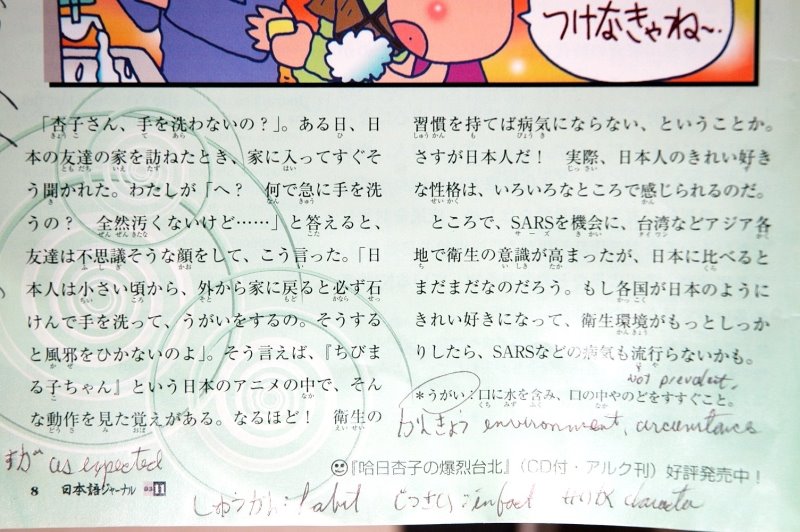

Until a few years ago, there was a magazine called Nihongo Journal meant for those studying Japanese. It, like many Japanese texts was full of ninhonjinron or some similar crap to try to convince students that Japan was not only uniquely unique, but in the end, superior to any other country.
Here is an example from a few years ago. I was studying, and though I rarely use this magazine because I don't want to puke, I had never read this before. Tonight I did.
Basically, it is telling the story of a girl (Kyoko) who was visiting her Japanese friend. As soon as they walked into the house, the Japanese girl asked "Aren't you going to wash your hands?" Of course, this visitor was surprised as her hands weren't dirty at all. Well, the Japanese girl explained, from the time that they are children, Japanese wash their hands and gargle when they come home. This tidbit of stunning information (for me, for I have yet to see a Japanese wash his/her hands any more often than anyone else when they come home.) caused the visitor to by all impressed once again with the wonderful Japanese. As expected, she thought, a Japanese. The Japanese like cleanliness. She continued to think, if only them thar other (lesser?) Asians would do the same. In fact, if other countries in the world would pay the same attention to cleanliness as the Japanese, there would not be diseases like SARS spreading.
Stunning. As I have written, people go into trains in the winter and cough openly. At any time people will sneeze and often will NOT bother to cover their big mouth. The sound in a train actually hurts one's ears. I have seen cooks go into the toilet (once in Futakotamagawa, and once at the Tsuki restaurant in Sakuragi-cho Washington Hotel, use the toilet, and give one had a quick 1-2 second soapless rinse before going back to cook---or roll your sushi. I would say hand-washing is not especially noticeable in public toilets in Japan, certainly no more so than anywhere else I've been..
You can ride the train and watch many pick their nose and roll buggers. Yea, real clean. Look at this. Impressed? This, of course is something one wouldn't see everyday, (and most Japanese, as well as other peoples would be disgusted) but it obviously happened in uniquely "clean" Japan. Should other nationalities emulate that too?
Japanese people are usually personally clean, just like most people with good hygiene. Sorry, but otherwise, I don't see anything uniquely or especiallly clean about the Japanese.
I could go on, but this is the nihonjinron-type propaganda that people are fed when they try to study Japanese with some of the texts or magazines like this. I have met very few Japanese who will be as openly boastful, superior, and arrogant as the writer of this piece must be, but I suppose they are around.
Sorry about the unclear photo.
Saturday, April 29, 2006
Japanese/foreign apologist hypocrisy
is discussed by a guy who pretty much has it nailed at this link . Strange how some people live in Japan for years and never get this. Granted, they are rare. Usually the apologists who give us the "Japanese are so polite" crap only visited or lived in an isolated dream world and were baka gaijin handled while they were here.
Ever wonder why any complaints or criticism about Japan is called whining? The Japanese in general are supersensitive to anything close to criticism, but white foreigners are the most likely to make this charge. It seems that they prefer that everyone goes-along-to-get-along just like the Japanese. They are of the same ilk that in the US tell anyone who would dare criticize that country "Why don't you leave if you don't like it." The answer is, "Because I live here, it's a democracy---whatever that is---and I have a right and a duty to participate in society. If you don't like democracy, then why don't you leave and go where nobody can make any openly critical comments."
Of course, this is not how society/democracy works in Japan. However, imagine that minorities were viewed and treated in the same way in the States or other countries. Would those same apologists who whine about any non-Japanese who criticizes (and even with Japanese- critics too--many will argue with a Japanese who criticize Japan that no, it isn't so bad, it's the same or worse in "my" country.) whine and complain about a minority criticizing their own country's short-comings?
I have pasted the full comment below because it is spot on. This guy has a better understanding of the country than old Edwin Reischauer ever did.
Ever wonder why any complaints or criticism about Japan is called whining? The Japanese in general are supersensitive to anything close to criticism, but white foreigners are the most likely to make this charge. It seems that they prefer that everyone goes-along-to-get-along just like the Japanese. They are of the same ilk that in the US tell anyone who would dare criticize that country "Why don't you leave if you don't like it." The answer is, "Because I live here, it's a democracy---whatever that is---and I have a right and a duty to participate in society. If you don't like democracy, then why don't you leave and go where nobody can make any openly critical comments."
Of course, this is not how society/democracy works in Japan. However, imagine that minorities were viewed and treated in the same way in the States or other countries. Would those same apologists who whine about any non-Japanese who criticizes (and even with Japanese- critics too--many will argue with a Japanese who criticize Japan that no, it isn't so bad, it's the same or worse in "my" country.) whine and complain about a minority criticizing their own country's short-comings?
I have pasted the full comment below because it is spot on. This guy has a better understanding of the country than old Edwin Reischauer ever did.
Are Japanese more hypocritical with foreigners ?
Foreword
I know some people are going to call this thread "overgeneralization" because I am talking about "the Japanese", a group of 126 million people. Let me say from the start that for the sake of discussion I will use the term "Japanese" not to refer to "all the Japanese", but to "the average Japanese in the streets (of Tokyo where I live), based on my observations". The purpose of this thread (and other ones with such generalization) is to compare one another's opinion based on our personal experience. This seems obvious to me, but I need to explain this if I don't want to be misunderstood.
Are Japanese more hypocritical with foreigners ?
I have now been living for 3,5 years in Japan, during which time I have assiduously analyzed the behaviour and mentality of people around me (just for the record, I very rarely meet foreigners in Japan, apart from Thomas once in a while )
)
I am pretty good when it comes to understanding people's emotions and guessing what they think. My wife is often surprised how I express her own feelings better than she can herself. I often predict correctly what the person I am talking to will reply to some questions - be it about their opinion, feelings or knowledge for something specific. When I ask the question, I can see in their eyes what they are going to say before they actually say it. I rarely mistake (esp. with Japanese people, which I usually find easier to understand than Westerners).
After these few years of mind-reading and careful observations, I am left with the feeling that the average Japanese have awkward and prejudiced feelings against anybody that doesn't look Japanese. (let me define that "the average Japanese " are not those who come to practice their English with the first foreign-looking person, or those who have lived abroad, but the real average Japanese that don't speak English and know little about other countries).
For example, no later than today, as I was queuing at the supermarket cashier, the careless woman in front of me walked back and stepped on my foot. She first started a typical "ahh, suuumimaseeen !", but as she turned and saw that I was not Japanese, her voice faded before she finished her "sumimasen" and she just walked away with a strange look on her face. This has happened to me times and again.
First, when I mentioned that to my wife or some Japanese friends, I heard "excuses" such as "they think you don't understand Japanese because you are a foreigner", or the like. But these are really just (prejudiced) excuses. At the place near my house where I usually buy my bento, and have been going for 3 years, the staff (you should know m by then), still hardly says anything to me and when they have run out of one kind of bento, make signs crossing fingers and speaking in strange Japanese as if I couldn't understand. They have heard me speak fluent Japanese with my wife, and could not possibly not remember me, but still act in such prejudiced ways (while I always speak Japanese with my Japanese friends, and the have no problem understanding me at all). The worst is when those kind of shop's staff thank the previous (Japanese) customer with "arigoto gozaimaashitaaa, mata okoshi kudasaimaseee" then when it is my turn, they just don't say anything or mumble a quick and dry "arigato gozaimass" as if they were angry.
This week again, as I was riding my bike at lunchtime in crowded central Tokyo, a police car stopped with the policeman rushing toward me and asking if that was my bicycle and checked the registration number. There were other bicycles around, so my intentionally stop me for no reason. That is very embarassing in front of hundreds of people (and made me come late to my appointment, as it took a few minutes). The policeman was also surprised that I spoke so well Japanese and asked me if I had lived for over 10 years in Japan. Again that is very prejudiced to think that foreigners can't speak decent Japanese just after a few years's stay (or maybe because he couldn't do the same in English).
Westerners usually see the Japanese as polite, well-mannered and respectful. But do they behave this way because of social-pressure or because of genuine good feelings ? Very often it is due to social norms. But taking things a step further, I'd like to say that the attitude of many Japanese toward foreigners is very different from the one they use between themselves. When the "foreigner" is a "customer/guest" (kyaku-san) and people treat him/her even better than they would treat a Japanese, with lots of blatant flattery (sometimes annoyingly so, like the fake expression of amazement at how well a gaijin can use chopsticks or eat sushi - which in fact conceals a deep-rooted cultural prejudice that foreigners are inferior to Japanese). But when the foreigner is not a "kyaku-san" or reluctantly so (esp. in small shops), we can see how this was really hypocrisy, as this time the gaijin is treated like a weird animal and not even like a standard Japanese customer.
Any thoughts ?
I know some people are going to call this thread "overgeneralization" because I am talking about "the Japanese", a group of 126 million people. Let me say from the start that for the sake of discussion I will use the term "Japanese" not to refer to "all the Japanese", but to "the average Japanese in the streets (of Tokyo where I live), based on my observations". The purpose of this thread (and other ones with such generalization) is to compare one another's opinion based on our personal experience. This seems obvious to me, but I need to explain this if I don't want to be misunderstood.
Are Japanese more hypocritical with foreigners ?
I have now been living for 3,5 years in Japan, during which time I have assiduously analyzed the behaviour and mentality of people around me (just for the record, I very rarely meet foreigners in Japan, apart from Thomas once in a while
)I am pretty good when it comes to understanding people's emotions and guessing what they think. My wife is often surprised how I express her own feelings better than she can herself. I often predict correctly what the person I am talking to will reply to some questions - be it about their opinion, feelings or knowledge for something specific. When I ask the question, I can see in their eyes what they are going to say before they actually say it. I rarely mistake (esp. with Japanese people, which I usually find easier to understand than Westerners).
After these few years of mind-reading and careful observations, I am left with the feeling that the average Japanese have awkward and prejudiced feelings against anybody that doesn't look Japanese. (let me define that "the average Japanese " are not those who come to practice their English with the first foreign-looking person, or those who have lived abroad, but the real average Japanese that don't speak English and know little about other countries).
For example, no later than today, as I was queuing at the supermarket cashier, the careless woman in front of me walked back and stepped on my foot. She first started a typical "ahh, suuumimaseeen !", but as she turned and saw that I was not Japanese, her voice faded before she finished her "sumimasen" and she just walked away with a strange look on her face. This has happened to me times and again.
First, when I mentioned that to my wife or some Japanese friends, I heard "excuses" such as "they think you don't understand Japanese because you are a foreigner", or the like. But these are really just (prejudiced) excuses. At the place near my house where I usually buy my bento, and have been going for 3 years, the staff (you should know m by then), still hardly says anything to me and when they have run out of one kind of bento, make signs crossing fingers and speaking in strange Japanese as if I couldn't understand. They have heard me speak fluent Japanese with my wife, and could not possibly not remember me, but still act in such prejudiced ways (while I always speak Japanese with my Japanese friends, and the have no problem understanding me at all). The worst is when those kind of shop's staff thank the previous (Japanese) customer with "arigoto gozaimaashitaaa, mata okoshi kudasaimaseee" then when it is my turn, they just don't say anything or mumble a quick and dry "arigato gozaimass" as if they were angry.
This week again, as I was riding my bike at lunchtime in crowded central Tokyo, a police car stopped with the policeman rushing toward me and asking if that was my bicycle and checked the registration number. There were other bicycles around, so my intentionally stop me for no reason. That is very embarassing in front of hundreds of people (and made me come late to my appointment, as it took a few minutes). The policeman was also surprised that I spoke so well Japanese and asked me if I had lived for over 10 years in Japan. Again that is very prejudiced to think that foreigners can't speak decent Japanese just after a few years's stay (or maybe because he couldn't do the same in English).
Westerners usually see the Japanese as polite, well-mannered and respectful. But do they behave this way because of social-pressure or because of genuine good feelings ? Very often it is due to social norms. But taking things a step further, I'd like to say that the attitude of many Japanese toward foreigners is very different from the one they use between themselves. When the "foreigner" is a "customer/guest" (kyaku-san) and people treat him/her even better than they would treat a Japanese, with lots of blatant flattery (sometimes annoyingly so, like the fake expression of amazement at how well a gaijin can use chopsticks or eat sushi - which in fact conceals a deep-rooted cultural prejudice that foreigners are inferior to Japanese). But when the foreigner is not a "kyaku-san" or reluctantly so (esp. in small shops), we can see how this was really hypocrisy, as this time the gaijin is treated like a weird animal and not even like a standard Japanese customer.
Any thoughts ?
Subscribe to:
Posts (Atom)
