Showing posts with label polite. Show all posts

Monday, November 01, 2010

Good service

I dropped by the Denenchofu Maison Kayser bread shop at noon to pick up some expensive pizza for lunch. Until recently, most shops in Denenchofu have not seemed to be very enthusiastic about actually attracting customers---I have heard unproven rumors that some may have been set up for tax purposes---but MK has always seemed to be interested in doing business. Perhaps they let their prices select for them.

Like almost every shop in Tokyo, they offer point cards where after you buy a few zillion dollars worth of products, you get something "free." At MK, you get ¥500 off your purchase after 20 purchases at a certain minimum price.

I don't go for these things much as the payoff is minimal, and I don't want to carry dozens of point cards around. However, I do like to use one for this shop, not because the ¥500 yen discount is anything special, but because they seem so reluctant to offer one to me.

Today I forgot mine and went ahead and made my purchase without it. The clerk said nothing but the usual thank you. The Japanese guy in the line next to me was asked if he had brought his point card as soon as he stepped up to the register. I suppose I could consider it an oversight on the part of the lady who served me except that I have been going to that shop for 4 years and have only once been asked about a point card. When I got my first one, I had to ask. If I want a new one, I usually have to ask. If I lose mine, I have to ask for a new one.

Perhaps the staff and management is worried about my comfort and do not want to embarrass me by asking me a question in Japanese as they figure that I could not understand. But then again, I always speak Japanese there, and they speak Japanese to me. Perhaps they assume the point card system too complex for me to understand, so they are reluctant to offer one. Perhaps they consider me rich and don't want to offend me by offering a discount.

Not really sure why I get this extra special customer service, but it must be a good thing.

Sunday, May 02, 2010

Did ya ever notice?

As I sat at the nice little fish and chips place Delight in Tamagawa Tokyo on a Golden Week Sunday and enjoyed a decent meal and a new Yebisu Creamy Top Stout, I pondered life amongst the worlds most polite and rule-obeying citizens.

If I walk down a street in Tokyo, a large portion of the population will only very, very reluctantly (or, on the case of certain very short middle-aged men completely refuse to) share the sidewalk with me.

However, if I carry a camera and stop to take a photo---or just look like I might take one---everyone will do anything, including climbing a wall, to avoid getting between me and the subject.** Some will duck down about an inch believing that doing so somehow keeps them out of the photo. Others will stand for eternity waiting for me to take the photo. It's almost as if I were on a firing range shooting an elephant rifle. Nobody would dare dally in front of me.
It might make life easier if I were to carry a camera---working or not---around my neck and pull it up as if to take a photo every time I saw a group walking side-by-side taking up the entire sidewalk.

This would have NO effect, however, on mama-chari-ists (who are licensed to kill anyway), nor the recent road bike converts (who have transferred their mama-chari skills to road bikes), nor cars---stop to take a photo in a crosswalk in Denenchofu and you are dead---taxis, buses, the large speeding dump trucks driven by lunatics, nor the young ladies who attend the Denenchofu private school for girls.

As I came out of my exercise in fantasy and was about to order another ¥880 pint, a fellow and his girl pulled up on shiny new road bikes dressed in the latest road bike fashion as promoted by Fun Ride magazine. After they came in and ordered, the future TDF yellow jersey prospect pulled out a cigarette and injected his lungs with the mama-chari-ist's EPO: nicotine. Next time, I am sitting outside.

*I keep forgetting the name and thus cannot find it on the Internut, including Google Japan. However, if you go to Tamagawa station and exit toward the river of the same name, you will find an nice little British-themed pub on the right just across from the bus stop. It has become my favorite local restaurant. 9:18PM: Found it here

**I often want people in the photos, although I rarely photograph someone's face clearly without asking, if I intend to put it on the web. Copyright/privacy laws are a bit strict in Japan about that sort of thing. Got your blog "monetized"? Well, hhssssssss---the sound of air being sucked through teeth.

Tuesday, October 14, 2008

Because he is Japanese?

As there are some much, much more important things going on in the world right now (which seems to have mostly escaped many people---both Japanese and not---whom I know) I haven't been focusing on the small little irritants recently.

However, my Japanese teacher who insists on spending the first hour of a two hour lesson on chatting* often gets me back to thinking of such things. A few weeks ago while wasting time BS-ing, she told me about a bicycle accident that she had recently been in. Seems it was raining and the normal, everyday mami-chari-riding head-up-the-keister salaryman came around a curve on the wrong side of the road with his umbrella in front of his face so that he could not see and ran into her injuring her wrist.

I didn't see anything unusual about this as it is the common, everyday way of riding. In fact, had he not come around the curve on the wrong side of the road with an umbrella blocking his forward vision, then I would have been shocked. Her story was only surprising because a just few weeks earlier I had mentioned how dangerous it was to ride a bicycle with people not paying any attention to where they were going, wobbling from side-to-side, and basically riding brain dead. She acknowledged this and said she was guilty of it herself, but seemed to see nothing especially wrong with it.

Except for her injury, I viewed this as a non-event, just an average day around mama-chari riders. I ask her one question, and that was "What did he say?" She replied "I'm sorry." THAT WAS A SHOCK!!!! I ride thousands of miles per year and have been in several accidents. I have found that it is EXTREMELY rare that any mama-chari rider will apologize for causing an accident.

I then told her about one of the accidents that I had where a guy jumped into his van, and without pausing to look, backed out directly in front of me. Fortunately I had seen him and identified him as a likely idiot and had hit the brakes and was able to slow quickly, but still had to swerve and hit gravel and crashed. As I was picking my bloody, road-rashed self up off the pavement, he rolled his window down about an inch and looked at me. Then he backed the rest of the way out and took off down the road. (Of the dozens who had seen the accident, nobody offered any assistance.)

She giggled when I told her about him taking off with no apology , no offer to help, and no show of concern. and said "Because he is Japanese!" I left it there as I knew what she meant and I have heard many Japanese say similar things. She didn't mean it is something genetic, or something that everyone does. But some people seem to find that sort of thing as pretty unsurprising.

Gee, wonder why that would be in the land of perfect politeness and where everyone obeys the rules?


*
I actually want to focus on improving reading skills/comprehension not on shooting the shit which I can already do. I can't complain much as I got her off the JPLT 1 test material for reading and into some actual materials that one could find some reason to read. Hell will be mighty frigid before I take another JPLT test anyway.

Sunday, June 22, 2008

One of the nice things about living in Tokyo is the number of bookstores. Some even have English language books and magazines---at a huge premium, of course.

I usually go to the bookstore near Denenchofu station once a week or more. Generally, I go to check out the photography magazines such as Nihon Camera or Asahi camera, or cycling mags.

(The August Asahi Camera came out Friday---the annual "Nude" special. When the mags run the Nude "art" specials, they generally sell out very quickly for some reason. I guess photography fans increase in the summer. The good thing is that since this is art---even though many of the images are in color instead of the supposedly more artistic monochromes---censors don't have to scratch away any pubic hair. Interestingly, they still do so for imported photography books with nudes, although they aren't always consistent about it.)

For English books, if possible I will look at a copy in the store to see if it is worth buying, then will order it through Amazon Japan.

The problem is that I have to go during normal work hours as one weekends and at evenings, it is almost impossible to get close enough to even see if a magazine is on the rack, let alone pick it up. Book stores seem to serve as libraries in which one may leisurely read magazines and books. While reading, you can feel free to block everyone else in the store. Should you see someone trying to squeeze through just enough to see or even pick up a book or magazine, you may be the nail that sticks up and let them through, or you may do as most and ignore them.

For some reason, I no longer even bother on weekends.

Friday, January 04, 2008

Uniquely unique Japanese good service

How nice to have had over a week off without focusing or even concerning myself much with news or anything else except hobbies and relaxing. Few crowded trains, not being coughed and sneezed on, not listening to constant sniffling, not much of being pushed and shoved....

Which for some reason brings me to the exaggerated reputation of politeness and good service in Japan.

It can be enlightening to leave big cities as often as possible and go to smaller towns and rural areas. And when visiting there, the "Japanese good service" can take on a different meaning.

We went to the mountains near Nikko and Chuzenjiko for a few days. In Chuzenjiko---a major tourist spot---we decided to have lunch on Saturday. We were a bit early and it was during the New Year holidays, so only a few places were open. Since 99% of the open restaurants were serving only soba, ramen, and yuba, we decided to go into one specializing in mushroom tempura.

We walked in and the old man sitting at a table seemed a bit surprised to see us, but he got up and told us to take a seat anywhere. I noticed that the cushions on the bench seats were sorta slightly filthy. Let me rephrase that: They were plain, flat filthy. I wondered how we could leave without causing offense, but ended up quietly sitting down at one of the tables. Been here way too long.

Ol' grampa then brought us a dirty menu and explained it. As we were deciding what to order, he told us what to order. To avoid trouble and confusion, we followed most of his advice.

He shouted the order into his kitchen staff which appeared to be his wife and maybe his daughter-in-law. Then he brought us two tea cups and a large thermos from another table and said, "Help yourself." Now "Help yourself" might be OK in some places or when visiting someone's home, but it just ain't heard often in Tokyo in a restaurant. My wife also noted that the thermos was a design from at least 20 years ago. As we waited for our order, we began to notice other small details, such as a thick layer of grease and grime all over everything. The case with the chopsticks was especially impressive in that way. I fished some out from the bottom assuming that they would be less decorated with said grease and grime.

Our lunch came about 10 minutes later and he told us how to eat it. Dip the tempura into salt he said, pointing out a grimy salt shaker. No choice of dipping sauce as is common in more citified areas.

A few minutes later, the old boy suddenly jumped up from his table and shouted to someone outside, "Welcome, please come in and take a break,. " Then he rushed outside to get them.

He returned with two women with children. As they entered, they paused and looked over the room. I knew what they were thinking, but before they could act on it, grampa guided them to a table and sat them down. They did not seem enthusiastic. Neither did grampa once he had his victims inside and was sure that they would not escape.

A few moments later, the same thing happened. This time, there was a shout from one of the women in the kitchen: "Welcome, please come in." Grampa chimed in, "Take a rest here," and rushed out to prevent their escape.

He returned with a young family with 3 kids. They displayed the same hesitation and desire to flee upon looking over the place, but like everyone else, they meekly followed grampa's commands and sat down. This family was shoved into a separate room with tatami and seated on the floor. Except for the kids, nobody in the family seemed happy.

Grampa had ignored us since he dumped our dishes in front of us. We had finished and were trying to pay and get out, but this was a bit troublesome to grandpa, because he had done his part. He just said "Pay over there," pointing to his daughter-in-law chef cum cashier.

The meal itself was not bad and we did not get sick. However my wife thought it was quite entertaining. "What was that? Did you see how he kidnapped people? What kind of dirty place? Can you believe he just told us 'Here you are, pour it yourself'?'"

Actually, what is hard to believe is that a restaurant with service like that could survive, or that it could pass any health inspection. But it obviously works well enough, because few people here will just walk out after being conned into the place. I didn't either. I, like Tom Cruise in the Last Samurai, am becoming Japanese. More Japanese than the Japanese--like Tom.

Unfortunately, I am turning Japanese at the same time that Japan is becoming a foreign country.

Tuesday, May 22, 2007

I have noticed that the idea of sharing a sidewalk is not well-developed in Tokyo. I am sure someone would say that this is because sidewalks here tend to be narrow, but even in areas with wide sidewalks folks tend to spread out and take up the entire sidewalk if possible, or at least walk down the middle crowding everyone else. Several years ago a guy told me that he recognized yakuza because, among other things, they would walk down the middle of the sidewalk and force others into the gutter. I wondered then if everyone in Tokyo wasn't in the yakuza.

Arrows on the sidewalks designating which side to walk on are ignored. You can notice this especially on stairs in train stations, and it doesn't have to be during a crowded rush hour either. People walk willy-nilly where ever they want, usually without watching where they are going. Folks will perhaps yield to someone coming the other way at the very last minute just before colliding head on.It sort of looks like something out of a Three Stooges movie, both dancing left and right trying to decide which way to go as there are no general rules which are regularly followed that I can see. (You have to be goofy to follow the arrows on stairs anyway. They may switch sides themselves, like they do in parts of Shibuya station. If people followed them, they'd be running into one another more than they do now. Fujiwara may be right about logic in Japan, at least as far as the arrow painters are concerned.)

Nobody seems to care about this. It is just the way it is. I once was talking to a guy who had returned from New York after his first trip and he remarked about what a "good system" it was that people tended to stick to the right side of the sidewalk. And he generally disliked anything about the US. (Ex-school teacher. In the past in Japan the counterpart of a right wing nutjob. A left wing loonybird. The loonybird teacher's union now has been properly tamed by the nutjobs. The union was a much-needed balance. Too bad the nutjobs have it so easy now.)

I was walking in the rain several months ago on a narrow sidewalk near Shibuya. A middle-aged guy with a couple of middle-aged women was coming the other way. They were spread out blocking the entire sidewalk and showed no signs of moving to one side to let me by. I guess I was supposed to walk into traffic to avoid inconveniencing them. Being a rude, ill-mannered foreigner I didn't. I just stopped directly in front of them and finally, after a bit of shock and confusion, they were kind and polite enough to move over and let me have a portion of the sidewalk. I was so impressed with such traditional Japanese good manners, that I now often do this in similar situations.

Saturday, April 29, 2006

Japanese/foreign apologist hypocrisy

is discussed by a guy who pretty much has it nailed at this link . Strange how some people live in Japan for years and never get this. Granted, they are rare. Usually the apologists who give us the "Japanese are so polite" crap only visited or lived in an isolated dream world and were baka gaijin handled while they were here.

Ever wonder why any complaints or criticism about Japan is called whining? The Japanese in general are supersensitive to anything close to criticism, but white foreigners are the most likely to make this charge. It seems that they prefer that everyone goes-along-to-get-along just like the Japanese. They are of the same ilk that in the US tell anyone who would dare criticize that country "Why don't you leave if you don't like it." The answer is, "Because I live here, it's a democracy---whatever that is---and I have a right and a duty to participate in society. If you don't like democracy, then why don't you leave and go where nobody can make any openly critical comments."

Of course, this is not how society/democracy works in Japan. However, imagine that minorities were viewed and treated in the same way in the States or other countries. Would those same apologists who whine about any non-Japanese who criticizes (and even with Japanese- critics too--many will argue with a Japanese who criticize Japan that no, it isn't so bad, it's the same or worse in "my" country.) whine and complain about a minority criticizing their own country's short-comings?

I have pasted the full comment below because it is spot on. This guy has a better understanding of the country than old Edwin Reischauer ever did.

Are Japanese more hypocritical with foreigners ?

Foreword

I know some people are going to call this thread "overgeneralization" because I am talking about "the Japanese", a group of 126 million people. Let me say from the start that for the sake of discussion I will use the term "Japanese" not to refer to "all the Japanese", but to "the average Japanese in the streets (of Tokyo where I live), based on my observations". The purpose of this thread (and other ones with such generalization) is to compare one another's opinion based on our personal experience. This seems obvious to me, but I need to explain this if I don't want to be misunderstood.

Are Japanese more hypocritical with foreigners ?

I have now been living for 3,5 years in Japan, during which time I have assiduously analyzed the behaviour and mentality of people around me (just for the record, I very rarely meet foreigners in Japan, apart from Thomas once in a while )

I am pretty good when it comes to understanding people's emotions and guessing what they think. My wife is often surprised how I express her own feelings better than she can herself. I often predict correctly what the person I am talking to will reply to some questions - be it about their opinion, feelings or knowledge for something specific. When I ask the question, I can see in their eyes what they are going to say before they actually say it. I rarely mistake (esp. with Japanese people, which I usually find easier to understand than Westerners).

After these few years of mind-reading and careful observations, I am left with the feeling that the average Japanese have awkward and prejudiced feelings against anybody that doesn't look Japanese. (let me define that "the average Japanese " are not those who come to practice their English with the first foreign-looking person, or those who have lived abroad, but the real average Japanese that don't speak English and know little about other countries).

For example, no later than today, as I was queuing at the supermarket cashier, the careless woman in front of me walked back and stepped on my foot. She first started a typical "ahh, suuumimaseeen !", but as she turned and saw that I was not Japanese, her voice faded before she finished her "sumimasen" and she just walked away with a strange look on her face. This has happened to me times and again.

First, when I mentioned that to my wife or some Japanese friends, I heard "excuses" such as "they think you don't understand Japanese because you are a foreigner", or the like. But these are really just (prejudiced) excuses. At the place near my house where I usually buy my bento, and have been going for 3 years, the staff (you should know m by then), still hardly says anything to me and when they have run out of one kind of bento, make signs crossing fingers and speaking in strange Japanese as if I couldn't understand. They have heard me speak fluent Japanese with my wife, and could not possibly not remember me, but still act in such prejudiced ways (while I always speak Japanese with my Japanese friends, and the have no problem understanding me at all). The worst is when those kind of shop's staff thank the previous (Japanese) customer with "arigoto gozaimaashitaaa, mata okoshi kudasaimaseee" then when it is my turn, they just don't say anything or mumble a quick and dry "arigato gozaimass" as if they were angry.

This week again, as I was riding my bike at lunchtime in crowded central Tokyo, a police car stopped with the policeman rushing toward me and asking if that was my bicycle and checked the registration number. There were other bicycles around, so my intentionally stop me for no reason. That is very embarassing in front of hundreds of people (and made me come late to my appointment, as it took a few minutes). The policeman was also surprised that I spoke so well Japanese and asked me if I had lived for over 10 years in Japan. Again that is very prejudiced to think that foreigners can't speak decent Japanese just after a few years's stay (or maybe because he couldn't do the same in English).

Westerners usually see the Japanese as polite, well-mannered and respectful. But do they behave this way because of social-pressure or because of genuine good feelings ? Very often it is due to social norms. But taking things a step further, I'd like to say that the attitude of many Japanese toward foreigners is very different from the one they use between themselves. When the "foreigner" is a "customer/guest" (kyaku-san) and people treat him/her even better than they would treat a Japanese, with lots of blatant flattery (sometimes annoyingly so, like the fake expression of amazement at how well a gaijin can use chopsticks or eat sushi - which in fact conceals a deep-rooted cultural prejudice that foreigners are inferior to Japanese). But when the foreigner is not a "kyaku-san" or reluctantly so (esp. in small shops), we can see how this was really hypocrisy, as this time the gaijin is treated like a weird animal and not even like a standard Japanese customer.


Any thoughts ?

Friday, April 14, 2006

Of all the myths about Japan, the one which is so absurdly false is the idea that the Japanese are so wonderfully polite. This is not true. In general, people are polite to those they know, or are interacting with personally. To people they don't know, or to the stranger passing on the street, they are at best indifferent and at worst extraordinarily rude. The Japanese are no more or less polite than others.

I suppose I am viewing that by western standards, but even many Japanese say this. Foreign apologists don't. The worst of the lot are those who have paid a short visit, or those who worked for a year in some school, or lived some pampered expat existence in Hiroo or some other "gaikokujin ghetto" and were treated like visiting royalty. What they don't know is, that people who are not guests aren't treated so well. If you stay any length of time, you learn this, unless you are wearing blinders.

One reason people believe this, is because the Japanese government promotes it. People also become deluded into believing that since nobody openly argues or disagrees with you, that it is politeness. Well, you could look at it that way. Or, you could say that someone lying to your face in order to avoid debate and allowing you to believe that the person agrees with you or is your "buddy," is a pure form of dishonesty and rudeness. Yes, I know about the wonderful Japanese tradition of (forced) harmony, and am very familiar with the "nail that sticks up" proverb. So what? That is Japanese, and these are Japanese good manners. It is not considered good manners in other places, so if they are polite by mainly Japanese standards and not others, how can they be considered so polite?

I have written about the very common open, uncovered sneezing and coughing that goes on here. I have seen people on trains cough or sneeze right on others without apologizing. Most likely, the sneezer would not do that to a colleague, and if she did, she would apologize. Now how is that in any way good manners? How about the pushing and shoving on trains? This occurs not only on crowded trains, but even uncrowded ones. It seems that on a train in Japan, anything short of murder is OK. Well, I guess sexually molesting women is now a little more restricted on trains. You will get arrested for that. But gee, how could a man, who is a member of the most polite ethnic group in the world be so rude as to molest a female? Evil, filthy foreign influence perhaps?

Just walking down the street requires extreme patience here. People will walk right into you. This is in part because nobody watches where they are going. I am not in any way exaggerating. Most people look no further in front than the toe of their shoe or the screen of their cell phone. They will run into you and to expect an apology is usually a dream.

At other times it is simply rude carelessness. I was in Tullys this afternoon and was walking out the door. A young woman was coming in. There was nobody else in the vicinity. She walked right down the middle of the floor headed directly at me. She was not on her cell. She was looking straight ahead and should have seen me unless she were blind or stupid, or both. I thought she would move an give me some room to get by, but she kept coming right at me. I had to actually jump to the side to keep Ms. Manners-san from smashing into me. Now a stupid rude evil foreigner in a dirty foreign country would have told her to "Watch WTF you are going," or "Pull your head out of your ass." But since this is Japan, there are no immediate penalties for being an asshole.

I remember when I came to Japan with my wife to meet her parents after we were married (yes, after). We were getting off a bus and I was behind some short, fat, bald guy. For no reason that I could think of, he suddenly elbowed me in the stomach. Luckily, it didn't hurt. If it had, I might have returned the favor, but I was more shocked than angry.

Every so often, you will be banged into very hard when there is absolutely no reason. Usually, this is by short middle-aged men, whom would be pounded into a pulp for such a thing elsewhere. But as I said, this is Japan and there is no immediate penalty for boorish behavior. Unless it is by a rude, evil, nasty, impure foreign creature such as myself. A few years ago, my wife and I were at a kiosk at Kajigaya station near my home. I was looking at magazines or something on a stand near the counter, when some short gummer came by and slammed into me. There had been plenty of room and no other people around. It was either carelessness and negligence, or he was trying to be a rude prick. He achieved that. But I got some satisfaction, because as he was at the counter paying for his Viagra or whatever, I went to pay for my purchase. I don't know what happened, but I suddenly lost all control of my body---very Japanese-like---an slammed right back into grampa. He said not a word as he bounced back from his impact with the counter. Shoganai! Can't be helped. Anyway, he probably expected such inconsiderate, rude, impolite behavior from an evil foreigner.

Saturday, March 18, 2006

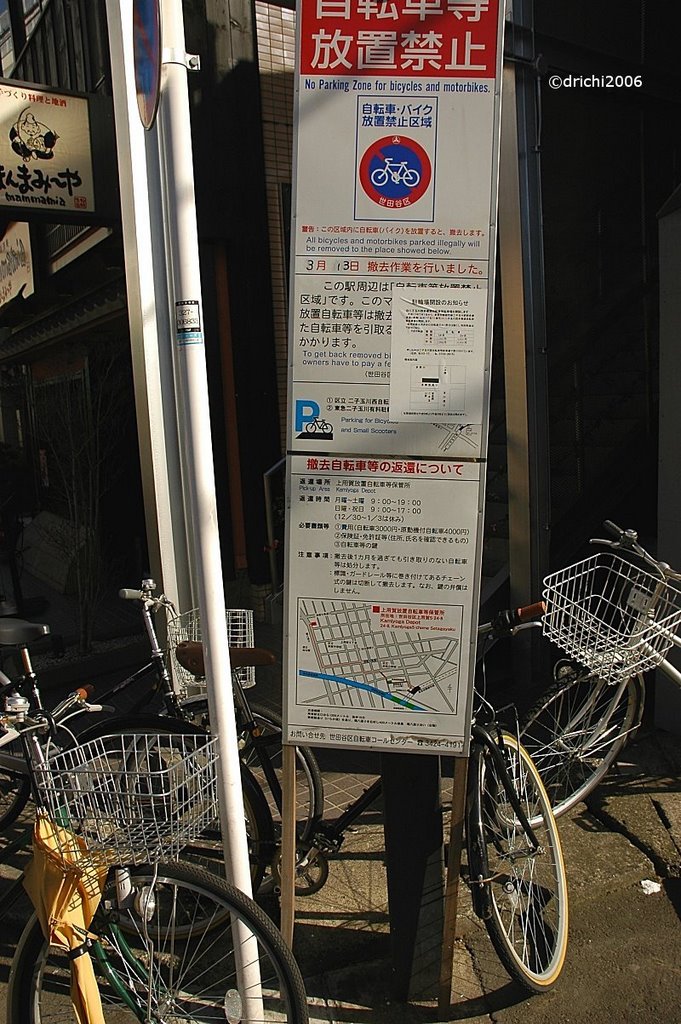
We Obey the Law in Japan


as everyone "knows." Can you read it? Click and enlarge it and you will see that it is partly in English for all the non-law abiding foreigners who always disobey laws. These bikes seemed to belong to Japanese though.