Striking a conciliatory tone on an issue that has divided and the United States, Defense Secretary said on Thursday that the Obama administration would follow Tokyo’s lead in working to relocate an American air base on Okinawa. NYT
So what the hell was all the fuss about last year?
Thank you, China and North Korea.
Oh, wait a second--- "follow Tokyo's lead" could conceivably be different than Okinawa's would be.
Showing posts with label futenma. Show all posts
Showing posts with label futenma. Show all posts
Thursday, January 13, 2011

Friday, September 10, 2010
Maybe Ozawa challenging Kan ain't so bad after all. I have heard and read some discussion about the debates between Kan and Ozawa being a rare opportunity in Japan. They have certainly been of a different tenor than the arguments heard from the LDP as of late. If one can hear any arguments from the LDP.
Ozawa, who rightly or wrongly has gotten a lot of criticism for being selfish (not only from the media, but from regular voters), has an excerpted interview in Mainichi in which he criticizes the enshrinement of Class A war criminals at Yasukuni and again shows support for voting rights for permanent residents in local elections. He also addresses Futenma, although there is nothing new in what he says about that issue. Basically, it's a problem that need to be solved and requires the involvement of the US government and Okinawan residents:
Concerning Futenma, we have no choice but to come up with a good idea for settling the issue through talks with Okinawa residents and the U.S. government. We can't come up with any idea without talking with them. Mainichi
The excerpts offer nothing new or earth shattering, but one could believe that should Ozawa win, things would still be much better than any current alternative party. Of course the problem is, how will voters react if he become head of the DPJ and prime minister. Folks I talk to are not enthusiastic.
Ozawa, who rightly or wrongly has gotten a lot of criticism for being selfish (not only from the media, but from regular voters), has an excerpted interview in Mainichi in which he criticizes the enshrinement of Class A war criminals at Yasukuni and again shows support for voting rights for permanent residents in local elections. He also addresses Futenma, although there is nothing new in what he says about that issue. Basically, it's a problem that need to be solved and requires the involvement of the US government and Okinawan residents:
Concerning Futenma, we have no choice but to come up with a good idea for settling the issue through talks with Okinawa residents and the U.S. government. We can't come up with any idea without talking with them. Mainichi
The excerpts offer nothing new or earth shattering, but one could believe that should Ozawa win, things would still be much better than any current alternative party. Of course the problem is, how will voters react if he become head of the DPJ and prime minister. Folks I talk to are not enthusiastic.
Friday, August 20, 2010
Barely concealed contempt*
Ian Buruma's recent Yomiuri op-ed, Japan's Unfinished Reformation, about how the Obama administration "has barely concealed its contempt for the DPJ" is now on line.
Revolutions, it is often claimed, do not happen when people are desperate. They occur in times of rising expectations. Perhaps this is why they so often end in disappointment. Expectations, usually set too high to begin with, fail to be met, resulting in anger, disillusion, and often in acts of terrifying violence.
And, as he notes, disillusionment has already set in.
The Nobel Prize in Peace 2009 was awarded to Barack H. Obama "for his extraordinary efforts to strengthen international diplomacy and cooperation between peoples". nobelprize.org
*It was certainly "barely" concealed for PM Hatoyama.
3:30PM: Edited to correct the incorrect spelling of Buruma as pointed out politely in the comments. I cannot spell, but neither can Google spell check.
Revolutions, it is often claimed, do not happen when people are desperate. They occur in times of rising expectations. Perhaps this is why they so often end in disappointment. Expectations, usually set too high to begin with, fail to be met, resulting in anger, disillusion, and often in acts of terrifying violence.
And, as he notes, disillusionment has already set in.
The Nobel Prize in Peace 2009 was awarded to Barack H. Obama "for his extraordinary efforts to strengthen international diplomacy and cooperation between peoples". nobelprize.org
*It was certainly "barely" concealed for PM Hatoyama.
3:30PM: Edited to correct the incorrect spelling of Buruma as pointed out politely in the comments. I cannot spell, but neither can Google spell check.
Wednesday, July 14, 2010
Blasphemy!
I don't think these guys (Congressman Barney Frank et al) are allowed to write this sort of thing:
Immediately after World War II, with much of the world devastated and the Soviet Union becoming increasingly aggressive, America took on the responsibility of protecting virtually every country that asked for it. Sixty-five years later, we continue to play that role long after there is any justification for it. Huffington Post
Given that every incremental federal dollar spent today is being financed with borrowed funds, maintaining that collection of overseas bases results in a perverse daisy chain of borrowing from foreigners,* spending those borrowed funds overseas then sending never-ending interest payments back overseas as we roll over that debt again and again. (Letter to the National Committee on Fiscal Responsibility and Reform by Rep. Barney Frank, Rep. Ron Paul, Rep. Ron Wyden, Rep. Walter B. Jones Linked PDF from the above Huffington Post)
I have read that Okinawa was mentioned somewhere by Reps Frank and Paul, but can find no direct reference to it. (Edited to add: Here is one.)However, wouldn't it be nice if Americans and Japanese---the people, not just the governments and the "experts"---would get a chance to look at this and debate it and force those "in the know" to explain exactly why forces at the present level and configuration are still necessary in 2010, and to explain what would indicate that they would no longer be necessary at some point in the future?
No, I am not on drugs; I am merely fantasizing.
NPR's On Point is to broadcast an discussion on the military spending issue with Ron Paul and Barney Frank today (audio not up yet.)
Note that they are not talking about cutting expenses on the backs of those in Iraq and Afghanistan, but questioning the continued need for 480 US military installations in 38 countries.
*Ironically, one of the recent justifications given for the need to have US troops in Japan is the----how shall I put it?---the rising China threat. China is one of our biggest creditors, so we are borrowing from China and paying interest on that debt to China, in order to defend against China. Wonder if China would demand higher interest should the the US get into a conflict with them? Or would the US just stop borrowing from China and fund the conflict some other way? Oh, wait....did I say fund a conflict, meaning something like pay for it without borrowing from foreigners? Sorry, maybe I am on drugs.
Immediately after World War II, with much of the world devastated and the Soviet Union becoming increasingly aggressive, America took on the responsibility of protecting virtually every country that asked for it. Sixty-five years later, we continue to play that role long after there is any justification for it. Huffington Post
Given that every incremental federal dollar spent today is being financed with borrowed funds, maintaining that collection of overseas bases results in a perverse daisy chain of borrowing from foreigners,* spending those borrowed funds overseas then sending never-ending interest payments back overseas as we roll over that debt again and again. (Letter to the National Committee on Fiscal Responsibility and Reform by Rep. Barney Frank, Rep. Ron Paul, Rep. Ron Wyden, Rep. Walter B. Jones Linked PDF from the above Huffington Post)
I have read that Okinawa was mentioned somewhere by Reps Frank and Paul, but can find no direct reference to it. (Edited to add: Here is one.)However, wouldn't it be nice if Americans and Japanese---the people, not just the governments and the "experts"---would get a chance to look at this and debate it and force those "in the know" to explain exactly why forces at the present level and configuration are still necessary in 2010, and to explain what would indicate that they would no longer be necessary at some point in the future?
No, I am not on drugs; I am merely fantasizing.
NPR's On Point is to broadcast an discussion on the military spending issue with Ron Paul and Barney Frank today (audio not up yet.)
Note that they are not talking about cutting expenses on the backs of those in Iraq and Afghanistan, but questioning the continued need for 480 US military installations in 38 countries.
*Ironically, one of the recent justifications given for the need to have US troops in Japan is the----how shall I put it?---the rising China threat. China is one of our biggest creditors, so we are borrowing from China and paying interest on that debt to China, in order to defend against China. Wonder if China would demand higher interest should the the US get into a conflict with them? Or would the US just stop borrowing from China and fund the conflict some other way? Oh, wait....did I say fund a conflict, meaning something like pay for it without borrowing from foreigners? Sorry, maybe I am on drugs.
Sunday, June 27, 2010
Pre-election political analysis
While some make their political predictions and analysis based on years of experience and research, I find that it is much better to use tangible things to get a feel of the mood and then make my unerringly accurate predictions in the 24-48 hours following the election.
Over the last few days, I have been conducting surveys of political posters in the Denechofu/Okusawa/Jiyugaoka areas which should give an accurate overview of the situation in the entire country. You know, sorta like those land-line telephone surveys of 621 people in a nation of 127+ million.
The New Komeito is relying on its reputation of cleanliness to attract voters:

The Commies are po'd about the US, Futenma, and nukes or something as they always have been. Should they ever come to power, one suspects that they might modify their position a bit, but there is no guarantee. The party that seems to have survived in large part due to the fact that it was the most opposite of the LDP hasn't had a new idea since Marx was a child.


The LDP wants to give Japan the finger yet again, but having entirely lost any competence they once had cannot even figure out the correct finger to use. Instead, some fellow named Tanigaki went berserk at the DPJ and Kan for suggesting that it might have been close to right about the consumption tax. The LDP is offended by the suggestion that any of its ideas might be correct. After all, what would happen if by some miracle the party did not continue to sink into the cesspool of irrelevance, but got back into power and had to do what it would not have proposed had it still been in power?

And the DPJ. I must admit a bias toward this party as I cannot see any of the others as anything but a bunch of goofballs. Perhaps that's why I am not even allowed to vote on local elections. Anyway, the DPJ poster below featuring Kan is short, sweet, and to the point.

Perhaps too short and sweet and that's why this fellow is pondering it. Maybe he is wondering about the DPJ's tax plans---you know, to lower corporate taxes so that Japanese companies won't flee Japan to areas of lower taxes while Japan receives increased revenue from the lowered corporate tax rate (it worked well in the US didn't it?). Perhaps he is wondering about DPJ Secretary General Yukio Edano's rather interesting, maybe controversial, and possibly insane claim that previous increases in the consumption tax had minimal repercussions on demand (Hmmm. What happened in 1997/98? No connection? Minimal?), and Edano's claim that it would not "accelerate" deflation. Deflation would like, what, stay at the present level. Oh, that's good!
He could be wondering how people would just calmly accept a 5% increase in the tax and not reduce spending. He could be asking himself that should that be proven to be inaccurate, is it at all possible that producers would react by reducing prices to offset the tax increase. What's the phrase he may be thinking of? Is it Voodoo Economics? (Edited to add: Not to be confused with the US version, but a homegrown voodoo economics.)
Or maybe he is ruminating on the meaning of Edano's translated statement that the DPJ "was debating whether to implement tax refunds for low-income families, and said such plans will be further discussed after the Upper House election. "* It may have entered his mind that if the DPJ decides not to address the recessiveness** of the consumption tax after the Upper House election, that it is in effect saying of the poor, "let them eat cake---but only after they pay the 10% tax."
*Emphasis mine. Edano quoted from "exclusive" JT interview (linked ).
**Google spell-check refuses to recognize recessiveness as a word. If it is not a real word, please pretend that it is not really written above.
Related: Economics prof. Hisakazu Kato of Meiji University doubts 10% consumption tax will ultimately be enough, but: "I think it would be much riskier than raising the consumption tax to do nothing about reducing the debt and possibly causing an excessive reaction in the market that would lead to a plunge in government bond prices," Japan Times.
Over the last few days, I have been conducting surveys of political posters in the Denechofu/Okusawa/Jiyugaoka areas which should give an accurate overview of the situation in the entire country. You know, sorta like those land-line telephone surveys of 621 people in a nation of 127+ million.
The New Komeito is relying on its reputation of cleanliness to attract voters:
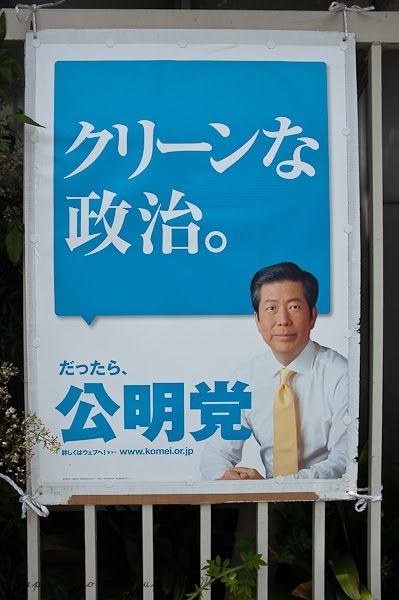
The Commies are po'd about the US, Futenma, and nukes or something as they always have been. Should they ever come to power, one suspects that they might modify their position a bit, but there is no guarantee. The party that seems to have survived in large part due to the fact that it was the most opposite of the LDP hasn't had a new idea since Marx was a child.


The LDP wants to give Japan the finger yet again, but having entirely lost any competence they once had cannot even figure out the correct finger to use. Instead, some fellow named Tanigaki went berserk at the DPJ and Kan for suggesting that it might have been close to right about the consumption tax. The LDP is offended by the suggestion that any of its ideas might be correct. After all, what would happen if by some miracle the party did not continue to sink into the cesspool of irrelevance, but got back into power and had to do what it would not have proposed had it still been in power?

And the DPJ. I must admit a bias toward this party as I cannot see any of the others as anything but a bunch of goofballs. Perhaps that's why I am not even allowed to vote on local elections. Anyway, the DPJ poster below featuring Kan is short, sweet, and to the point.

Perhaps too short and sweet and that's why this fellow is pondering it. Maybe he is wondering about the DPJ's tax plans---you know, to lower corporate taxes so that Japanese companies won't flee Japan to areas of lower taxes while Japan receives increased revenue from the lowered corporate tax rate (it worked well in the US didn't it?). Perhaps he is wondering about DPJ Secretary General Yukio Edano's rather interesting, maybe controversial, and possibly insane claim that previous increases in the consumption tax had minimal repercussions on demand (Hmmm. What happened in 1997/98? No connection? Minimal?), and Edano's claim that it would not "accelerate" deflation. Deflation would like, what, stay at the present level. Oh, that's good!
He could be wondering how people would just calmly accept a 5% increase in the tax and not reduce spending. He could be asking himself that should that be proven to be inaccurate, is it at all possible that producers would react by reducing prices to offset the tax increase. What's the phrase he may be thinking of? Is it Voodoo Economics? (Edited to add: Not to be confused with the US version, but a homegrown voodoo economics.)
Or maybe he is ruminating on the meaning of Edano's translated statement that the DPJ "was debating whether to implement tax refunds for low-income families, and said such plans will be further discussed after the Upper House election. "* It may have entered his mind that if the DPJ decides not to address the recessiveness** of the consumption tax after the Upper House election, that it is in effect saying of the poor, "let them eat cake---but only after they pay the 10% tax."
*Emphasis mine. Edano quoted from "exclusive" JT interview (linked ).
**Google spell-check refuses to recognize recessiveness as a word. If it is not a real word, please pretend that it is not really written above.
Related: Economics prof. Hisakazu Kato of Meiji University doubts 10% consumption tax will ultimately be enough, but: "I think it would be much riskier than raising the consumption tax to do nothing about reducing the debt and possibly causing an excessive reaction in the market that would lead to a plunge in government bond prices," Japan Times.
Friday, June 11, 2010
Futenma becomes interesting
Or at least the issues connected with it do.
For a serious discussion on the U.S.-Japan "alliance" it would be worthwhile---if the whole world has not already done so---to read this June 9 post at Shisaku and download the PDF and read it. Essays include:
For a serious discussion on the U.S.-Japan "alliance" it would be worthwhile---if the whole world has not already done so---to read this June 9 post at Shisaku and download the PDF and read it. Essays include:
- Troubled Alliance by Kenneth B. Pyle
- Return to Basics: Recalibrating the US-Japan Security Alliance by Michael Finnegan
- Redefining the US-Japan Security Alliance by Michael Green
- Alliance Endangered by Kent Calder
- The 50th Anniversary: Time for a "Renewal of Vows" by Andrew Oros
- A Short-term challenge to the US-Japan Security Alliance Putting its Long-term Heath at Risk by Yuki Tatsumi
With Friends Like Us
the title of a new article by R. Taggart Murphy in The New Republic.
Having tied their fortunes so tightly to the United States—or, more generously, having had them tied by history and circumstance—Japan's power-holders in the LDP and the bureaucracy, in business, finance, media, and academia have, since the 1950s, built an elaborate and sophisticated infrastructure of relationships and institutions in the United States capable of detecting and acting on the most subtle shifts in American opinion where Japan is concerned—and, when necessary, influencing it...
...But until last August, these “agents of influence,” as the title of a controversial book on the subject put it, were deployed to achieve Japanese government objectives. Now they were brought out to undermine them. Any American seen able to influence Washington's Japan policy was fed a predictable line: Hatoyama was “weak and vacillating,” the DPJ was filled with “amateurs,” and, most damning, Ozawa was “anti-American.” The New Republic.
Murphy writes that Okinawa has "now been radicalized" and that the only way the agreement can be implemented is by "brute force." Should he be right, Kan (and ultimately, Obama) is in for a huge surprise. There is no way that he can fulfill his supposed promise to Obama to implement it.
8:50: Edited
Having tied their fortunes so tightly to the United States—or, more generously, having had them tied by history and circumstance—Japan's power-holders in the LDP and the bureaucracy, in business, finance, media, and academia have, since the 1950s, built an elaborate and sophisticated infrastructure of relationships and institutions in the United States capable of detecting and acting on the most subtle shifts in American opinion where Japan is concerned—and, when necessary, influencing it...
...But until last August, these “agents of influence,” as the title of a controversial book on the subject put it, were deployed to achieve Japanese government objectives. Now they were brought out to undermine them. Any American seen able to influence Washington's Japan policy was fed a predictable line: Hatoyama was “weak and vacillating,” the DPJ was filled with “amateurs,” and, most damning, Ozawa was “anti-American.” The New Republic.
Murphy writes that Okinawa has "now been radicalized" and that the only way the agreement can be implemented is by "brute force." Should he be right, Kan (and ultimately, Obama) is in for a huge surprise. There is no way that he can fulfill his supposed promise to Obama to implement it.
8:50: Edited
Thursday, June 10, 2010
Japan as #3: the benefits of hiring out national defense
Japan has come in as number 3 on the totally reliable, accurate, and based in reality Global Peace Index.
This rigorous scientific survey measures such things as such as "conflicts with foreign countries, numbers of murder cases, risks of terrorism, the level of respect for human rights and military expenditures." Japan Times
There are a total of 23 areas evaluated. I am not sure if one criteria would be: "Said country should have a lop-sided---or one-sided---"security treaty" which is somewhat weirdly referred to as an "alliance" with the country with the world's most powerful military. That would help in the area of reduced military expenditures, conflicts with foreign countries, and possibly the risk of terrorism, and it might have been enough to propel Japan ahead of warmongering #7 Luxembourg. I wonder, is the US penalized for providing personal and arms for the military security of Japan? A read of the Results and Methodology PDF at GPI's site might lead one to think so. No mention of the US military role in Japan's defense.
Would other criteria be: Does said country respect the human rights* of those of different ethnic/racial/national backgrounds? Has said country signed the Hague Convention Treaty on International Child Abductions? Not sure how those would affect the level of respect for human rights. Perhaps Japan improved four notches because we don't hear right-wingers in the government nor Hobbesian Bushidoists like Fujiwara Masahiko railing against too many human rights as much as we did a few years ago under the LDP.
A check of the GPI website shows a few other interesting tidbits which makes one wonder if the creators of The Onion are not behind this whole thing**. The main findings show that the most peaceful societies contain the following attributes in addition to the above:
The lack of a refugee population also seems to raise the peace index of a country. Very helpful for a country like Japan that allows almost no refugees in.
A number of famous people have signed on as "Endorsers" of the GPI agreeing that: ..."without a world that is basically peaceful, it will be exceedingly difficult to solve many of the intractable problems facing humanity today." How insightful is that?
*The Results and Methodology PDF at the site uses "Levels of disrespect for human right (Political Terror Scale)" using a definition by Amnesty International/ and US Department County Reports (sic) and also refers to "Respect for Human Rights."
**It's actually The Economist trying to measure the ultimately unmeasurable. The folks at The Onion would have more sense.
Edited several times as author cannot write, spell, or proofread because he is from the US. He also added a few items that he thought was relevant.
This rigorous scientific survey measures such things as such as "conflicts with foreign countries, numbers of murder cases, risks of terrorism, the level of respect for human rights and military expenditures." Japan Times
There are a total of 23 areas evaluated. I am not sure if one criteria would be: "Said country should have a lop-sided---or one-sided---"security treaty" which is somewhat weirdly referred to as an "alliance" with the country with the world's most powerful military. That would help in the area of reduced military expenditures, conflicts with foreign countries, and possibly the risk of terrorism, and it might have been enough to propel Japan ahead of warmongering #7 Luxembourg. I wonder, is the US penalized for providing personal and arms for the military security of Japan? A read of the Results and Methodology PDF at GPI's site might lead one to think so. No mention of the US military role in Japan's defense.
Would other criteria be: Does said country respect the human rights* of those of different ethnic/racial/national backgrounds? Has said country signed the Hague Convention Treaty on International Child Abductions? Not sure how those would affect the level of respect for human rights. Perhaps Japan improved four notches because we don't hear right-wingers in the government nor Hobbesian Bushidoists like Fujiwara Masahiko railing against too many human rights as much as we did a few years ago under the LDP.
A check of the GPI website shows a few other interesting tidbits which makes one wonder if the creators of The Onion are not behind this whole thing**. The main findings show that the most peaceful societies contain the following attributes in addition to the above:
- A well-functioning government
- High levels of freedom of information
- Good relations with neighboring states (We can see why Japan has improved in this area compared to the Koizumi/Abe eras.)
- Acceptance of others
The lack of a refugee population also seems to raise the peace index of a country. Very helpful for a country like Japan that allows almost no refugees in.
A number of famous people have signed on as "Endorsers" of the GPI agreeing that: ..."without a world that is basically peaceful, it will be exceedingly difficult to solve many of the intractable problems facing humanity today." How insightful is that?
*The Results and Methodology PDF at the site uses "Levels of disrespect for human right (Political Terror Scale)" using a definition by Amnesty International/ and US Department County Reports (sic) and also refers to "Respect for Human Rights."
**It's actually The Economist trying to measure the ultimately unmeasurable. The folks at The Onion would have more sense.
Edited several times as author cannot write, spell, or proofread because he is from the US. He also added a few items that he thought was relevant.
Monday, June 07, 2010
Groundhog Day
Years ago, there was a frustrating movie called Groundhog Day about a guy played by Bill Murray who was stuck experiencing the same things over and over, day after day. Just like we are doing now.
About 60 percent of voters surveyed have expressed positive expectations for incoming Prime Minister Naoto Kan, two major dailies said Sunday, releasing the results of opinion polls they conducted recently. Japan Times
It's kinda hard not to have positive expectations for Kan as nobody can expect a quicker fall than Hatoyama's. It ain't too encouraging that Kan has been reported to have informed the Obama administration* that he would make "strenuous efforts" on still-not-implemented Futenma agreement---whatever strenuous efforts turns out to mean.
In an arguably more democratic country and a seemingly more participatory democracy than existed under the LDP, one has to wonder exactly how he is going to do that and satisfy those on Okinawa who want nothing to do with the agreement. Is he ultimately going to just run it through like the LDP did in the past over the objections of Okinawans? I'd wager that he ain't going to get any flexibility from the US.
Once again, Japanese politics will be more interesting than frustrating. Then, not all that far in the future Japanese politics will once again become more frustrating than interesting. Then....well, we know the drill.
*ABC (US) reported that: "This is a bilateral accord, and therefore decisions will be based on the accord," Kan said today. "As indicated in the bilateral agreement, there will be emphasis on alleviating the load on the Okinawans. This is a priority of concern and this is an issue that is extremely important."
Xuihan reported:
About 60 percent of voters surveyed have expressed positive expectations for incoming Prime Minister Naoto Kan, two major dailies said Sunday, releasing the results of opinion polls they conducted recently. Japan Times
It's kinda hard not to have positive expectations for Kan as nobody can expect a quicker fall than Hatoyama's. It ain't too encouraging that Kan has been reported to have informed the Obama administration* that he would make "strenuous efforts" on still-not-implemented Futenma agreement---whatever strenuous efforts turns out to mean.
In an arguably more democratic country and a seemingly more participatory democracy than existed under the LDP, one has to wonder exactly how he is going to do that and satisfy those on Okinawa who want nothing to do with the agreement. Is he ultimately going to just run it through like the LDP did in the past over the objections of Okinawans? I'd wager that he ain't going to get any flexibility from the US.
Once again, Japanese politics will be more interesting than frustrating. Then, not all that far in the future Japanese politics will once again become more frustrating than interesting. Then....well, we know the drill.
*ABC (US) reported that: "This is a bilateral accord, and therefore decisions will be based on the accord," Kan said today. "As indicated in the bilateral agreement, there will be emphasis on alleviating the load on the Okinawans. This is a priority of concern and this is an issue that is extremely important."
Xuihan reported:
Kan said that he will strive to fulfill the Japan-U.S. pact on the relocation of the U.S. Marine Futenma base within Okinawa Prefecture.
"I want to make strenuous efforts" on the relocation of the base, Kan was quoted as saying.
Thursday, June 03, 2010
I spent a lot of the day reading about the resignation of Yukio Hatoyama and various opinions of whose fault it was:
1) Hatoyama's. He should have handled Futenma and the US better, plus he got money from his mother instead of some half-crooked company.
2) The US: Parts of the US gov't were confused and worried about the DPJ's attempt to move Japan .0001mm away on security issues which would have destroyed the most-important-bilateral-relationship-in-the-world-bar-none, as well as have resulted in the collapse of human civilization. These expert managers wanted the policies of their old and trusted Freedom-Fighters in the LDP to continue forever.
3) Nobel Laureate Barack Obama, who was not up to speed on the most-important-bilateral-relationship-in-the-world-bar-none, and whose meaning of the word "change" as far as Japan policy goes appears to have been restricted to "(ex)change George Bush for me." Nobel-man Obama has been a little tied up lately anyway, since he shockingly discovered that the company that was responsible for a major environmental disaster in the Gulf of Mexico was not as responsible as it could have been at stopping it. He is now making angry faces, clenching his jaw, and has become so outraged as to have uttered the stinging expletive "damn."
4) The MSM: Goes without saying. The media is always responsible for everything everywhere.
5) The citizens of this fine land themselves, the least likely culprits.
6) All of the above.
I must rule out "all of the above," even though it seems reasonable. I must rule it out for I read somewhere on the Internet that if we say that, it means everyone is guilty and if we say everyone is guilty it means that no one is guilty. Perhaps due to cultural differences, I am unable to figure out exactly how that works or what it means, so I will focus on the group that has received the least attention: The folks of Japan.
I am not so sure how important the Futenma issue really was to anyone in the mainland. There are polls around that show that most Japanese wanted the Futenma mess solved by relocating the base outside Okinawa, but nobody seems to want those bases, with their lower-than-the-average-compared-to-Japanese-citizens crime rates, near their homes. They simply want and expect the US to defend Japan until hell freezes over because that's the way things have always been, and to do so under "tightened discipline" (perhaps chained to a table when off-duty) at a distance. Besides, Japan is a peace country and Japanese should not have to fight a war for Japan should one come.* And some have called Hatoyama indecisive and loopy**.
I am looking at this from the perspective that citizens of a democracy are over the long term, allowing for normal miscalculations***, voting for politicians and policies that they agree with. So I figure that after 65 years of democracy [Edited: We can't call the Occupation era democracy. Let's say 50-odd years] when folks keep electing politicians who continue the same policies, that they are voting for what they really want. I don't recall Futenma or the so-called alliance**** being a major issue during the election last fall, so I'd guess most outside of Okinawa did not especially object to the status quo. In the US we want low/no taxes, free government programs, wars fought mostly by lesser-well-off citizens and paid for by foreigners. In Japan, we want the US to provide a military and a foreign policy cover and to have little contact with the troops unless we can pawn them off on a poorer prefecture inhabited by Okinawans.
The good thing is, according to some theories, the US may not get what it wants now as there might be some reluctance on the part of the government to follow through on the Henko move. Okinawans ain't gonna just give in because Hatoyama is gone. And Naoto Kan is said to be sort of stubborn. He is also said to be more "practical" in foreign policy, which I take to mean more likely to do what Uncle Sam wants. But maybe, just maybe, this will get folks to think a little more deeply about this "alliance." It obviously isn't going to come from the US side without a swift kick.
*I don't get a chance to ask Japanese acquaintances this as often as I would like. In fact, I think I have only asked it once: If there is a war and an American soldier is killed fighting for Japan, what would you say to the mother and father of that soldier when they ask you "Why did my son (or daughter) die fighting for Japan?"
**I am using the Washington Post's Al Kamen's definition of loopy: "...oddly detached from reality."
***See G.W. Bush, the man who accepted Abe's "apology" about the Japanese Imperial Army's forced recruitment of sex slaves in WW2 which Abe claimed never really happened, but apologized for in spite of the fact that he claimed it never happened and had been claiming for years that it never happened. Sorry, I didn't understand it either. Ask Boy George or Abe.
****Describing the relationship as an alliance was first done in a communique when PM Suzuki visited the White House in 1981 and it was not well-received in Japan. The phrase US-Japan Alliance was not used in an official document until 1995. See AMPO's Troubled 50th: Hatoyama's aborted rebellion, Okinawa's Mounting Resistance and the US Japan Relationship. (Under Treaty? Alliance? about 1/3 down the page.)
1) Hatoyama's. He should have handled Futenma and the US better, plus he got money from his mother instead of some half-crooked company.
2) The US: Parts of the US gov't were confused and worried about the DPJ's attempt to move Japan .0001mm away on security issues which would have destroyed the most-important-bilateral-relationship-in-the-world-bar-none, as well as have resulted in the collapse of human civilization. These expert managers wanted the policies of their old and trusted Freedom-Fighters in the LDP to continue forever.
3) Nobel Laureate Barack Obama, who was not up to speed on the most-important-bilateral-relationship-in-the-world-bar-none, and whose meaning of the word "change" as far as Japan policy goes appears to have been restricted to "(ex)change George Bush for me." Nobel-man Obama has been a little tied up lately anyway, since he shockingly discovered that the company that was responsible for a major environmental disaster in the Gulf of Mexico was not as responsible as it could have been at stopping it. He is now making angry faces, clenching his jaw, and has become so outraged as to have uttered the stinging expletive "damn."
4) The MSM: Goes without saying. The media is always responsible for everything everywhere.
5) The citizens of this fine land themselves, the least likely culprits.
6) All of the above.
I must rule out "all of the above," even though it seems reasonable. I must rule it out for I read somewhere on the Internet that if we say that, it means everyone is guilty and if we say everyone is guilty it means that no one is guilty. Perhaps due to cultural differences, I am unable to figure out exactly how that works or what it means, so I will focus on the group that has received the least attention: The folks of Japan.
I am not so sure how important the Futenma issue really was to anyone in the mainland. There are polls around that show that most Japanese wanted the Futenma mess solved by relocating the base outside Okinawa, but nobody seems to want those bases, with their lower-than-the-average-compared-to-Japanese-citizens crime rates, near their homes. They simply want and expect the US to defend Japan until hell freezes over because that's the way things have always been, and to do so under "tightened discipline" (perhaps chained to a table when off-duty) at a distance. Besides, Japan is a peace country and Japanese should not have to fight a war for Japan should one come.* And some have called Hatoyama indecisive and loopy**.
I am looking at this from the perspective that citizens of a democracy are over the long term, allowing for normal miscalculations***, voting for politicians and policies that they agree with. So I figure that after 65 years of democracy [Edited: We can't call the Occupation era democracy. Let's say 50-odd years] when folks keep electing politicians who continue the same policies, that they are voting for what they really want. I don't recall Futenma or the so-called alliance**** being a major issue during the election last fall, so I'd guess most outside of Okinawa did not especially object to the status quo. In the US we want low/no taxes, free government programs, wars fought mostly by lesser-well-off citizens and paid for by foreigners. In Japan, we want the US to provide a military and a foreign policy cover and to have little contact with the troops unless we can pawn them off on a poorer prefecture inhabited by Okinawans.
The good thing is, according to some theories, the US may not get what it wants now as there might be some reluctance on the part of the government to follow through on the Henko move. Okinawans ain't gonna just give in because Hatoyama is gone. And Naoto Kan is said to be sort of stubborn. He is also said to be more "practical" in foreign policy, which I take to mean more likely to do what Uncle Sam wants. But maybe, just maybe, this will get folks to think a little more deeply about this "alliance." It obviously isn't going to come from the US side without a swift kick.
*I don't get a chance to ask Japanese acquaintances this as often as I would like. In fact, I think I have only asked it once: If there is a war and an American soldier is killed fighting for Japan, what would you say to the mother and father of that soldier when they ask you "Why did my son (or daughter) die fighting for Japan?"
**I am using the Washington Post's Al Kamen's definition of loopy: "...oddly detached from reality."
***See G.W. Bush, the man who accepted Abe's "apology" about the Japanese Imperial Army's forced recruitment of sex slaves in WW2 which Abe claimed never really happened, but apologized for in spite of the fact that he claimed it never happened and had been claiming for years that it never happened. Sorry, I didn't understand it either. Ask Boy George or Abe.
****Describing the relationship as an alliance was first done in a communique when PM Suzuki visited the White House in 1981 and it was not well-received in Japan. The phrase US-Japan Alliance was not used in an official document until 1995. See AMPO's Troubled 50th: Hatoyama's aborted rebellion, Okinawa's Mounting Resistance and the US Japan Relationship. (Under Treaty? Alliance? about 1/3 down the page.)
Thursday, May 20, 2010
A moment of silence, please
Major Japanese newspapers reported on Thursday that Prime Minister has decided to largely accept Washington’s demands that he honor an existing agreement to relocate an American air base on Okinawa, in an attempt to end a damaging dispute that had sown confusion and mistrust between the longtime allies. NYT.
Wouldn't want any confusion as that's the worst nightmare in Japan. If Prof. Hiroshi Nakanishi of Kyoto University is correct, it'll be a "long, punishing process" to convince Okinawans about the wholesome goodness of the deal. Might take until temperatures drop well below 0 degrees Celsius in hell. Does that mean it'll settle back to the pace it was proceeding under the LDP and we'll have to hear about it for another 14 years?
Wouldn't want any confusion as that's the worst nightmare in Japan. If Prof. Hiroshi Nakanishi of Kyoto University is correct, it'll be a "long, punishing process" to convince Okinawans about the wholesome goodness of the deal. Might take until temperatures drop well below 0 degrees Celsius in hell. Does that mean it'll settle back to the pace it was proceeding under the LDP and we'll have to hear about it for another 14 years?
Thursday, May 06, 2010
Okinawa Redux
If the Futenma mess---perhaps disaster for Hatoyama, who has thrown in the towel in the fight with the US over who actually runs Japan as far as security issues go---is so unbelievable as to make you pinch yourself to make sure you aren't just dreaming it all, then perhaps you need to read the Chalmers Johnson editorial in the LA Times: Another Battle of Okinawa:
...I find Hatoyama's behavior craven and despicable, but I deplore even more the U.S. government's arrogance in forcing the Japanese to this deeply humiliating impasse...
That about says it all. (Edited to add: I don't personally don't feel that strongly about Hatoyama.)
A thank you towards the Potomac for the heads up.
...I find Hatoyama's behavior craven and despicable, but I deplore even more the U.S. government's arrogance in forcing the Japanese to this deeply humiliating impasse...
That about says it all. (Edited to add: I don't personally don't feel that strongly about Hatoyama.)
A thank you towards the Potomac for the heads up.
Tuesday, April 27, 2010
Somebody slap me
I did not read this letter in the Japan Times Hotline to Nagatacho. I rarely bother with that section. Just like the folks in Nagatacho, I am sure.
It is not wise to mix local politics with diplomacy. Diplomacy is like a poker game played by sovereign states. You cannot play it with your cards exposed. And to read the cards of others, you need the advice of career diplomats... ...Futenma is a case in point...JT
OK, the video has nothing to do with this except for the title, but I did search in vain for a girl like that before getting hitched.
It is not wise to mix local politics with diplomacy. Diplomacy is like a poker game played by sovereign states. You cannot play it with your cards exposed. And to read the cards of others, you need the advice of career diplomats... ...Futenma is a case in point...JT
And Hatoyama, who was lucky enough to be born into a wealthy family (which always seems to make one suspect) ought to be more considerate to bureaucrats. Hasn''t the advice of career diplomats (from the old days, both in the US and Japan) been part of the problem? And ain't it about time someone did listen to Okinawans even though it smacks of democracy?
It is a shock when you vote for someone for change, and the person makes some attempt to actually change something.
OK, no more reading of that part of the JT. Ruins my lunch, for I will be thinking of responding there. I once read or heard that one of the first signs of insanity is writing letters to the editor. Blogging may be one of the latter stages.
OK, the video has nothing to do with this except for the title, but I did search in vain for a girl like that before getting hitched.
Wednesday, April 14, 2010
Crazy Karl
I have to admit that no major writer on things Japanese attracts my interest more than Karl van Wolferen. Since I first read his book, The Enigma of Japanese Power, in about 1992/93, I have always thought that what he writes just fits since it matches what I have seen and experienced here. I suppose that means he is all wrong.
His latest Japan Focus article was tremendously interesting. I was especially intrigued by his opinions about the US and its vision of Japan. I would say that there should be nothing radical about his thoughts as everything has been out in the open at least since the Futenma mess began. Did it not seem absurd that such a thing would cause a "crisis" in "the most important bilateral relationship in the world--bar none"? Did it not seem even more absurd since the US had a new, more internationally aware president than the old with us or agin' us fellow? Karl has certainly put the parts together so very well, as he always does.
The only thing that I would emphasize is that we do have to remember that Japan made the choice to submit its sovereignty in international affairs and defense back in the 60s.** And it benefited mightily from it---at least economically---in the short-term. There are other possible, but unprovable benefits too. Had Japan needed to provide fully for its own defense and foreign policy, would it have been a nuclear weapons free "peace country" today? What if some of the more extreme fringes had gotten into power? Would they have tempered their loud-mouths knowing that there weren't foreign watchdogs to provide cover for them? Or would they have acted on their words? If so, how would things have turned out?
On the other hand, had this perverted arrangement not been in place, would Japanese citizens have been more involved in politics knowing that the country would have to face the full consequences of military or diplomatic missteps? Could it have been a much more democratic country earlier? Then again, was any of this directly the business of the US?
Times have changed and the fact that Japan sold its soul for short-term benefit is no longer seen as so beneficial by many. Unfortunately, that does not seem to include those running the show in the US.
Previously, I had believed that if Japan really wanted to have an "equal relationship," or at least get out of the submissive role it placed itself in, it would do it. However, as we have seen since the DPJ came into power, and as mentioned in the article, things aren't that simple. The US can intimidate Japan (again, Japan is not blameless for putting itself in a position to be intimidated) and influence politicians through citizens and seems very willing to do it where security is concerned (less so where economic/trade issues are concerned. Wonder why?). Why else would the polls show so many Japanese concerned about Hatoyama's handling of Futenma? And we know that the US expected citizens to pressure the government---at least that was what I felt earlier this year when reading some of the US statements. Many seemed confident that Hatoyama would back down because of public reaction.
They who can give up essential liberty to obtain a little temporary safety, deserve neither liberty nor safety: Attributed to Ben Franklin. Perhaps Prime Minister Yoshida should have considered that before committing to his "doctrine."
*I read some of the amazon.com reviews of his book several years ago and discovered he actually knows nothing. A Japanese professor has refuted all of his claims. So has a fellow I once knew personally, although he was never exactly specific about anything, except that only fools believed van Wolferen. Cool. The fool's view of Japan seems more accurate than any of the others.
**Apologies for the Wikipedia link. The Yoshida Doctrine (PM Shigeru Yoshida) should be easy to confirm elsewhere on the web, or, god-forbid, in a book or something.
Edited for corrections at 2030 and again later.
His latest Japan Focus article was tremendously interesting. I was especially intrigued by his opinions about the US and its vision of Japan. I would say that there should be nothing radical about his thoughts as everything has been out in the open at least since the Futenma mess began. Did it not seem absurd that such a thing would cause a "crisis" in "the most important bilateral relationship in the world--bar none"? Did it not seem even more absurd since the US had a new, more internationally aware president than the old with us or agin' us fellow? Karl has certainly put the parts together so very well, as he always does.
The only thing that I would emphasize is that we do have to remember that Japan made the choice to submit its sovereignty in international affairs and defense back in the 60s.** And it benefited mightily from it---at least economically---in the short-term. There are other possible, but unprovable benefits too. Had Japan needed to provide fully for its own defense and foreign policy, would it have been a nuclear weapons free "peace country" today? What if some of the more extreme fringes had gotten into power? Would they have tempered their loud-mouths knowing that there weren't foreign watchdogs to provide cover for them? Or would they have acted on their words? If so, how would things have turned out?
On the other hand, had this perverted arrangement not been in place, would Japanese citizens have been more involved in politics knowing that the country would have to face the full consequences of military or diplomatic missteps? Could it have been a much more democratic country earlier? Then again, was any of this directly the business of the US?
Times have changed and the fact that Japan sold its soul for short-term benefit is no longer seen as so beneficial by many. Unfortunately, that does not seem to include those running the show in the US.
Previously, I had believed that if Japan really wanted to have an "equal relationship," or at least get out of the submissive role it placed itself in, it would do it. However, as we have seen since the DPJ came into power, and as mentioned in the article, things aren't that simple. The US can intimidate Japan (again, Japan is not blameless for putting itself in a position to be intimidated) and influence politicians through citizens and seems very willing to do it where security is concerned (less so where economic/trade issues are concerned. Wonder why?). Why else would the polls show so many Japanese concerned about Hatoyama's handling of Futenma? And we know that the US expected citizens to pressure the government---at least that was what I felt earlier this year when reading some of the US statements. Many seemed confident that Hatoyama would back down because of public reaction.
They who can give up essential liberty to obtain a little temporary safety, deserve neither liberty nor safety: Attributed to Ben Franklin. Perhaps Prime Minister Yoshida should have considered that before committing to his "doctrine."
*I read some of the amazon.com reviews of his book several years ago and discovered he actually knows nothing. A Japanese professor has refuted all of his claims. So has a fellow I once knew personally, although he was never exactly specific about anything, except that only fools believed van Wolferen. Cool. The fool's view of Japan seems more accurate than any of the others.
**Apologies for the Wikipedia link. The Yoshida Doctrine (PM Shigeru Yoshida) should be easy to confirm elsewhere on the web, or, god-forbid, in a book or something.
Edited for corrections at 2030 and again later.
Monday, April 12, 2010
A "Stumbling Revolution"
The next couple of years will be crucial for the realization of genuine Japanese democracy. More than that. If the Minshuto leaders succeed in carrying out their aim of creating a cabinet-centered government this will be a grand example for others – one of the very few positive turns of fate in the political life of our planet. But the obstacles to achieving this are formidable. Not only domestic forces but also Washington will seek to torpedo the plans for a truly independent Japan that can stand on its own feet in the world. Understanding those obstacles well could help Japanese citizens contribute to the chances for a good outcome. Japan Focus
The article, Japan's Stumbling Revolution, by Karl van Wolferen, originally published in Chou Koron in Japanese last March is now at Japan Focus in English.
The last time I posted van Wolferen's comments
One must be wary of using the label ‘revolutionary’, but if they [DPJ] succeed this would be appropriate in the context of Japan's controlling political institutions.
it irked one of the commenters who thought DPJ being revolutionary was absurd. I think he missed the key word "if." Today "revolutionary" is still in "if" form and that "if" may seem a little less likely every day. Karl van Wolferen writes that "to call the task that the Minshuto has taken upon itself a heavy one is very, very understated." No doubt about that.
I think his take on the Japanese system is always worth reading. And rereading.
Edited to add: His take on the big newspapers and their "creating political reality as it exists in people's minds" seems especially accurate. I wish I could paste the whole article here, it's very good.
The article, Japan's Stumbling Revolution, by Karl van Wolferen, originally published in Chou Koron in Japanese last March is now at Japan Focus in English.
The last time I posted van Wolferen's comments
One must be wary of using the label ‘revolutionary’, but if they [DPJ] succeed this would be appropriate in the context of Japan's controlling political institutions.
it irked one of the commenters who thought DPJ being revolutionary was absurd. I think he missed the key word "if." Today "revolutionary" is still in "if" form and that "if" may seem a little less likely every day. Karl van Wolferen writes that "to call the task that the Minshuto has taken upon itself a heavy one is very, very understated." No doubt about that.
I think his take on the Japanese system is always worth reading. And rereading.
Edited to add: His take on the big newspapers and their "creating political reality as it exists in people's minds" seems especially accurate. I wish I could paste the whole article here, it's very good.
Wednesday, January 06, 2010
Washington Post solves Futenma
Having campaigned against the corruption of 50 years of rule by the Liberal Democratic Party, Mr. Hatoyama also has been dogged by his own fundraising scandal. Polls show his approval rating has fallen from more than 70 percent to less than 50 percent in just three months. Like the Japanese public, the Obama administration has not concealed its exasperation. The president and other senior officials visiting the country have repeatedly called for an "expedited" resolution to the base dispute. Washington Post editorial
Having been on vacation, I somehow missed the unconcealed exasperation of the Japanese public. Is it because of the Futenma issue? I even wonder just how exasperated the Obama administration is since:
"People tend towards the hyperbolic because that makes for more interesting cocktail conversation and better stories. I wouldn't exaggerate things," one administration official close to the issue told The Cable.
I have to admit that I don't understand the point of the Post editorial---it reads like an editorial in the Japanese press except the schoolmarmish tone of "must" and "must not" is missing. I think it means that even though Obama and the Japanese public are exasperated to tears with the wildly unpredictable Hatoyama, the Futenma issue should not be allowed to damage the alliance to the point where the smaller coalition parties get their wish and kick all US troops out of Japan. This, of course, is a real danger right up there with the alien invasion threat. Then there is the threat posed by folks like Ozawa who go to China and work on improving ties instead of staying in Japan and visiting Yasukuni like the Old Schoolers. But the key point is in the last sentence--something which no other person on earth has thought of:
Japan's nascent two-party system is a democratic achievement, not a diplomatic nuisance; give it a little time to find its course. (Washington Post)
We need a kinder, gentler Obama. This is why I read the Post.
Tweaked slightly at 1058
Having been on vacation, I somehow missed the unconcealed exasperation of the Japanese public. Is it because of the Futenma issue? I even wonder just how exasperated the Obama administration is since:
"People tend towards the hyperbolic because that makes for more interesting cocktail conversation and better stories. I wouldn't exaggerate things," one administration official close to the issue told The Cable.
I have to admit that I don't understand the point of the Post editorial---it reads like an editorial in the Japanese press except the schoolmarmish tone of "must" and "must not" is missing. I think it means that even though Obama and the Japanese public are exasperated to tears with the wildly unpredictable Hatoyama, the Futenma issue should not be allowed to damage the alliance to the point where the smaller coalition parties get their wish and kick all US troops out of Japan. This, of course, is a real danger right up there with the alien invasion threat. Then there is the threat posed by folks like Ozawa who go to China and work on improving ties instead of staying in Japan and visiting Yasukuni like the Old Schoolers. But the key point is in the last sentence--something which no other person on earth has thought of:
Japan's nascent two-party system is a democratic achievement, not a diplomatic nuisance; give it a little time to find its course. (Washington Post)
We need a kinder, gentler Obama. This is why I read the Post.
Tweaked slightly at 1058
Tuesday, December 22, 2009
Futenma, an unnecessary fuss?
It seems to be about impossible to understand what is really going on with the Futenma mess. An article challenging some of the Japanese government claims at Japan Focus (Japanese Bureaucrats Hide Decision to Move All US Marines out of Okinawa to Guam, by Gavan McCormac and Sakai Tanaka) does not help:
...according to the investigations of Mayor Iha and members of the Ginowan City Assembly, American forces have already been implementing a plan to relocate to Guam not only the command unit but also, by 2014, the majority of combat forces and even logistic sections including supply units.
Tanaka makes the obvious conclusion that if true:
"This means that the great fuss over the removal to Henoko that has been festering over the past few years may have been completely unnecessary from the beginning."
McCormac believes that Hatoyama's decision not to make a decision on Futenma until after the New Year has a huge symbolic importance and may signal "a possible changing of tide of history in East Asia, and especially the US Japan relationship."
Some polls have shown that a majority of the public thinks Hatoyama has mishandled the issue (Observing Japan has details of various poll results) and I have neither seen nor heard anything that gives any hint that the public would like to see the US military out (folks in Okinawa may have a different view). I wonder just how huge any change would really be?
...according to the investigations of Mayor Iha and members of the Ginowan City Assembly, American forces have already been implementing a plan to relocate to Guam not only the command unit but also, by 2014, the majority of combat forces and even logistic sections including supply units.
Tanaka makes the obvious conclusion that if true:
"This means that the great fuss over the removal to Henoko that has been festering over the past few years may have been completely unnecessary from the beginning."
McCormac believes that Hatoyama's decision not to make a decision on Futenma until after the New Year has a huge symbolic importance and may signal "a possible changing of tide of history in East Asia, and especially the US Japan relationship."
Some polls have shown that a majority of the public thinks Hatoyama has mishandled the issue (Observing Japan has details of various poll results) and I have neither seen nor heard anything that gives any hint that the public would like to see the US military out (folks in Okinawa may have a different view). I wonder just how huge any change would really be?
Friday, December 18, 2009
Imagine: The D-Y relationship
Instead of John McCain nominating Sarah Palin to run with him last year, what if he had nominated me? Why not? I've plenty of foreign experience, and although I have never seen Russia (well, maybe a glimpse or two from an airplane) I have been stationed in South Korea and have actually set foot in North Korea. I haven't hunted moose, but I have hunted deer and elk. And squirrel. A ticket like that would have sent the skinny fellow with big ears back to Chicago.
Assume that since the financial/economic crisis is still going on, John would have suspended his presidency to work on solving it. That would leave me as president, and I would be the one whom PM Hatoyama would have to call about Futenma:
Good Morning, Mr. President. I'm calling to discuss the Futenma crisis.
Ohio Gazimass, Mr. Prime Minister. Sorry to hear that there is a crisis. I was never much of a fan of bathing with large groups of naked men, but I am sorry to hear about your onsen problem. Is a Futenba the indoor or outdoor type?
It's Futenma, not Futenba, Mr. President. By the way, may I call you D? You may call me Y. Anyway, you are thinking of a rotenburo. I guess the "ten" threw you off. I am talking about the US Marine air station in Okinawa. We would like you to move it to Guam.
A U.S. Marine base in Okinawa? My god, Y, what are they doing there? Were they left behind after the war?
In a way, they were D. We also have much more U.S. military here, including the Air Force.
The Air Force? How did they get there? We didn't even have a U.S.A.F. until 1947. Y, I sincerely apologize. We'll pull them all out immediately. You needn't worry about them being as close as Guam, either. That's a U.S. territory, but we don't need such a large force to protect it.
Oh my god, D! I didn't mean to pull them all out! What about the security treaty? You can't just back out of something that you've already agreed to.
Isn't that from, like, 1960 or something, Y? It's still in force? What year is this? Why are we talking about these things as if it were still the last century? Well, we can renegotiate it later, but right now I wanna help you with the problem of foreign troops on your soil doing what, I am sure you know, Japan should be doing for itself.
I'm sorry D, perhaps you don't understand. You see, Gen. MacArthur helped us write a new constitution after the war which prohibits us from having a military unless we call it "self-defense forces." We also have a policy against possessing nukes for self-defense, so we must get our nuclear deterrence capability from a nuclear-armed foreign country. Plus, I am sure that you know that our countries have had a more or less unofficial agreement that the US would provide security for Japan if we did not establish a military, unless we call it a self-defense force, and that in return you would provide a market for our products. This sort of arrangement has worked out well for both of us for 65 years and we'd pretty much like to continue it as is, except we'd like it to be a more equal relationship. I'll explain exactly what that means at some other time, though.
That's crazy-talk, Y! By the way, how's the missus?
She's on a little trip right now, but she's fine, thank you for asking.
Glad to hear that, Y. But back to the crazy-talk. None of that stuff makes any sense to me. The world has changed. I mean, WW2 is like totally over.
Well, D, it may be in some places, but we have a few here who are still fighting it, even in my own party. I believe the word for them in English is ナッツ*。
Oh yea, I remember the Washington Post ad from a few years ago. We have several varieties of ナッツ here too. But listen, Y. We gotta do something about foreign troops from a country halfway around the world being stationed on your soil. It's not like you're a poor country or something, and besides, we all know how some folks over there feel about foreigners.
D, I've been talking about maybe thinking about possibly at some time perhaps doing some sort of thing about kinda improving some things for foreigners here maybe, but that doesn't really apply in this case. There's no danger of your troops trying to assimilate into society, so we can use them and hopefully give them good memories before they return back to where they belong. Return individually, of course, not the whole military. As far as doing something, I can't make any decisions right now, perhaps maybe next year. Gotta figure out how to get rid of the things we don't like about having a foreign country provide our defense while making sure they they continue to provide one for us. It's much cheaper and more politically feasible for us to rent a military than to build one of comparable capabilities ourselves, you know.
But Y, you called me about the problem. Let's make a decision. How about you just do it my way, like y'all did in the past. We'll pull out all the troops and renegotiate the whole security treaty thing. I'll fax a new version for you to sign this afternoon.
Sorry D, but things don't work that way anymore. I gotta listen to what the people want, not just Mitsubishi. I also have some obstinate folk in the Diet whose asses I have to either kiss or kick to get anything done. Otherwise, they'll just oppose everything I try to do.
Good Lord, Y, don't tell me that we have Republicans stationed over there too! Anyway, I gotta go. Let's get this worked out soon. Say hello to the missus for me.
Sure thing D. I was just about to call her...could I get the number for NASA from you so they can transfer me to her? I could call her directly with my super-advanced Japanese keitai, but I'd have to go 3,576,987,201 items deep in the menu just to turn it on.
Oh, that's simple. I know the short cut. Just press "menu", then enter #678a999.072zg781-b and it will take you right to it. You really ought to memorize those shortcuts, Y. You can find them on pages 983-1014 of the quick-start manual for your phone.
Thanks a ton, D. Bye, bye.
*nuts
Tweaked at 12:53
Assume that since the financial/economic crisis is still going on, John would have suspended his presidency to work on solving it. That would leave me as president, and I would be the one whom PM Hatoyama would have to call about Futenma:
Good Morning, Mr. President. I'm calling to discuss the Futenma crisis.
Ohio Gazimass, Mr. Prime Minister. Sorry to hear that there is a crisis. I was never much of a fan of bathing with large groups of naked men, but I am sorry to hear about your onsen problem. Is a Futenba the indoor or outdoor type?
It's Futenma, not Futenba, Mr. President. By the way, may I call you D? You may call me Y. Anyway, you are thinking of a rotenburo. I guess the "ten" threw you off. I am talking about the US Marine air station in Okinawa. We would like you to move it to Guam.
A U.S. Marine base in Okinawa? My god, Y, what are they doing there? Were they left behind after the war?
In a way, they were D. We also have much more U.S. military here, including the Air Force.
The Air Force? How did they get there? We didn't even have a U.S.A.F. until 1947. Y, I sincerely apologize. We'll pull them all out immediately. You needn't worry about them being as close as Guam, either. That's a U.S. territory, but we don't need such a large force to protect it.
Oh my god, D! I didn't mean to pull them all out! What about the security treaty? You can't just back out of something that you've already agreed to.
Isn't that from, like, 1960 or something, Y? It's still in force? What year is this? Why are we talking about these things as if it were still the last century? Well, we can renegotiate it later, but right now I wanna help you with the problem of foreign troops on your soil doing what, I am sure you know, Japan should be doing for itself.
I'm sorry D, perhaps you don't understand. You see, Gen. MacArthur helped us write a new constitution after the war which prohibits us from having a military unless we call it "self-defense forces." We also have a policy against possessing nukes for self-defense, so we must get our nuclear deterrence capability from a nuclear-armed foreign country. Plus, I am sure that you know that our countries have had a more or less unofficial agreement that the US would provide security for Japan if we did not establish a military, unless we call it a self-defense force, and that in return you would provide a market for our products. This sort of arrangement has worked out well for both of us for 65 years and we'd pretty much like to continue it as is, except we'd like it to be a more equal relationship. I'll explain exactly what that means at some other time, though.
That's crazy-talk, Y! By the way, how's the missus?
She's on a little trip right now, but she's fine, thank you for asking.
Glad to hear that, Y. But back to the crazy-talk. None of that stuff makes any sense to me. The world has changed. I mean, WW2 is like totally over.
Well, D, it may be in some places, but we have a few here who are still fighting it, even in my own party. I believe the word for them in English is ナッツ*。
Oh yea, I remember the Washington Post ad from a few years ago. We have several varieties of ナッツ here too. But listen, Y. We gotta do something about foreign troops from a country halfway around the world being stationed on your soil. It's not like you're a poor country or something, and besides, we all know how some folks over there feel about foreigners.
D, I've been talking about maybe thinking about possibly at some time perhaps doing some sort of thing about kinda improving some things for foreigners here maybe, but that doesn't really apply in this case. There's no danger of your troops trying to assimilate into society, so we can use them and hopefully give them good memories before they return back to where they belong. Return individually, of course, not the whole military. As far as doing something, I can't make any decisions right now, perhaps maybe next year. Gotta figure out how to get rid of the things we don't like about having a foreign country provide our defense while making sure they they continue to provide one for us. It's much cheaper and more politically feasible for us to rent a military than to build one of comparable capabilities ourselves, you know.
But Y, you called me about the problem. Let's make a decision. How about you just do it my way, like y'all did in the past. We'll pull out all the troops and renegotiate the whole security treaty thing. I'll fax a new version for you to sign this afternoon.
Sorry D, but things don't work that way anymore. I gotta listen to what the people want, not just Mitsubishi. I also have some obstinate folk in the Diet whose asses I have to either kiss or kick to get anything done. Otherwise, they'll just oppose everything I try to do.
Good Lord, Y, don't tell me that we have Republicans stationed over there too! Anyway, I gotta go. Let's get this worked out soon. Say hello to the missus for me.
Sure thing D. I was just about to call her...could I get the number for NASA from you so they can transfer me to her? I could call her directly with my super-advanced Japanese keitai, but I'd have to go 3,576,987,201 items deep in the menu just to turn it on.
Oh, that's simple. I know the short cut. Just press "menu", then enter #678a999.072zg781-b and it will take you right to it. You really ought to memorize those shortcuts, Y. You can find them on pages 983-1014 of the quick-start manual for your phone.
Thanks a ton, D. Bye, bye.
*nuts
Tweaked at 12:53
Thursday, December 17, 2009
Futenma goes pandemic
It started like a niggling itch in the throat, one initially ignored as just a minor irritant. Then it became a bit sore---nothing to worry about, but enough to make one suspect that something was not quite right. Later it got to the point where it was obvious that there was a problem. Then came the diagnosis---H1futeNma1---which would either result in a period of light discomfort or would end it all.
It seems that the subject of Futenma has become something that cannot be avoided.
It is easy for many of us with personal interests in Japan (and the success of the DPJ) to cast the US as the bullying heavy in this little spat. However, I am fortunate enough to have gotten my hands on a copy of the Nelson Report. Contained within were the key points of a paper, US Should Stand Firm on Implementation of Okinawa Force Realignment, by Bruce Klingner, Senior Research Fellow at the Heritage Foundation. Mr Klingner wrote of the strategic concerns of the US government.
My (too) brief summary of those key points:
One can argue that whether or not the US should even have forces in Japan (or in nearly every other corner of the world), but that is not what this dispute is about. There is, however, a fear that a delay will "inflame" the left to "expand the debate to a more comprehensive reassessment of the US-Japan alliance." That is perhaps long overdue, but it's doubtful that either government wants that now or in the near future---if ever.
And that is the main problem in my opinion. The government and the populace want to continue to have the US provide a military for Japan sixty-five years after the end of WW2. The whole set-up is one that cannot last forever.
1606: Edited because neither I nor Blogger spellcheck can spell.
It seems that the subject of Futenma has become something that cannot be avoided.
It is easy for many of us with personal interests in Japan (and the success of the DPJ) to cast the US as the bullying heavy in this little spat. However, I am fortunate enough to have gotten my hands on a copy of the Nelson Report. Contained within were the key points of a paper, US Should Stand Firm on Implementation of Okinawa Force Realignment, by Bruce Klingner, Senior Research Fellow at the Heritage Foundation. Mr Klingner wrote of the strategic concerns of the US government.
My (too) brief summary of those key points:
The major provisions agreed to are 1) the redeployment of USMC air units from Futenma to a less populated area near Camp Schwab; 2) A reduction of a total of 17000 Marines and their dependents to Guam and Japan paying 60% of the $10 billion price tag for the move; 3) The consolidation of the remaining Marine units into less-populated areas of Okinawa and the return of a number of US bases to Okinawan control.
The provisions of the 13-years-in-the-making-agreement are interconnected and one part cannot be changed without threatening the whole agreement.
Since the Marines (unlike the other services) operate in combined-arms units, the removal of any of these units from Okinawa would have a very negative effect on its (Marines) rapid response capabilities. In short, one cannot willy-nilly move a highly integrated component without affecting the whole.
Relocating the Futenma unit to Guam would also mean that the plan to build two new runways at Camp Schwab to replace the one lost at Futenma would be scrapped, eliminating a "strategic [Japanese] national security asset" negatively affecting the augmentation of US or Japanese security forces during a crisis. The distance form Guam to Okinawa would cause a further in force capabilities. "The DPJ advocacy for removing Marine helicopter units from Okinawa...but still expecting the same level of protection, which is impossible given the tyranny of the distance."
A point which is often forgotten in this debate is that the US is obligated under the security treaty not only to defend Japan, but that it also gives the US broader regional responsibilities. In bilateral agreements from 2005 other objectives beyond the defense of Japan were "affirmed."
He ends with the concern that further delays will be more likely to turn public opinion against the US presence and by leaving the Futenma Marines in their current location during the delay risks another military-related incident.
The provisions of the 13-years-in-the-making-agreement are interconnected and one part cannot be changed without threatening the whole agreement.
Since the Marines (unlike the other services) operate in combined-arms units, the removal of any of these units from Okinawa would have a very negative effect on its (Marines) rapid response capabilities. In short, one cannot willy-nilly move a highly integrated component without affecting the whole.
Relocating the Futenma unit to Guam would also mean that the plan to build two new runways at Camp Schwab to replace the one lost at Futenma would be scrapped, eliminating a "strategic [Japanese] national security asset" negatively affecting the augmentation of US or Japanese security forces during a crisis. The distance form Guam to Okinawa would cause a further in force capabilities. "The DPJ advocacy for removing Marine helicopter units from Okinawa...but still expecting the same level of protection, which is impossible given the tyranny of the distance."
A point which is often forgotten in this debate is that the US is obligated under the security treaty not only to defend Japan, but that it also gives the US broader regional responsibilities. In bilateral agreements from 2005 other objectives beyond the defense of Japan were "affirmed."
He ends with the concern that further delays will be more likely to turn public opinion against the US presence and by leaving the Futenma Marines in their current location during the delay risks another military-related incident.
One can argue that whether or not the US should even have forces in Japan (or in nearly every other corner of the world), but that is not what this dispute is about. There is, however, a fear that a delay will "inflame" the left to "expand the debate to a more comprehensive reassessment of the US-Japan alliance." That is perhaps long overdue, but it's doubtful that either government wants that now or in the near future---if ever.
And that is the main problem in my opinion. The government and the populace want to continue to have the US provide a military for Japan sixty-five years after the end of WW2. The whole set-up is one that cannot last forever.
1606: Edited because neither I nor Blogger spellcheck can spell.
Subscribe to:
Posts (Atom)

