Richard Katz of The Oriental Economist, and Naomi Fink of UFJ Bank were asked to write five sentences in answer to two questions concerning Japan's national debt and its assets and and they responded with one of the most informative dialogs I have read on these topics. You can read this over at Shisaku, should anyone not have already done so.
One particularly interesting fact in the post---only because PM Kan had planned to cut Japan's corporate tax from the 40% current rate---is that only one-third of Japan's corporations pay any corporate taxes and the actual tax rate is closer to 26%.
The OECD has recommended lowering the tax while increasing the base (corps actually paying taxes) and in this OECD Observer article stated that increasing indirect taxes (eg consumption taxes) taxes has had a "less negative" effect on economies in OECD countries than increasing income taxes.
Anyhow, not directly connected to the Shisaku post, but maybe ol' Kan was close to being onto something before he got his head handed to him on Sunday. Perhaps if he had done a little better job of explaining his tax plans, and had any sense of timing, and had not assumed that his party was immune to what happened after the last two consumption tax increases, and had guessed that just because people may believe a tax increase is needed sometime in the future that it doesn't necessarily mean that they want one soon (i.e. while they are still living), and....well, let's just say that we might have been spared the spectacle of the LDP appearing to rise from the grave. They haven't really, of course, since when the sun comes back out, they'll realize that nobody believes they have an answer for anything and they'll sooner or later be heading back underground.
By the way, as usual with things economic, one can easily find an opposing point of view. Here is one concerning the wisdom of corporate tax cuts:
The conventional wisdom is that it is primarily small economies that feel compelled to cut corporate taxes in order to attract foreign investments–Ireland and a handful of the newest EU members are often put forward as examples of this–but it is actually some of the largest economies in the world that have lost most tax revenue from corporations over the last decades. Most notably, between 1970 and 2003, corporate taxation as a share of total taxation dropped by 51% in Japan and by 39% in the US and in Germany.
Yet at the same time corporate profits are booming and wages are stagnating. After-tax profits in the US are, as a proportion of GDP, at their highest in 75 years, and in the euro area and Japan they are also close to 25-year highs.
Wages, on the other hand, are making up an ever smaller part of national income, down from 68% in 1982 to 59% in 2005 in the 15 EU members. And at 56.9% in the US in 2005, they are, except for a brief period in 1997, at their lowest level since 1966. Kristian Weise, of The International Trade Union Confederation at OECD Observer
This wage stagnation thing seems somewhat familiar. Thank goodness for deflation.
Showing posts with label consumption tax. Show all posts
Showing posts with label consumption tax. Show all posts
Thursday, July 15, 2010

Sunday, June 27, 2010
Pre-election political analysis
While some make their political predictions and analysis based on years of experience and research, I find that it is much better to use tangible things to get a feel of the mood and then make my unerringly accurate predictions in the 24-48 hours following the election.
Over the last few days, I have been conducting surveys of political posters in the Denechofu/Okusawa/Jiyugaoka areas which should give an accurate overview of the situation in the entire country. You know, sorta like those land-line telephone surveys of 621 people in a nation of 127+ million.
The New Komeito is relying on its reputation of cleanliness to attract voters:

The Commies are po'd about the US, Futenma, and nukes or something as they always have been. Should they ever come to power, one suspects that they might modify their position a bit, but there is no guarantee. The party that seems to have survived in large part due to the fact that it was the most opposite of the LDP hasn't had a new idea since Marx was a child.


The LDP wants to give Japan the finger yet again, but having entirely lost any competence they once had cannot even figure out the correct finger to use. Instead, some fellow named Tanigaki went berserk at the DPJ and Kan for suggesting that it might have been close to right about the consumption tax. The LDP is offended by the suggestion that any of its ideas might be correct. After all, what would happen if by some miracle the party did not continue to sink into the cesspool of irrelevance, but got back into power and had to do what it would not have proposed had it still been in power?

And the DPJ. I must admit a bias toward this party as I cannot see any of the others as anything but a bunch of goofballs. Perhaps that's why I am not even allowed to vote on local elections. Anyway, the DPJ poster below featuring Kan is short, sweet, and to the point.

Perhaps too short and sweet and that's why this fellow is pondering it. Maybe he is wondering about the DPJ's tax plans---you know, to lower corporate taxes so that Japanese companies won't flee Japan to areas of lower taxes while Japan receives increased revenue from the lowered corporate tax rate (it worked well in the US didn't it?). Perhaps he is wondering about DPJ Secretary General Yukio Edano's rather interesting, maybe controversial, and possibly insane claim that previous increases in the consumption tax had minimal repercussions on demand (Hmmm. What happened in 1997/98? No connection? Minimal?), and Edano's claim that it would not "accelerate" deflation. Deflation would like, what, stay at the present level. Oh, that's good!
He could be wondering how people would just calmly accept a 5% increase in the tax and not reduce spending. He could be asking himself that should that be proven to be inaccurate, is it at all possible that producers would react by reducing prices to offset the tax increase. What's the phrase he may be thinking of? Is it Voodoo Economics? (Edited to add: Not to be confused with the US version, but a homegrown voodoo economics.)
Or maybe he is ruminating on the meaning of Edano's translated statement that the DPJ "was debating whether to implement tax refunds for low-income families, and said such plans will be further discussed after the Upper House election. "* It may have entered his mind that if the DPJ decides not to address the recessiveness** of the consumption tax after the Upper House election, that it is in effect saying of the poor, "let them eat cake---but only after they pay the 10% tax."
*Emphasis mine. Edano quoted from "exclusive" JT interview (linked ).
**Google spell-check refuses to recognize recessiveness as a word. If it is not a real word, please pretend that it is not really written above.
Related: Economics prof. Hisakazu Kato of Meiji University doubts 10% consumption tax will ultimately be enough, but: "I think it would be much riskier than raising the consumption tax to do nothing about reducing the debt and possibly causing an excessive reaction in the market that would lead to a plunge in government bond prices," Japan Times.
Over the last few days, I have been conducting surveys of political posters in the Denechofu/Okusawa/Jiyugaoka areas which should give an accurate overview of the situation in the entire country. You know, sorta like those land-line telephone surveys of 621 people in a nation of 127+ million.
The New Komeito is relying on its reputation of cleanliness to attract voters:
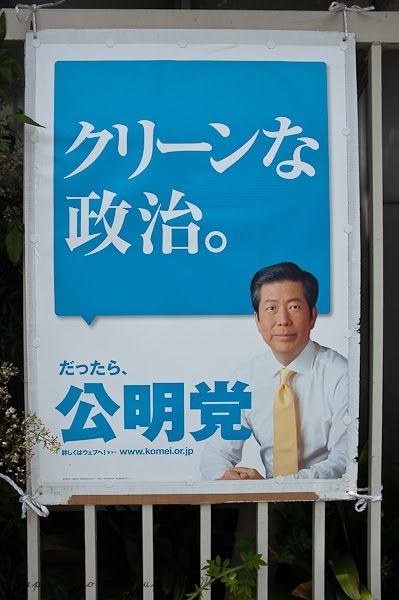
The Commies are po'd about the US, Futenma, and nukes or something as they always have been. Should they ever come to power, one suspects that they might modify their position a bit, but there is no guarantee. The party that seems to have survived in large part due to the fact that it was the most opposite of the LDP hasn't had a new idea since Marx was a child.


The LDP wants to give Japan the finger yet again, but having entirely lost any competence they once had cannot even figure out the correct finger to use. Instead, some fellow named Tanigaki went berserk at the DPJ and Kan for suggesting that it might have been close to right about the consumption tax. The LDP is offended by the suggestion that any of its ideas might be correct. After all, what would happen if by some miracle the party did not continue to sink into the cesspool of irrelevance, but got back into power and had to do what it would not have proposed had it still been in power?

And the DPJ. I must admit a bias toward this party as I cannot see any of the others as anything but a bunch of goofballs. Perhaps that's why I am not even allowed to vote on local elections. Anyway, the DPJ poster below featuring Kan is short, sweet, and to the point.

Perhaps too short and sweet and that's why this fellow is pondering it. Maybe he is wondering about the DPJ's tax plans---you know, to lower corporate taxes so that Japanese companies won't flee Japan to areas of lower taxes while Japan receives increased revenue from the lowered corporate tax rate (it worked well in the US didn't it?). Perhaps he is wondering about DPJ Secretary General Yukio Edano's rather interesting, maybe controversial, and possibly insane claim that previous increases in the consumption tax had minimal repercussions on demand (Hmmm. What happened in 1997/98? No connection? Minimal?), and Edano's claim that it would not "accelerate" deflation. Deflation would like, what, stay at the present level. Oh, that's good!
He could be wondering how people would just calmly accept a 5% increase in the tax and not reduce spending. He could be asking himself that should that be proven to be inaccurate, is it at all possible that producers would react by reducing prices to offset the tax increase. What's the phrase he may be thinking of? Is it Voodoo Economics? (Edited to add: Not to be confused with the US version, but a homegrown voodoo economics.)
Or maybe he is ruminating on the meaning of Edano's translated statement that the DPJ "was debating whether to implement tax refunds for low-income families, and said such plans will be further discussed after the Upper House election. "* It may have entered his mind that if the DPJ decides not to address the recessiveness** of the consumption tax after the Upper House election, that it is in effect saying of the poor, "let them eat cake---but only after they pay the 10% tax."
*Emphasis mine. Edano quoted from "exclusive" JT interview (linked ).
**Google spell-check refuses to recognize recessiveness as a word. If it is not a real word, please pretend that it is not really written above.
Related: Economics prof. Hisakazu Kato of Meiji University doubts 10% consumption tax will ultimately be enough, but: "I think it would be much riskier than raising the consumption tax to do nothing about reducing the debt and possibly causing an excessive reaction in the market that would lead to a plunge in government bond prices," Japan Times.
Sunday, June 20, 2010
In reference to the post below, Kan has stated that he wants to make the regressive consumption tax more progressive by lowering it for certain items.
June 21: Japan Times article in English here.
June 21: Japan Times article in English here.
Sunday, September 14, 2008
While seeking taxcuts
for its corporate members, Keidanren wants to help Japan by punishing domestic consumers. No problem, export everything to other countries and let Japan's residents subsidize it.
The Japan Business Federation will call for doubling the consumption tax rate to 10 percent by fiscal 2011 and urge the government to fund all budget outlays for the state-run basic pension plan with tax revenues, the group's draft policy recommendation showed Saturday.
Great idea brought to us by a bunch of old men with no new ideas.
(Quote above from Japan Times Online)
The Japan Business Federation will call for doubling the consumption tax rate to 10 percent by fiscal 2011 and urge the government to fund all budget outlays for the state-run basic pension plan with tax revenues, the group's draft policy recommendation showed Saturday.
Great idea brought to us by a bunch of old men with no new ideas.
(Quote above from Japan Times Online)
Monday, June 23, 2008
LDP may cut corporate taxes and increase personal taxes
And they are going to do this in part to encourage more foreign investment into Japan. They are also going to do this while sticking to the goal of balancing the budget by 2011. At least that is what Bloomberg is reporting.
After all of the roadblocks that Japanese companies and the Japanese government have thrown up to restrict foreign investment, now they are going to cut taxes on the folks who have blocked the investment in order to attract it? I understand. And with the Fukuda and the LDP talking about how the consumption tax increase cannot be delayed any longer, corporate taxes will be cut. Naturally, this will result in increased profits for companies, thus more investment, more jobs, and higher pay for workers.
Watch for the public to rise up and throw the bums out. And watch. And wait. And watch. And wait. And ...
After all of the roadblocks that Japanese companies and the Japanese government have thrown up to restrict foreign investment, now they are going to cut taxes on the folks who have blocked the investment in order to attract it? I understand. And with the Fukuda and the LDP talking about how the consumption tax increase cannot be delayed any longer, corporate taxes will be cut. Naturally, this will result in increased profits for companies, thus more investment, more jobs, and higher pay for workers.
Watch for the public to rise up and throw the bums out. And watch. And wait. And watch. And wait. And ...
Subscribe to:
Posts (Atom)

